

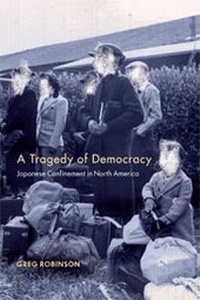
A Tragedy of Democracy
Japanese Confinement in North America
Will be published approx. on 30. June 2009
Book
Hardback
408 pages
978-0-231-12922-0 (ISBN)
Description
The confinement of some 120,000 Japanese Americans during World War II, often called the Japanese American internment, has been described as the worst official civil rights violation of modern U. S. history. Greg Robinson not only offers a bold new understanding of these events but also studies them within a larger time frame and from a transnational perspective. Drawing on newly discovered material, Robinson provides a backstory of confinement that reveals for the first time the extent of the American government's surveillance of Japanese communities in the years leading up to war and the construction of what officials termed "concentration camps" for enemy aliens. He also considers the aftermath of confinement, including the place of Japanese Americans in postwar civil rights struggles, the long movement by former camp inmates for redress, and the continuing role of the camps as touchstones for nationwide commemoration and debate. Most remarkably, A Tragedy of Democracy is the first book to analyze official policy toward West Coast Japanese Americans within a North American context.
Robinson studies confinement on the mainland alongside events in wartime Hawaii, where fears of Japanese Americans justified Army dictatorship, suspension of the Constitution, and the imposition of military tribunals. He similarly reads the treatment of Japanese Americans against Canada's confinement of 22,000 citizens and residents of Japanese ancestry from British Columbia. A Tragedy of Democracy recounts the expulsion of almost 5,000 Japanese from Mexico's Pacific Coast and the poignant story of the Japanese Latin Americans who were kidnapped from their homes and interned in the United States. Approaching Japanese confinement as a continental and international phenomenon, Robinson offers a truly kaleidoscopic understanding of its genesis and outcomes. The confinement of some 120,000 Japanese Americans during World War II, often called the Japanese American internment, has been described as the worst official civil rights violation of modern U. S. history. Greg Robinson not only offers a bold new understanding of these events but also studies them within a larger time frame and from a transnational perspective.
Drawing on newly discovered material, Robinson provides a backstory of confinement that reveals for the first time the extent of the American government's surveillance of Japanese communities in the years leading up to war and the construction of what officials termed "concentration camps" for enemy aliens. He also considers the aftermath of confinement, including the place of Japanese Americans in postwar civil rights struggles, the long movement by former camp inmates for redress, and the continuing role of the camps as touchstones for nationwide commemoration and debate. Most remarkably, A Tragedy of Democracy is the first book to analyze official policy toward West Coast Japanese Americans within a North American context. Robinson studies confinement on the mainland alongside events in wartime Hawaii, where fears of Japanese Americans justified Army dictatorship, suspension of the Constitution, and the imposition of military tribunals. He similarly reads the treatment of Japanese Americans against Canada's confinement of 22,000 citizens and residents of Japanese ancestry from British Columbia.
A Tragedy of Democracy recounts the expulsion of almost 5,000 Japanese from Mexico's Pacific Coast and the poignant story of the Japanese Latin Americans who were kidnapped from their homes and interned in the United States. Approaching Japanese confinement as a continental and international phenomenon, Robinson offers a truly kaleidoscopic understanding of its genesis and outcomes.
Robinson studies confinement on the mainland alongside events in wartime Hawaii, where fears of Japanese Americans justified Army dictatorship, suspension of the Constitution, and the imposition of military tribunals. He similarly reads the treatment of Japanese Americans against Canada's confinement of 22,000 citizens and residents of Japanese ancestry from British Columbia. A Tragedy of Democracy recounts the expulsion of almost 5,000 Japanese from Mexico's Pacific Coast and the poignant story of the Japanese Latin Americans who were kidnapped from their homes and interned in the United States. Approaching Japanese confinement as a continental and international phenomenon, Robinson offers a truly kaleidoscopic understanding of its genesis and outcomes. The confinement of some 120,000 Japanese Americans during World War II, often called the Japanese American internment, has been described as the worst official civil rights violation of modern U. S. history. Greg Robinson not only offers a bold new understanding of these events but also studies them within a larger time frame and from a transnational perspective.
Drawing on newly discovered material, Robinson provides a backstory of confinement that reveals for the first time the extent of the American government's surveillance of Japanese communities in the years leading up to war and the construction of what officials termed "concentration camps" for enemy aliens. He also considers the aftermath of confinement, including the place of Japanese Americans in postwar civil rights struggles, the long movement by former camp inmates for redress, and the continuing role of the camps as touchstones for nationwide commemoration and debate. Most remarkably, A Tragedy of Democracy is the first book to analyze official policy toward West Coast Japanese Americans within a North American context. Robinson studies confinement on the mainland alongside events in wartime Hawaii, where fears of Japanese Americans justified Army dictatorship, suspension of the Constitution, and the imposition of military tribunals. He similarly reads the treatment of Japanese Americans against Canada's confinement of 22,000 citizens and residents of Japanese ancestry from British Columbia.
A Tragedy of Democracy recounts the expulsion of almost 5,000 Japanese from Mexico's Pacific Coast and the poignant story of the Japanese Latin Americans who were kidnapped from their homes and interned in the United States. Approaching Japanese confinement as a continental and international phenomenon, Robinson offers a truly kaleidoscopic understanding of its genesis and outcomes.
Reviews / Votes
tour de force Nichi Bei Times Robinson deftly merges the Pacific Rim experience into one coherent magnum opus. -- Wayne Maeda Nichi Bei Times A superb history about one of the more shameful chapters in U.S. history. -- Jeff Kingston The Japan Times [A] memorable... revealing book. -- Jonathan Mirsky Times Literary Supplement Robinson has clearly mastered his subject, and this book provides a clear, comprehensive account, including facts both well known and obscure... Highly recommended. Choice Magazine A Tragedy of Democracy serves as a timely reminder of how badly things can get out of control in times of war. -- Rachel Pistol Reviews in History In examining the mistreatment of ethnic Japanese Americans and Canadians as a tragedy of democracy, Greg Robinson has produced a triumph of narrative synthesis, one that will stand as the definitive work of its generation. -- Daryl J. Maeda Journal of American Ethnic History A Tragedy of Democracy is a remarkably well-written, extensively researched, and innovatively reasoned history of internment... One wishes that this important book would appear on the shelves of every Justice Department and military lawyer. Canadian Journal of HistoryMore details
Language
English
Place of publication
New York
United States
Target group
Professional and scholarly
Product notice
Trade binding
Dimensions
Height: 229 mm
Width: 161 mm
Weight
680 gr
ISBN-13
978-0-231-12922-0 (9780231129220)
Copyright in bibliographic data and cover images is held by Nielsen Book Services Limited or by the publishers or by their respective licensors: all rights reserved.
Schweitzer Classification
Other editions
Additional editions
E-Book
10/2015
1st Edition
De Gruyter
from
€25.95
Available for download
Book
12/2010
Columbia University Press
€37.20
Article not available at the moment
Person
Greg Robinson, a native of New York City, is associate professor of history at l'Universite du Quebec a Montreal and author of By Order of the President: FDR and the Internment of Japanese Americans. Greg Robinson, a native of New York City, is associate professor of history at l'Universite du Quebec a Montreal and author of By Order of the President: FDR and the Internment of Japanese Americans.
Content
A Note on Terminology Introduction 1. Background to Confinement 2. The Decision to Remove Ethnic Japanese from the West Coast 3. Removal from the West Coast and Control of Ethnic Japanese Outside 4. The Camp Experience 5. Military Service and Legal Challenges 6. The End of Confinement and the Postwar Readjustment of Issei and Nisei 7. Redress and the Bitter Heritage Notes Acknowledgments Index