

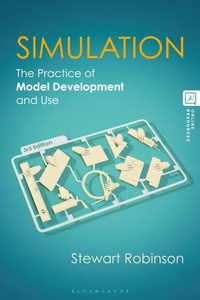
Simulation
The Practice of Model Development and Use
3rd Edition
Will be published approx. on 11. December 2025
Book
Paperback/Softback
448 pages
978-1-350-44522-2 (ISBN)
Description
Guiding you through the key stages of a simulation project, this textbook provides a comprehensive introduction to the discipline.
The book shows you how to develop conceptual models, perform simulation experiments, analyse the results and draw insightful conclusions. It takes a non-software specific view and can be used regardless of individual software preferences. Almost all of the techniques described also apply to the use of non-specialist simulation software, such as programming languages and spreadsheets. This edition also details advancements such as hybrid simulation, multiple recursive random number generators and digital twins. A new chapter has also been added on single-use systems, which solidifies the text's holistic approach to simulation studies.
Critical engagement is encouraged through the inclusion of practical case studies and complementary online resources. Each simulation model is accompanied by illustrative examples, comparative discussions and references to promote deeper understanding of each depicted model. Every chapter is bookended by key concept definitions and summaries.
Packed full of practical tips that can be immediately employed in any model development cycle - regardless of your knowledge level - Simulation is an ideal textbook for students studying simulation on upper level undergraduate and postgraduate degree courses in Business and Management, Operations Management, Logistics and Supply Chain Management, Computer Science, Engineering, Mathematics and Statistics. The text is also an invaluable resource for practitioners, such as business analysts.
The book shows you how to develop conceptual models, perform simulation experiments, analyse the results and draw insightful conclusions. It takes a non-software specific view and can be used regardless of individual software preferences. Almost all of the techniques described also apply to the use of non-specialist simulation software, such as programming languages and spreadsheets. This edition also details advancements such as hybrid simulation, multiple recursive random number generators and digital twins. A new chapter has also been added on single-use systems, which solidifies the text's holistic approach to simulation studies.
Critical engagement is encouraged through the inclusion of practical case studies and complementary online resources. Each simulation model is accompanied by illustrative examples, comparative discussions and references to promote deeper understanding of each depicted model. Every chapter is bookended by key concept definitions and summaries.
Packed full of practical tips that can be immediately employed in any model development cycle - regardless of your knowledge level - Simulation is an ideal textbook for students studying simulation on upper level undergraduate and postgraduate degree courses in Business and Management, Operations Management, Logistics and Supply Chain Management, Computer Science, Engineering, Mathematics and Statistics. The text is also an invaluable resource for practitioners, such as business analysts.
Reviews / Votes
I recommend the book to my students, as it helps build good understanding of how simulation studies are applied in practice. The book is supported by good illustrative examples, case studies, as well as self-assessment questions. -- Sondoss El-Sawah * University of New South Wales * It is a very good book. Text wise, substantially easy to follow by students, and full of practical tips that can be immediately employed in any model development cycle, even by students with no prior exposure to simulation techniques. -- Dr Maurizio Tomasella * Edinburgh University * "I believe the book provides the reader with a thorough introduction to the field of (discrete event) simulation. The book is authored by a true authority in simulation. It succeeds in providing the reader with an end-to-end understanding of the multitude of activities constituting a simulation project from before its begun until implementing the findings.I think the book makes an important contribution to the literature and I will welcome a third edition." -- Prof Allan Larsen * Technical University of Denmark * "It's the best book of its type that exists right now." -- Prof Simon Taylor * Brunel University * "An excellent book about simulation modelling." -- Dr Hazel Squires * Sheffield University *
More details
Edition
3rd edition
Language
English
Place of publication
London
United Kingdom
Publishing group
Bloomsbury Publishing PLC
Target group
College/higher education
Illustrations
145 figures and tables
Dimensions
Height: 230 mm
Width: 156 mm
Thickness: 24 mm
Weight
658 gr
ISBN-13
978-1-350-44522-2 (9781350445222)
Copyright in bibliographic data and cover images is held by Nielsen Book Services Limited or by the publishers or by their respective licensors: all rights reserved.
Schweitzer Classification
Other editions
Additional editions
E-Book
02/2026
3rd Edition
Bloomsbury Academic
€60.99
Available for download
E-Book
02/2026
3rd Edition
Bloomsbury Academic
€60.99
Available for download
Person
Stewart Robinson is Dean of Newcastle University Business School, UK.
Content
1. Defining simulation: what, why and when?
2. Inside simulation software
3. Software for simulation
4. Simulation studies: an overview
5. Conceptual modelling
6. Developing the conceptual model
7. Data collection and analysis
8. Model coding
9. Experimentation: obtaining accurate results
10. Experimentation: searching the solution space
11. Implementation
12. Verification, validation and confidence
13. The practice of simulation
2. Inside simulation software
3. Software for simulation
4. Simulation studies: an overview
5. Conceptual modelling
6. Developing the conceptual model
7. Data collection and analysis
8. Model coding
9. Experimentation: obtaining accurate results
10. Experimentation: searching the solution space
11. Implementation
12. Verification, validation and confidence
13. The practice of simulation