

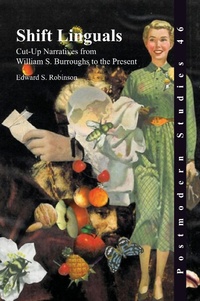
Shift Linguals.
Cut-Up Narratives from William S. Burroughs to the Present.
Published in May 2011
Book
304 pages
978-90-420-3303-0 (ISBN)
Description
Shift Linguals traces a history of the cut-up method, the experimental writing practice discovered by Brion Gysin and made famous by Beat author William S. Burroughs. From the groundbreaking works of Dada and Surrealism that paved the way for Burroughs' breakthrough, through the countercultural explosion of the 1960s, Shift Linguals explores the evolution of the cut-ups within the theoretical frameworks of postmodernism and the avant-garde to arrive at the present and the digital age.
Some 50 years on from the first 'discovery' of the cut-ups in 1959, it is only now that we are truly able to observe the method's impact, not only on literature, but on music and culture in a broader sense. The result of over nine years of research, this study represents the first sustained and detailed analysis of the cut-ups as a narrative form. With explorations of the works of Burroughs, Gysin, Kathy Acker, and John Giorno, it also contains the first critical writing on the works of Claude Pélieu and Carl Weissner in English, as well as the first in-depth discussion of the writing of Stewart Home to date.
Edward S. Robinson has published articles on William Burroughs, Stewart Home and Kathy Acker, and provided the introduction to Jürgen Ploog's cut-up novella, Flesh Film.
More details
Language
English
Place of publication
Leiden
Netherlands
Publishing group
Brill
Target group
Professional and scholarly
Product notice
Paperback (trade)
Unsewn / adhesive bound
Dimensions
Height: 228 mm
Width: 153 mm
Thickness: 20 mm
Weight
485 gr
ISBN-13
978-90-420-3303-0 (9789042033030)
Schweitzer Classification
Person
Edward S. Robinson has published articles on William Burroughs, Stewart Home and Kathy Acker, and provided the introduction to Juergen Ploog's cut-up novella, Flesh Film.
Content
Contents
Acknowledgements
Introduction. Before Burroughs: The Prehistory of the Cut-Ups
The Origin and Theory of the Cut-Ups
Early Successors: Pélieu, Giorno, Weissner
Inter-Section. The Mutations of Burroughs: Revising the Cut-Up Technique
Kathy Acker: Plagiarism and Adaptation - From Cut-Up to Cut-and-Paste
Stewart Home: Pulp, Parody, Repetition and the Cut-Up Renaissance
Further Mutations: The Cut-Ups in the New Millennium
Works Cited
Index