

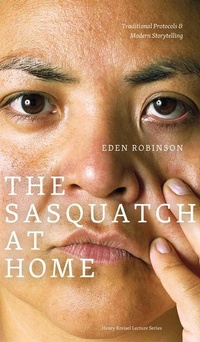
The Sasquatch at Home
Traditional Protocols & Modern Storytelling
Published on 19. May 2011
Book
Paperback/Softback
64 pages
978-0-88864-559-3 (ISBN)
Description
In March 2010 the Canadian Literature Centre hosted award-winning novelist and storyteller Eden Robinson at the 4th annual Henry Kreisel Lecture. Robinson shared an intimate look into the intricacies of family, culture, and place through her talk, "The Sasquatch at Home." Robinson's disarming honesty and wry irony shine through her depictions of her and her mother's trip to Graceland, the potlatch where she and her sister received their Indian names, how her parents first met in Bella Bella (Waglisla, British Columbia) and a wilderness outing where she and her father try to get a look at b'gwus, the Sasquatch. Readers of memoir, Canadian literature, Aboriginal history and culture, and fans of Robinson's delightful, poignant, sometimes quirky tales will love The Sasquatch at Home.
Reviews / Votes
"[Robinson] strikes sweetly at the commonality of people rather than narrowing in on cultural differences. The entire book is fast, colloquial, and engaging; concise enough to be read in one sitting, yet retaining the weightiness of a larger work. Its brevity makes it an ideal re-read and the second reading proves just as entertaining. The funny parts remain funny, the rendering of landscapes evocative and intimate, and the general themes stay relevant. Through rich and often comic dialogue and her painterly descriptions of the northwest landscape, Eden Robinson presents a glimpse into her community with the delicious, whispered quality of a well-told, yet well-protected, family story. Cara-Lyn Morgan, The Malahat Review, Winter 2011 [Full review at http://bit.ly/wJo067] "[Eden Robinson's] lecture reprises the Sasquatch theme from her novel, Monkey Beach. It is less a lecture than an extended poem - a love song to a place and people, a celebration of survival of places, names, and humans... The work is filled with alternate narratives. Just when we are eagerly following a line of story or thought, out come Trickster-ish turns and teases... Robinson seductively draws outsiders in, then sharply clarifies the limits of the welcome... Eden Robinson brings her own literary ethics to the discussion [of the limits of cross-cultural sharing]. Her consciousness and conscientiousness permeate her fiction as well as the Sasquatch lecture. It is fitting that Paula Simons calls her 'one of Canada's most provocative and talented writers' and also 'a moral and cultural force'." Valerie Alia, Cantext, February 2012 "Robinson sees and shows how culture is not something frozen in the past, that it embraces shopping and mail order and outboard motors and McDonald's as much as it does medicinal plants, poles, and potlatches. That the processing is the same, whether the stories involve Elvis, his mother, and Graceland, or Sasquatch and oolichan. If I were minister of culture or of education, I would recommend this book as compulsory reading for every Canadian; it's about who we are and how we know." J.M. Bridgeman, Prairie Fire Review of Books, March 23, 2012 (Vol. 12, No. 1) "Since publishing Monkey Beach, Eden Robinson has been one of Canada's most engaging writers... Her latest work is flat out delicious reading, entertaining and informative at same time... That's Robinson's method-righteous storytelling, straight from the heart. With this new one, Robinson further cements her place as a national treasure." Trevor Carolan, Pacific Rim Review of Books, April 2011 (full review at http://www.prrb.ca/articles/issue16-sasquatch.htm) "Eden Robinson's The Sasquatch at Home offers the reader a taste of her skill as a storyteller. The book is a tiny gem... This brilliant little jewel, under 50 pages, offers readers a quick, but intense opportunity to experience the work of a rising Canadian writer. Like her novel, Monkey Beach, the accessibility of The Sasquatch at Home suggests its appropriateness for use in undergraduate courses. Above all, it is an essential acquisition for anyone with an interest in Pacific Northwest or Native Canadian studies, but it is also a find for those who just like a good story." Amy J. Ransom, American Review of Canadian Studies "The genius of Robinson's lecture is that it makes the reader/listener 'do the work' of making meaning: as in oral traditions, we are called to draw the connections and come to our own conclusions." Canadian LiteratureMore details
Series
Language
English
Place of publication
Edmonton
Canada
Product notice
Paperback (trade)
Dimensions
Height: 236 mm
Width: 136 mm
Thickness: 8 mm
Weight
109 gr
ISBN-13
978-0-88864-559-3 (9780888645593)
Copyright in bibliographic data and cover images is held by Nielsen Book Services Limited or by the publishers or by their respective licensors: all rights reserved.
Schweitzer Classification
Other editions
Additional editions
E-Book
07/2012
University of Alberta Press
€10.69
Available for download
Person
Eden Robinson is the internationally acclaimed author of Traplines, Monkey Beach, and Blood Sports. Traplines was the winner of the New York Times Notable Book of the Year and Britain's Winifred Holtby Memorial Prize. Monkey Beach was nominated for the Giller Prize, the 2000 Governor General's Award for Fiction, and was selected as the Globe and Mail's Editor's Choice. Robinson is a member of the Haisla and Heiltsuk First Nations.
Content
Introduction; Precarious Pyramid: The Economics & Politics of the CPP; The Quebec Pension Plan; Institutional Arrangements & Lessons for Alberta; Checking Out of the Hotel California: The Desirability of an Alberta Pension Plan; Alberta Opting Out of the Canada Pension Plan: Can it be done? Should it be done?; An Alberta Pension Plan: What Have We Learned?
"Wow," I said when I heard the story. "What does my name mean?" "Big lady." "Um, what else does it mean?" Ma-ma-oo paused. "Biiiiiig lady." I paused. Implied in my name, Wiwltx° is a high rank as it was obtained through marriage and only given to women of noble birth. I was disappointed in my name, and it had nothing to do with rank: I had story-envy.