

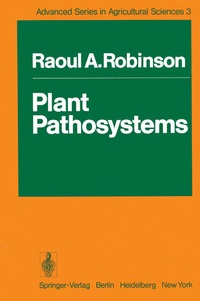
Plant Pathosystems
Published on 19. January 2012
Book
Paperback/Softback
X, 186 pages
978-3-642-66361-1 (ISBN)
Description
One of the points clearly stressed in the beginning of this book is that the essential feature of any dynamic system is change and that, where there is change, there may also be growth and evolution. Plant breeding and plant protection have grown and evolved considerably during the past century; they have also witnessed several, important Hegelian changes. This book, by R.A.Robinson, is just such a change in scientific thinking. It is unique in presenting an entirely new insight to plant-parasite relationships, and in providing a practical guide for managing plant pathosystems for man's advantage in agriculture. The author brings together for the first time in a holistic manner the various plant protection and breeding disciplines; he analyses their past limitations and deficiencies and throws useful new light on the nature of parasitism. From this he is able to gain a clear understanding of the functions of the various pathosystem components. On the basis of this understanding he then proposes practical ways for using these components to achieve and maintain the type of balance which is the basis of survival in any evolutionary system, including that of man himself. All this is done in a lively and elegant manner, using logic as the main driving force to elucidate and define entirely new concepts without obstruse mathematical or biochemical formulae.
More details
Series
Edition
Softcover reprint of the original 1st ed. 1976
Language
English
Place of publication
Berlin
Germany
Publishing group
Springer Berlin
Target group
Professional and scholarly
Research
Illustrations
X, 186 p.
Dimensions
Height: 244 mm
Width: 156 mm
Thickness: 12 mm
Weight
326 gr
ISBN-13
978-3-642-66361-1 (9783642663611)
DOI
10.1007/978-3-642-66359-8
Schweitzer Classification
Other editions
Additional editions
Raoul A. Robinson
Plant Pathosystems
Book
07/1976
1st Edition
Springer
€85.55
Article exhausted; check different version
Content
1 Systems.- 1.1 The Systems Concept.- 1.2 Properties of Systems.- 1.3 Systems Analysis.- 1.4 Systems Management.- 2 Plant Pathosystems.- 2.1 Definitions.- 2.2 The Agricultural Context.- 2.3 The Genetical Context.- 2.4 The Epidemiological Context.- 2.5 The Histological Context.- 2.6 The Zoological Context.- 2.7 The Pathosystem Context.- 2.8 The Esodemic.- 2.9 The Exodemic.- 3 Vertical Pathosystem Analysis.- 3.1 General.- 3.2 The Gene-for-Gene Relationship.- 3.3 Vertical Pathosystems Behaviour.- 3.4 The Components of Host Population Flexibility.- 3.5 The Components of Parasite Population Flexibility.- 4 Vertical Pathosystem Management.- 4.1 Conventional Management.- 4.2 Vertical Pathosystem Demonstration.- 4.3 Strong Vertical Genes.- 4.4 Patterns of Strong Genes.- 4.5 The Hegelian Change in Strength.- 5 Horizontal Pathosystem Analysis.- 5.1 General.- 5.2 Horizontal Resistance is Universal.- 5.3 Horizontal Resistance is Permanent.- 5.4 Genetically Flexible Crop Populations.- 5.5 Genetically Inflexible Crop Populations.- 6 Horizontal Pathosystem Management.- 6.1 The Demonstration of Horizontal Resistance.- 6.2 The Measurement of Horizontal Resistance.- 6.3 The Value of Horizontal Resistance in Agriculture.- 6.4 Maize in Africa.- 6.5 Annual Crops.- 6.6 Sugarcane.- 6.7 Long-Term Perennial Crops.- 7 Polyphyletic Pathosystems.- 7.1 The Qualitative Polyphyletic Pathosystem.- 7.2 The Quantitative Polyphyletic Pathosystem.- 7.3 Examples.- 8 Crop Vulnerability.- 8.1 Description of Crop Vulnerability.- 8.2 Categories of Vulnerability.- 8.3 Assessment of Vulnerability.- 8.4 Reduction of Crop Vulnerability.- 9 Conclusions.- 9.1 The Value of the Systems Concept.- 9.2 The Domestication of Resistance.- 9.3 Cumulative Crop Improvement.- 10 Terminology.- References.