

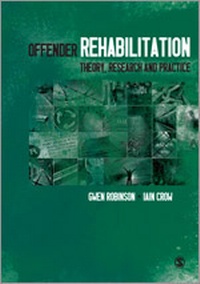
Offender Rehabilitation
Theory, Research and Practice
1st Edition
Published on 22. January 2009
Book
Hardback
208 pages
978-1-4129-4770-1 (ISBN)
Description
'Robinson and Crow have achieved the seemingly impossible: a book about rehabilitation that transcends the "medical model", that is original and contemporary yet grounded in a sophisticated history, and most of all that is fun to read. It will become a new classic text in a field that has been crying out for one' - Professor Shadd Maruna, Queen's University, Belfast
'In an age where there is much public and political confusion about many criminal justice matters, this book brings considerable clarity to the idea of rehabilitation, its theoretical and historical roots, and contemporary practical application. This is an accessible, lively, and critical account of a concept which is central to the shape of the criminal justice system in pursuance of something that will "work" to reduce reoffending. "Rehabilitation" seems to go in and out of fashion depending on the politics of the day, but the careful and thorough examination of the different contexts in which it operates and competing perspectives on its potential offered here highlights its enduring qualities. This is a fascinating and engaging book by two established and "real world" scholars which will serve students and policy makers alike in the fields of criminal justice and social policy' - Loraine Gelsthorpe, Reader in Criminology and Criminal Justice, Institute of Criminology, University of Cambridge
This comprehensive text explains all the key themes in the development and practice of offender rehabilitation. It explores how the issue fits within its wider social and political contexts, giving an insight into its current and future relevance to criminal justice.
The book covers the full range of rehabilitative approaches, exploring how criminal justice responses have been influenced by trends such as the treatment model, 'What Works?', desistance, risk and public protection, and changes in social policy. It offers the following essential features:
" theoretical grounding - providing students with all the essential background they need in order to fully understand the subject
" historical context - enabling the reader to see how ideas, policies and practices have developed over time
" research focus - introducing the reader to questions about how rehabilitative approaches have been evaluated and debates about 'what works' for particular groups of offenders, such as sexual offenders and drug misusers
" study questions and further reading - giving students the tools both to revise and to expand their knowledge
Offender Rehabilitation both advances thinking about the notion of rehabilitation, and ensures that students of crime and justice can keep abreast of the most recent developments in this area.
'In an age where there is much public and political confusion about many criminal justice matters, this book brings considerable clarity to the idea of rehabilitation, its theoretical and historical roots, and contemporary practical application. This is an accessible, lively, and critical account of a concept which is central to the shape of the criminal justice system in pursuance of something that will "work" to reduce reoffending. "Rehabilitation" seems to go in and out of fashion depending on the politics of the day, but the careful and thorough examination of the different contexts in which it operates and competing perspectives on its potential offered here highlights its enduring qualities. This is a fascinating and engaging book by two established and "real world" scholars which will serve students and policy makers alike in the fields of criminal justice and social policy' - Loraine Gelsthorpe, Reader in Criminology and Criminal Justice, Institute of Criminology, University of Cambridge
This comprehensive text explains all the key themes in the development and practice of offender rehabilitation. It explores how the issue fits within its wider social and political contexts, giving an insight into its current and future relevance to criminal justice.
The book covers the full range of rehabilitative approaches, exploring how criminal justice responses have been influenced by trends such as the treatment model, 'What Works?', desistance, risk and public protection, and changes in social policy. It offers the following essential features:
" theoretical grounding - providing students with all the essential background they need in order to fully understand the subject
" historical context - enabling the reader to see how ideas, policies and practices have developed over time
" research focus - introducing the reader to questions about how rehabilitative approaches have been evaluated and debates about 'what works' for particular groups of offenders, such as sexual offenders and drug misusers
" study questions and further reading - giving students the tools both to revise and to expand their knowledge
Offender Rehabilitation both advances thinking about the notion of rehabilitation, and ensures that students of crime and justice can keep abreast of the most recent developments in this area.
Reviews / Votes
Robinson and Crow have developed a satisfactory primer on the complex and increasingly important topic of offender rehabilitation...Offender Rehabilitation is well-written, easy to comprehend, and touches upon major issues in less than 200 pages... [it] provides a framework for scholars and students to understand the topic. It is easily read and written by experts in the field. Anyone interested in the topic of offender rehabilitation should read this bookDaniel W. Phillips III
The Kentucky Journal of Anthropology and Sociology
More details
Language
English
Place of publication
Thousand Oaks
United States
Target group
College/higher education
Dimensions
Height: 242 mm
Width: 170 mm
Weight
520 gr
ISBN-13
978-1-4129-4770-1 (9781412947701)
Copyright in bibliographic data and cover images is held by Nielsen Book Services Limited or by the publishers or by their respective licensors: all rights reserved.
Schweitzer Classification
Other editions
Additional editions
E-Book
01/2009
1st Edition
SAGE Publications Ltd
€78.49
Available for download
E-Book
01/2009
1st Edition
SAGE Publications Ltd
€69.39
Available for download
Book
01/2009
1st Edition
SAGE Publications Inc
€86.80
Shipment within 10-20 days
Persons
I studied psychology as an undergraduate at the University of Sussex, and went on to complete an MSc in Applied Social Studies and a Diploma in Social Work at the University of Oxford, specialising in probation practice. After working as a researcher at the University of Oxford Centre for Criminological Research, I completed a PhD at the University of Wales, Swansea. My thesis examined the changing contours of probation practice and in particular the influence of risk assessment technologies on the rehabilitation and management of offenders.
In the last ten years I have been involved in a number of empirical research projects and have published in the areas of: offender rehabilitation and management; community sanctions/penalties; and restorative justice. I initially came to work in the School of Law in 2002 as a member of a large research team which conducted a major evaluation of Restorative Justice schemes for the Home Office/Ministry of Justice (led by Joanna Shapland). The book Restorative Justice in Practice: Evaluating What Works for Victims and Offenders (with Joanna Shapland and Angela Sorsby) was published by Routledge in 2011 and provides an account of that study and its findings. I am also co-author (with Peter Raynor) of Rehabilitation, Crime and Justice (Palgrave Macmillan 2009) and co-editor (with Tony Bottoms and Sue Rex) of Alternatives to Prison: Options for an Insecure Society (Willan 2004). I am an active member of the European Society of Criminology's community sanctions network.
Member of the Centre for Criminological Research research cluster.
In the last ten years I have been involved in a number of empirical research projects and have published in the areas of: offender rehabilitation and management; community sanctions/penalties; and restorative justice. I initially came to work in the School of Law in 2002 as a member of a large research team which conducted a major evaluation of Restorative Justice schemes for the Home Office/Ministry of Justice (led by Joanna Shapland). The book Restorative Justice in Practice: Evaluating What Works for Victims and Offenders (with Joanna Shapland and Angela Sorsby) was published by Routledge in 2011 and provides an account of that study and its findings. I am also co-author (with Peter Raynor) of Rehabilitation, Crime and Justice (Palgrave Macmillan 2009) and co-editor (with Tony Bottoms and Sue Rex) of Alternatives to Prison: Options for an Insecure Society (Willan 2004). I am an active member of the European Society of Criminology's community sanctions network.
Member of the Centre for Criminological Research research cluster.
Content
Introducing Rehabilitation
The Theoretical Context
Rehabilitation in an Historical Context
Delivering Rehabilitation
Custodial and Community Contexts
The Evaluation Context
Reviving Rehabilitation
The 'What Works?' Movement
Assessing Offenders
Risks, Needs, Responsivity and Strengths
Offending Behaviour Programmes
Social Rehabilitation
Emerging Approaches
Rehabilitation and the Relational Context
Conclusion
Rehabilitation in the Twenty-First Century
The Theoretical Context
Rehabilitation in an Historical Context
Delivering Rehabilitation
Custodial and Community Contexts
The Evaluation Context
Reviving Rehabilitation
The 'What Works?' Movement
Assessing Offenders
Risks, Needs, Responsivity and Strengths
Offending Behaviour Programmes
Social Rehabilitation
Emerging Approaches
Rehabilitation and the Relational Context
Conclusion
Rehabilitation in the Twenty-First Century