

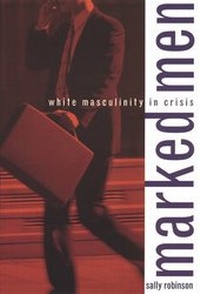
Marked Men
White Masculinity in Crisis
Published on 31. August 2000
Book
Paperback/Softback
288 pages
978-0-231-11293-2 (ISBN)
Description
White men still hold most of the political and economic cards in the United States; yet stories about wounded and traumatized men dominate popular culture. Why are white men jumping on the victim bandwagon? Examining novels by Philip Roth, John Updike, James Dickey, John Irving, and Pat Conroy and such films as Deliverance, Misery, and Dead Poets Society-as well as other writings, including The Closing of the American Mind-Sally Robinson argues that white men are tempted by the possibilities of pain and the surprisingly pleasurable tensions that come from living in crisis.
Reviews / Votes
Marked Men: White Masculinity in Crisis is an intelligent, wide-ranging, clearly argued and thoroughly femnist book about the shifting meanings of dominant masculinity in American culture...Robinson makes appropriate but not heavy-handed use of other theorists and literary critics, often developing their insights in original directions...Robinson is an astute critic of cultural images. -- Judith Kegan Gardiner The Women's Review of Books White men have it all, except the hardship of having to live in a world dominated by white men. Sally Robinson argues, with shocking originality... that they now want that too: Through victimization, we find the tensions that make us most alive. -- Jonathon Keats San Francisco Sunday Examiner & Chronicle Book ReviewMore details
Language
English
Place of publication
New York
United States
Target group
Professional and scholarly
Product notice
Paperback (trade)
Weight
397 gr
ISBN-13
978-0-231-11293-2 (9780231112932)
Copyright in bibliographic data and cover images is held by Nielsen Book Services Limited or by the publishers or by their respective licensors: all rights reserved.
Schweitzer Classification
Other editions
Additional editions
E-Book
10/2015
1st Edition
De Gruyter
from
€27.95
Available for download

Book
08/2000
Columbia University Press
€72.55
Article exhausted; check different version
Person
Sally Robinson is associate professor of English at Texas A&M University and the author of Engendering the Subject: Gender and Self-Representation in Contemporary Women's Fiction.
Content
Introduction: Visibility, Crisis, and the Wounded White Male Body Notes to Intorduction One: Marked Men, Embodying America: John Updike and the Reconstruction of Middle American Masculinity I. The "Discovery" of Middle America and the Marking of White Masculinity II. Rabbit Redux: Black Power, the Counterculture, and the Decentering of White Masculinity III. Rabbit is Rich: Feminism, the Third World, and the Screwing of White Masculinity Coda: The Death of White Masculinity? Notes to Chapter One Two: Pale Males, Dead Poets and the Crisis in White Masculinity: Scenes from the Culture Wars I. Spectacles of (Dis)Embodiment II. American Minds and American Bodies: Reproducing Elitism III. Dead Poets and the Pathos of Wounded White Masculinity Notes to Chapter Two Three: Traumas of Embodiment: White Male Authorship in Crisis I. The "Myth of Male Inviolability": Somatic Disintegration in Philip Roth's My Life as a Man II. Rapists, Feminists and The World According to Garp: Authentic and Inauthentic Trauma III: "Exercising Editorial Authority Over His Body: The Crippling of Body and Text in Stephen King's Misery Notes to Chapter Three Four: Masculinity as Emotional Constipation: Men's Liberation and the Wounds of Patriarchal Power I. The Hazards of Being Male II. The Wisdom of the Penis III. The Embarrassments of Emotional Incontinence Notes to Chapter Four Five: Expression, Repression, and Male Hysteria: Marked Men and the Wounds of Patriarchal Power I. Men's Liberation Redux: Sexuality, Evolution, and the Embodied Struggle Between Blockage and Release II. Damned if They Do, Damned if They Don't: Deliverance and the Hysterical Male Body III. Feminism and Masochism: The Prince of Tides and the Pleasure of Repression Notes to Chapter Five Works Cited