

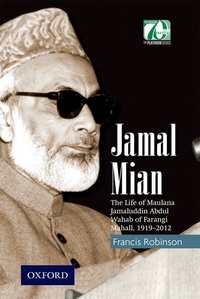
Jamal Mian
The Life of Maulana Jamaluddin Abdul Wahab of Farangi Mahall, 1919-2012
Published on 12. April 2018
Book
Hardback
460 pages
978-0-19-940568-8 (ISBN)
Description
This book relates the life of Jamal Mian Farangi Mahalli, a highly respected scion of Lucknow's scholarly culture and a major leader of the Pakistan Movement. Based on the archives left by Jamal Mian, in particular his personal diaries, it explores his life as a member of Farangi Mahall, South Asia's leading family of Islamic learning from Lucknow. The author covers the colourful life of a dynamic personality-from his education in the Dars-I Nizami and the spiritual traditions of his family to his rise to the Muslim League High Command, and his involvement in the campaign for Pakistan.
Independence and Partition wrecked Jamal Mian's family's fortunes. An Indian citizen, he had to find work in East Pakistan to support his family. Eventually, the Government of India forced him to choose between Indian and Pakistani citizenship. During the 1950s and 1960s, while based in Dhaka, he was close to both Iskander Mirza and Ayub Khan. After losing almost everything in the Bangladesh crisis, he resettled in Karachi, and did different jobs. He was also involved in international Islamic organizations.
Through the book, one is able to gain insight into his relationships with Jinnah, Jawaharlal Nehru, and Mirza Ahmed Ispahani; his close friendships with Hasrat Mohani, the Raja of Mahmudabad, Sadri Ispahani, and Mufti Amin al-Husseini; his consistent opposition to the Islamization of Pakistani politics; the extent to which his life was infused by poetry and spiritual devotion; and the length of time it took for the meaning of Partition in his life to be realized in full.
Independence and Partition wrecked Jamal Mian's family's fortunes. An Indian citizen, he had to find work in East Pakistan to support his family. Eventually, the Government of India forced him to choose between Indian and Pakistani citizenship. During the 1950s and 1960s, while based in Dhaka, he was close to both Iskander Mirza and Ayub Khan. After losing almost everything in the Bangladesh crisis, he resettled in Karachi, and did different jobs. He was also involved in international Islamic organizations.
Through the book, one is able to gain insight into his relationships with Jinnah, Jawaharlal Nehru, and Mirza Ahmed Ispahani; his close friendships with Hasrat Mohani, the Raja of Mahmudabad, Sadri Ispahani, and Mufti Amin al-Husseini; his consistent opposition to the Islamization of Pakistani politics; the extent to which his life was infused by poetry and spiritual devotion; and the length of time it took for the meaning of Partition in his life to be realized in full.
Reviews / Votes
Following one man through multiple homes and nationalities, competing visions of religious politics, and the shifting meaning and indeed location of Islam from a Sufi geography of shrines left behind in India to a Mecca-centred reformism, this is an unusually meticulous biography of a South Asian Muslim. * Nile Green, Times Literary Supplement * Robinson has given us a tremendously detailed account of this life, utilizing the wealth of sources Jamal Mian provided. It is clear there was much respect, even affection, between author and subject. * Gail Minault, University of Texas, Austin, Journal of the American Oriental Society *More details
Language
English
Place of publication
Oxford
Pakistan
Illustrations
22 plates
Dimensions
Height: 223 mm
Width: 142 mm
Thickness: 33 mm
Weight
685 gr
ISBN-13
978-0-19-940568-8 (9780199405688)
Copyright in bibliographic data and cover images is held by Nielsen Book Services Limited or by the publishers or by their respective licensors: all rights reserved.
Schweitzer Classification
Person
Francis Robinson is a British historian and Professor of the History of South Asia. He completed his undergraduate and postgraduate studies at Trinity College Cambridge and went on to become the head of the Department of History at Royal Holloway, University of London. In addition to visiting professorships at the Universities of Oxford and Chicago, Professor Robinson has twice been President of the Royal Asiatic Society and was appointed CBE (Commander of the Most Excellent Order of the British Empire) for his contributions to Islamic Studies and Higher Education in 2006. A prolific writer, Professor Robinson has previously published numerous titles such as: The Mughal Emperors and the Islamic Dynasties of India, Iran and Central Asia; Islam, South Asia and the West; The 'Ulama of Farangi Mahall and Islamic Culture in South Asia; and Islam and Muslim History in South Asia.
Content
- Acknowledgements
- Preface
- Note on Transliteration
- Abbreviations
- List of Illustrations and Map
- 1. Jamal Mian announces himself
- 2. Jamal Mian's heritage
- 3. Jamal Mian's early life
- 4. The education of Jamal Mian
- 5. The devotional world of Farangi Mahall
- 6. Jamal Mian's rise to the front rank of Muslim Politics, 1936-43
- 7. Business, marriage, and friendships
- 8. The Simla Conference, fighting the 1945-46 elections, and membership of the UP Legislative Assembly, 1945-47
- 9. Middle East Delegation, Independence, the end of the All-India Muslim League, and the death of Gandhi, March 1947-January 1948
- 10. Things fall apart, 1949-50
- 11. Life in Dacca, 1951-57
- 12. Politics, business, international engagements, and the break-up of Pakistan, 1958-71
- 13. Life in Karachi, 1971-2012
- 14. The nature of the man and the meaning of his life
- Appendix 1. Maulana Ruhullah's Milad
- Appendix 2. Jamal Mian's two Khutbas given on the Maidan in Calcutta, Eid October 1943
- Glossary
- Note on Sources
- Bibliography
- Index
- Preface
- Note on Transliteration
- Abbreviations
- List of Illustrations and Map
- 1. Jamal Mian announces himself
- 2. Jamal Mian's heritage
- 3. Jamal Mian's early life
- 4. The education of Jamal Mian
- 5. The devotional world of Farangi Mahall
- 6. Jamal Mian's rise to the front rank of Muslim Politics, 1936-43
- 7. Business, marriage, and friendships
- 8. The Simla Conference, fighting the 1945-46 elections, and membership of the UP Legislative Assembly, 1945-47
- 9. Middle East Delegation, Independence, the end of the All-India Muslim League, and the death of Gandhi, March 1947-January 1948
- 10. Things fall apart, 1949-50
- 11. Life in Dacca, 1951-57
- 12. Politics, business, international engagements, and the break-up of Pakistan, 1958-71
- 13. Life in Karachi, 1971-2012
- 14. The nature of the man and the meaning of his life
- Appendix 1. Maulana Ruhullah's Milad
- Appendix 2. Jamal Mian's two Khutbas given on the Maidan in Calcutta, Eid October 1943
- Glossary
- Note on Sources
- Bibliography
- Index