

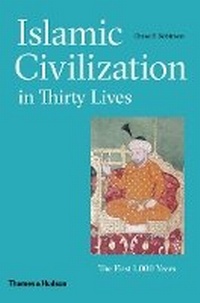
Islamic Civilization in Thirty Lives
The First 1,000 Years
Published on 27. October 2016
Book
Hardback
272 pages
978-0-500-11030-0 (ISBN)
Description
The religious thinkers, political leaders, law-makers, writers and philosophers of the early Muslim world helped to shape the 1,400-year-long development of today's second- largest world religion. But who were these people? What do we know of their lives, and the ways in which they influenced their societies?
Chase F. Robinson draws on the long tradition in Muslim scholarship of commemorating in writing the biographies of notable figures, but weaves these ambitious lives together to create a rich narrative of early Islamic civilization, from the Prophet Muhammad to fearsome Tamerlane. Beginning in Islam's heartland, Mecca, we move across Arabia to follow Islam's journey across North Africa, as far as Spain in the West, and eastwards through Central and East Asia; we see the rise and fall of Islamic states through the political and military leaders working to secure peace or expand their power, and, within this political climate, the development of Islamic law, scientific thought and literature through the words of the scholars who devoted themselves to these pursuits. Alongside the famous characters who coloured this landscape, including Muhammad's controversial cousin, 'Ali; the first Sultan of Egypt, Saladin; and the poet Rumi, the reader will also meet less well- known figures, such as Shajar al-Durr, slave-turned-Sultana of Egypt, and Ibn Fadlan, whose travels in Eurasia brought first-hand accounts of the Volka Vikings to the Abbasid Caliph.
Chase F. Robinson draws on the long tradition in Muslim scholarship of commemorating in writing the biographies of notable figures, but weaves these ambitious lives together to create a rich narrative of early Islamic civilization, from the Prophet Muhammad to fearsome Tamerlane. Beginning in Islam's heartland, Mecca, we move across Arabia to follow Islam's journey across North Africa, as far as Spain in the West, and eastwards through Central and East Asia; we see the rise and fall of Islamic states through the political and military leaders working to secure peace or expand their power, and, within this political climate, the development of Islamic law, scientific thought and literature through the words of the scholars who devoted themselves to these pursuits. Alongside the famous characters who coloured this landscape, including Muhammad's controversial cousin, 'Ali; the first Sultan of Egypt, Saladin; and the poet Rumi, the reader will also meet less well- known figures, such as Shajar al-Durr, slave-turned-Sultana of Egypt, and Ibn Fadlan, whose travels in Eurasia brought first-hand accounts of the Volka Vikings to the Abbasid Caliph.
Reviews / Votes
'A beautifully written, well-illustrated set of brief, vividly drawn portraits' - Times Higher Education 'Fascinating ... offers a unique introduction to Islamic history ... not to be missed' - Timeless Travels 'Vast in scope' - AramcoWorld 'An elegant digest of the many colourful, creative and technologically innovative manifestations that the Prophet Muhammad inspired from his seventh-century oases in the Arabian peninsula' - The Economist 'Fascinating' - The Yorkshire Post 'Accessible and readable ... a good introduction' - Shiny New BooksMore details
Language
English
Place of publication
London
United Kingdom
Illustrations
With 72 illustrations in colour and black and white
Dimensions
Height: 235 mm
Width: 152 mm
Weight
890 gr
ISBN-13
978-0-500-11030-0 (9780500110300)
Copyright in bibliographic data and cover images is held by Nielsen Book Services Limited or by the publishers or by their respective licensors: all rights reserved.
Schweitzer Classification
Person
Chase F. Robinson taught Islamic history for fourteen years at the University of Oxford before being appointed President of the Graduate Center of the City University of New York, and later Distinguished Professor of History. His extensive publications on pre-modern Islam include Islamic Historiography (2003), Empires and Elites after the Muslim Conquest: The Transformation of Northern Mesopotamia (2000) and The New Cambridge History of Islam, Vol. 1 (2010).
Content
1. Islam and Empire 600-850 * 2. The Islamic Commonwealth 850-1050 * 3. The Sunni Synthesis 1050-1250 * 4. Conflict & Change 1250-1550