

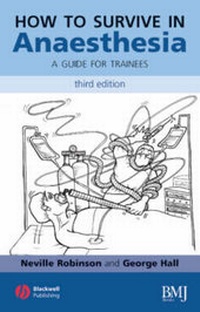
How to Survive in Anaesthesia
A Guide for Trainees
3rd Edition
Published on 10. October 2006
Book
Paperback/Softback
216 pages
978-1-4051-4645-6 (ISBN)
Description
How to Survive in Anaesthesia, third edition, continues to provide an essential, step-by-step guide for new trainees to practical procedures in anaesthesia. * Written in a light-hearted style by authors with 60 years of anaesthetic experience between them * Includes two new chapters on anaesthetic mishaps and the recognition and management of the sick patient * Resuscitation guidelines, intubation procedures and aspects of laryngeal mask design have also been updated * Clear text, interspersed with bullet-point boxes highlighting the procedures, makes it quick and easy to follow * Also popular with ODPs (Operation Department Practitioners).
Reviews / Votes
"This book maintains its previously high standards by presenting basic information in a very readable manner...[it] should be recommended to those embarking on a career in anaesthesia. It would also prove useful to medical students and operating department practitioners." Anaesthesia 62:2, February 2007More details
Edition
3rd Revised edition
Language
English
Place of publication
Oxford
United Kingdom
Publishing group
John Wiley and Sons Ltd
Target group
Professional and scholarly
Edition type
Revised edition
Illustrations
13 illustrations
Dimensions
Height: 217 mm
Width: 139 mm
Thickness: 12 mm
Weight
262 gr
ISBN-13
978-1-4051-4645-6 (9781405146456)
Copyright in bibliographic data and cover images is held by Nielsen Book Services Limited or by the publishers or by their respective licensors: all rights reserved.
Schweitzer Classification
Other editions
Previous edition

George Hall | P. Robinson
How to Survive in Anaesthesia
Book
05/2002
2nd Edition
BMJ Books
€52.18
Article exhausted; check for reprint
Persons
Neville Robinson is Consultant Anaesthetist at Northwick Park and St Mark's Hospital, Harrow, Middlesex UK. He is coauthor of Final FRCA: Short Answer Questions. George Hall is Professor of Anaesthesia at St George's Hospital Medical School, London, UK. He is past president of the British Journal of Anaesthesia board and editor of How to Write a Paper and How to Present at Meetings.
Content
Part I Nuts and bolts. 1. Evaluation of the airway. 2. Control of the airway. 3. Tracheal intubation. 4. Failed intubation drill. 5. Vascular access. 6. Intravenous fluids. 7. The anaesthetic machine. 8. Anaesthetic breathing systems. 9. Ventilators and other equipment. 10. Monitoring in anaesthesia. Part II Crises and complications. 11. Cardiac arrest. 12. Haemorrhage and blood transfusion. 13. Anaphylactic reactions. 14. Malignant hyperthermia. 15. Stridor - upper airway obstruction. 16. Pneumothorax. 17. Common intraoperative problems. 18. Postoperative problems. 19. Anaesthetic mishaps. Part III Passing the gas. 20. Preoperative evaluation. 21. Recognition and management of the sick patient. 22. Principles of emergency anaesthesia. 23. Regional anaesthesia. 24. Anaesthesia for gynaecological surgery. 25. Anaesthesia for urological surgery. 26. Anaesthesia for abdominal surgery. 27. Anaesthesia for dental and ENT surgery. 28. Anaesthesia for orthopaedic surgery. 29. Anaesthesia for day case surgery. 30. Management of the patient in the recovery area. 31. Postoperative analgesia. 32. Management of head injuries. 33. Anaesthesia in the corridor. 34. Anaesthetic aphorisms