

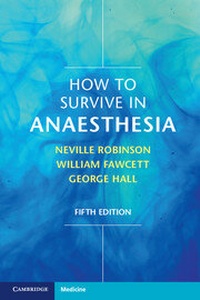
How to Survive in Anaesthesia
5th Edition
Published on 16. March 2017
Book
Paperback/Softback
220 pages
978-1-316-61402-0 (ISBN)
Description
The first few months as a trainee anaesthetist are a daunting prospect, filled with new information, skills and terminology. This concise reference, now in its fifth edition, provides doctors with a clear introduction to the practice. Fully updated and split into four key parts for quick consultation, the reader can recap on the airway and anaesthetic equipment, and find crucial advice on crises such as cardiac arrest, haemorrhage and blood transfusion. Part III focuses on subspecialties, with new chapters on obstetric anaesthesia, common regional nerve blocks, and laparoscopy, while the newly added fourth part provides information on intensive care and peri-operative medicine. Written in an accessible and often humorous style, How to Survive in Anaesthesia is an essential resource in learning the safe fundamentals of the practice for trainee anaesthetists, as well as operating department practitioners, physicians' assistants and anaesthetic nurses.
Reviews / Votes
'We think that How to Survive in Anaesthesia very much meets its goal of building a solid foundation of knowledge for the beginner in anesthesiology in an accessible and attractive format.' Sinead M. O'Shaughessy and Abigail M. Walsh, Anesthesia & AnalgesiaMore details
Edition
5th Revised edition
Language
English
Place of publication
Cambridge
United Kingdom
Target group
Professional and scholarly
College/higher education
Edition type
Revised edition
Product notice
Paperback (trade)
Illustrations
17 Halftones, black and white
Dimensions
Height: 235 mm
Width: 155 mm
Thickness: 10 mm
Weight
400 gr
ISBN-13
978-1-316-61402-0 (9781316614020)
Copyright in bibliographic data and cover images is held by Nielsen Book Services Limited or by the publishers or by their respective licensors: all rights reserved.
Schweitzer Classification
Other editions
New editions
William Fawcett | Olivia Dow | Judith Dinsmore
Robinson and Hall's How to Survive in Anaesthesia
Book
06/2025
6th Edition
Cambridge University Press
€69.00
Shipment within 15-20 days
Additional editions
Neville Robinson
How to Survive in Anaesthesia
E-Book
03/2017
Cambridge University Press
€36.99
Available for download
Neville Robinson | George Hall | William Fawcett
How to Survive in Anaesthesia
E-Book
03/2017
5th Edition
Cambridge University Press
€42.99
Available for download
Persons
Neville Robinson was appointed a consultant anaesthetist in 1987. He has co-authored/edited some eleven books primarily aimed at teaching, six book chapters, and some thirty papers, including those related to metabolic stress, patient satisfaction, sepsis in obstetrics, and more recently, a new airway, the Tulip. He was the recipient of the Evelyn Baker Award (AAGBI) in 2008. He is a Royal College of Anaesthetists (RCA) assessor and is on the national MMBRACE committee. He is a past RCA College tutor and teaches on several courses aimed at passing the RCA examinations. George Hall was a Professor of Anaesthesia in the University of London from 1989 to 2013. He has authored/edited twelve books and written over two hundred papers as well as many book chapters. He was a member of the Editorial Board of the British Journal of Anaesthesia for thirty years and Chairman for seven years. He was also an editor of Anesthesia and Analgesia for ten years. A dedicated teacher, he has received awards from medical students for his excellence in instructing in anaesthesia. William Fawcett has run and taught on courses in the UK, Europe and the US. He has produced over 130 publications including three text books, fourteen textbook chapters, five review articles and two major editorials. He is an Editor for the British Journal of Anaesthesia Education, and a National Assessor and chapter writer for MBBRACE-UK. He is an executive committee member and website editor for the World Enhanced Recovery After Surgery Society.
Content
List of figures; List of tables; List of boxes; Preface to the fifth edition; Preface to the fourth edition; Preface to the third edition; Preface to the second edition; Preface to the first edition; Let's start at the very beginning ...; Part I. Nuts and Bolts: 1. Evaluation of the airway; 2. Control of the airway; 3. Tracheal intubation; 4. Failed intubation drill; 5. Vascular access; 6. Intravenous fluids; 7. The anaesthetic machine; 8. Anaesthetic breathing systems; 9. Ventilators and other equipment; 10. Monitoring in anaesthesia; Part II. Crises and Complications: 11. Cardiac arrest; 12. Haemorrhage and blood transfusion; 13. Anaphylactic reactions; 14. Malignant hyperthermia; 15. Local anaesthetic toxicity; 16. Stridor - upper airway obstruction; 17. Pneumothorax; 18. Common intraoperative problems; 19. Postoperative problems; 20. Anaesthetic mishaps; Part III. Passing the Gas: 21. Preoperative evaluation; 22. Principles of emergency anaesthesia; 23. Anaesthesia for laparoscopic surgery; 24. Anaesthesia for abdominal surgery; 25. Anaesthesia for gynaecological surgery; 26. Anaesthesia for urological surgery; 27. Anaesthesia for dental and ENT surgery; 28. Anaesthesia for orthopaedic surgery; 29. Anaesthesia for day case surgery; 30. Epidural and spinal anaesthesia; 31. Common regional blocks; 32. Obstetric anaesthesia; 33. Anaesthesia in the corridor; Part IV. Walking the Walk (Talking the Talk): 34. Management of the patient in the recovery area; 35. Postoperative analgesia; 36. Recognition and management of the sick patient; 37. Intensive care (critical care), section 1; 38. Intensive care (critical care), section 2; 39. Peri-operative medicine; 40. Management of head injuries; Part V. And Finally ...: 41. Anaesthetic aphorisms; Index.