

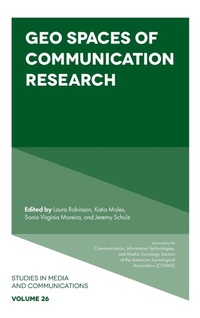
Geo Spaces of Communication Research
Published on 28. March 2024
Book
Hardback
216 pages
978-1-80071-606-3 (ISBN)
Description
Sponsored by the Brazil-U.S. Colloquium on Communication Studies of the Brazilian Society for Interdisciplinary Studies in Communication and the Communication, Information Technologies, and Media Sociology Section of the American Sociological Association (CITAMS), this volume of Studies in Media and Communications is entitled Geo Spaces of Communication Research.
The volume brings together scholars from across the Americas to address the complex evolution of political and policy media spaces as they are studied from a range of perspectives. The volume probes how media and digital tech are transforming how individuals, groups, and societies communicate within and across social worlds, as well as how emergent methodologies are evolving to keep pace with these phenomena.
The volume brings together scholars from across the Americas to address the complex evolution of political and policy media spaces as they are studied from a range of perspectives. The volume probes how media and digital tech are transforming how individuals, groups, and societies communicate within and across social worlds, as well as how emergent methodologies are evolving to keep pace with these phenomena.
More details
Series
Language
English
Place of publication
Bingley
United Kingdom
Target group
College/higher education
Dimensions
Height: 235 mm
Width: 157 mm
Thickness: 16 mm
Weight
471 gr
ISBN-13
978-1-80071-606-3 (9781800716063)
Copyright in bibliographic data and cover images is held by Nielsen Book Services Limited or by the publishers or by their respective licensors: all rights reserved.
Schweitzer Classification
Other editions
Additional editions
Laura Robinson | Katia Moles | Sonia Virginia Moreira
Geo Spaces of Communication Research
E-Book
03/2024
1st Edition
Emerald Publishing Limited
€98.49
Available for download
Persons
Laura Robinson is Professor of Sociology at Santa Clara University, USA.
Katia Moles is a Social Ethicist of Technology in the School of Engineering at Santa Clara University, USA.
Sonia Virginia Moreira is Professor of the Graduate Program in Communication at the State University of Rio de Janeiro, Brazil.
Jeremy Schulz is Researcher at the UC Berkeley Institute for the Study of Societal Issues, USA.
Katia Moles is a Social Ethicist of Technology in the School of Engineering at Santa Clara University, USA.
Sonia Virginia Moreira is Professor of the Graduate Program in Communication at the State University of Rio de Janeiro, Brazil.
Jeremy Schulz is Researcher at the UC Berkeley Institute for the Study of Societal Issues, USA.
Content
Chapter 1. Problematizing Communication Research in the Public Sphere; Katia Moles, Laura Robinson, Sonia Virginia Moreira, and Jeremy Schulz
Section 1. Political and Policy Media Spaces
Chapter 2. Small Internet Providers as Agents: Internalizing Digital Infrastructure in Brazil; Sonia V. Moreira, Nelia R. Del Bianco, and Cezar F. Martins
Chapter 3. An Analysis of Bolsonaro and Trump's Social Media: Agenda Setting in Presidential Campaigns in Brazil and the U.S.; Elida Borges Rodrigues Gomes and Tatiana Monteiro Reis
Chapter 4. A Disaster After the Disaster: A Comparative Framing Analysis of the Samarco Dam Collapse; Julianna M. Trammel
Chapter 5. Digital Participation of Left-Wing Activists in Brazil: Cultural Events, Mobilization, and Networked Protest; Julien Figeac, Nathalie Paton, Angelina Peralva, Arthur Coelho Bezerra, Heloise Prevost, Pierre Ratinaud, and Tristan Salord
Section 2. Communication Research and Journalism
Chapter 6. Local and Regional Journalism in the Interior of Brazil: Contexts, Developments, and Emergent Themes; Jacqueline da Silva Deolindo
Chapter 7. On the Role of Redundancy in the Popularization of Science: An Analysis of Brazilian Journalistic Texts on Covid-19; Margarethe Born Steinberger-Elias
Chapter 8. Reshaping Journalism Practices through Collaboration: An Analysis of Three Collaborative Projects in the Americas; Lucia Mesquita, Gabriela Gruszynski Sanseverino, Mathias Felipe de Lima Santos, and Giuliander Carpes da Silva
Section 3. Communication Research Methods
Chapter 9. In the field in Brazil and the USA: Doing Ethnography in Communication; Aline Maia
Chapter 10. Visualizations as Evidence in the Arts, Humanities, and Social Sciences; Jeremy Schulz, Laura Robinson, and Katia Moles
Section 1. Political and Policy Media Spaces
Chapter 2. Small Internet Providers as Agents: Internalizing Digital Infrastructure in Brazil; Sonia V. Moreira, Nelia R. Del Bianco, and Cezar F. Martins
Chapter 3. An Analysis of Bolsonaro and Trump's Social Media: Agenda Setting in Presidential Campaigns in Brazil and the U.S.; Elida Borges Rodrigues Gomes and Tatiana Monteiro Reis
Chapter 4. A Disaster After the Disaster: A Comparative Framing Analysis of the Samarco Dam Collapse; Julianna M. Trammel
Chapter 5. Digital Participation of Left-Wing Activists in Brazil: Cultural Events, Mobilization, and Networked Protest; Julien Figeac, Nathalie Paton, Angelina Peralva, Arthur Coelho Bezerra, Heloise Prevost, Pierre Ratinaud, and Tristan Salord
Section 2. Communication Research and Journalism
Chapter 6. Local and Regional Journalism in the Interior of Brazil: Contexts, Developments, and Emergent Themes; Jacqueline da Silva Deolindo
Chapter 7. On the Role of Redundancy in the Popularization of Science: An Analysis of Brazilian Journalistic Texts on Covid-19; Margarethe Born Steinberger-Elias
Chapter 8. Reshaping Journalism Practices through Collaboration: An Analysis of Three Collaborative Projects in the Americas; Lucia Mesquita, Gabriela Gruszynski Sanseverino, Mathias Felipe de Lima Santos, and Giuliander Carpes da Silva
Section 3. Communication Research Methods
Chapter 9. In the field in Brazil and the USA: Doing Ethnography in Communication; Aline Maia
Chapter 10. Visualizations as Evidence in the Arts, Humanities, and Social Sciences; Jeremy Schulz, Laura Robinson, and Katia Moles