

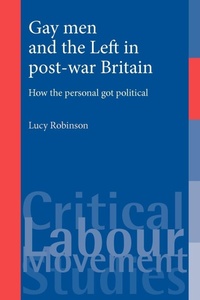
Gay Men and the Left in Post-War Britain
How the Personal Got Political
Published on 30. November 2011
Book
Paperback/Softback
232 pages
978-0-7190-8639-7 (ISBN)
Description
Available in paperback for the first time, his book demonstrates how the personal became political in post-war Britain, and argues that attention to gay activism can help us to fundamentally rethink the nature of post-war politics. While the Left were fighting among themselves and the reformists were struggling with the limits of law reform, gay men started organising for themselves, first individually within existing organisations and later rejecting formal political structures altogether.
Culture, performance and identity took over from economics and class struggle, as gay men worked to change the world through the politics of sexuality. Throughout the post-war years, the new cult of the teenager in the 1950s, CND and the counter-culture of the 1960s, gay liberation, feminism, the Punk movement and the miners' strike of 1984 all helped to build a politics of identity.
There is an assumption among many of today's politicians that young people are apathetic and disengaged. This book argues that these politicians are looking in the wrong place. People now feel that they can impact the world through the way in which they live, shop, have sex and organise their private lives. Robinson shows that gay men and their politics have been central to this change in the post-war world. -- .
Culture, performance and identity took over from economics and class struggle, as gay men worked to change the world through the politics of sexuality. Throughout the post-war years, the new cult of the teenager in the 1950s, CND and the counter-culture of the 1960s, gay liberation, feminism, the Punk movement and the miners' strike of 1984 all helped to build a politics of identity.
There is an assumption among many of today's politicians that young people are apathetic and disengaged. This book argues that these politicians are looking in the wrong place. People now feel that they can impact the world through the way in which they live, shop, have sex and organise their private lives. Robinson shows that gay men and their politics have been central to this change in the post-war world. -- .
Reviews / Votes
"Lucy Robinson's excellent account of 'how the personal got political' tells the story of Clause 28 and some of what happened afterwards, but mostly it tells what went before."James Heartfield, Spiked Review of Books. -- .
More details
Series
Language
English
Place of publication
Manchester
United Kingdom
Target group
Adult education
Dimensions
Height: 234 mm
Width: 156 mm
Thickness: 13 mm
Weight
360 gr
ISBN-13
978-0-7190-8639-7 (9780719086397)
Copyright in bibliographic data and cover images is held by Nielsen Book Services Limited or by the publishers or by their respective licensors: all rights reserved.
Schweitzer Classification
Other editions
Additional editions
E-Book
07/2013
11th Edition
Manchester University Press
€23.49
Available for download
Person
Lucy Robinson is Lecturer in Modern British History at the University of Sussex. -- .
Content
Acknowledgements
List of abbreviations
Introduction
1. Politics and culture - homosexuality and the left in post-war Britain
2. Reporting change - law reform, homosexual identity and the role of the counter-culture
3. Praxis, protest and performance - gay liberation 1969-1973
4. The left gets personal - identity, performance and the left 1972-1979
5. The next big thing - from gay left collective to Greater London Council, paedophile identity and the state of the left
6. Confronting Thatcher - The Bermondsey by-election, lesbians and gays support the miners and AIDS activism
Conclusion
Selected Bibliography
Index -- .
List of abbreviations
Introduction
1. Politics and culture - homosexuality and the left in post-war Britain
2. Reporting change - law reform, homosexual identity and the role of the counter-culture
3. Praxis, protest and performance - gay liberation 1969-1973
4. The left gets personal - identity, performance and the left 1972-1979
5. The next big thing - from gay left collective to Greater London Council, paedophile identity and the state of the left
6. Confronting Thatcher - The Bermondsey by-election, lesbians and gays support the miners and AIDS activism
Conclusion
Selected Bibliography
Index -- .