

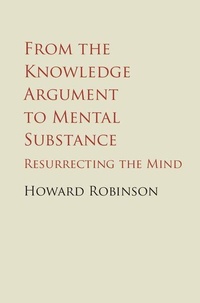
From the Knowledge Argument to Mental Substance
Resurrecting the Mind
Published on 5. February 2016
Book
Hardback
286 pages
978-1-107-08726-2 (ISBN)
Description
This book presents a strong case for substance dualism and offers a comprehensive defense of the knowledge argument, showing that materialism cannot accommodate or explain the 'hard problem' of consciousness. Bringing together the discussion of reductionism and semantic vagueness in an original and illuminating way, Howard Robinson argues that non-fundamental levels of ontology are best treated by a conceptualist account, rather than a realist one. In addition to discussing the standard versions of physicalism, he examines physicalist theories such as those of McDowell and Price, and accounts of neutral monism and panpsychism from Strawson, McGinn and Stoljar. He also explores previously unnoticed historical parallels between Frege and Aristotle, and between Hume and Plotinus. His book will be a valuable resource for scholars and advanced students of philosophy of mind, in particular those looking at consciousness, dualism, and the mind-body problem.
Reviews / Votes
'From the Knowledge Argument to Mental Substance is an extremely ambitious and original book, crystallizing several decades of Howard Robinson's work in the philosophy of mind ... In a field that is sometimes concerned with relatively small details of technical arguments, Robinson's highly ambitious and very novel approach is refreshingly different.' The Times Literary SupplementMore details
Language
English
Place of publication
Cambridge
United Kingdom
Target group
Professional and scholarly
Dimensions
Height: 235 mm
Width: 157 mm
Thickness: 20 mm
Weight
568 gr
ISBN-13
978-1-107-08726-2 (9781107087262)
Copyright in bibliographic data and cover images is held by Nielsen Book Services Limited or by the publishers or by their respective licensors: all rights reserved.
Schweitzer Classification
Other editions
Additional editions
Book
09/2017
Cambridge University Press
€39.70
Shipment within 15-20 days
E-Book
07/2016
Cambridge University Press
€23.49
Available for download
E-Book
02/2016
Cambridge University Press
€20.99
Available for download
Person
Howard Robinson is University Professor in the Department of Philosophy at Central European University, Budapest, Senior Fellow at the Rutgers Center for Philosophy of Religion, New Brunswick, and a Visiting Scholar at Fordham University, New York. He is the author of Matter and Sense: A Critique of Contemporary Materialism (Cambridge, 1982) and Perception (1994).
Content
Part I. The Power of the Knowledge Argument: 1. Introducing the knowledge argument; 2. Dennett's denial of Mary's ignorance; 3. The abilities hypothesis and other functionalist strategies; 4. Why Frank should not have jilted Mary: the inadequacy of representationalism as a strategy against KA; 5. The phenomenal concept strategy: more enigma than argument; 6. Davidson, non-reductive physicalism and naturalism without physicalism; 7. Mysterianism, neutral monism and panpsychism; 8. Conclusion: the real power of the knowledge argument - qualia, qualities and our conception of the physical world; Part II. Why Physicalism Entails Epiphenomenalism: 9. Reductionism and the status of the special sciences; 10. Vagueness, realism, language and thought; 11. Composite objects, the special sciences, conceptualism and realism; 12. Why there are (probably) no physical individuals; 13. Dennett and the human perspective; Part III. Arguments for Mental Substance: 14. Some current arguments for substance dualism; 15. An argument for the existence of mental substance; 16. Plotinus, Locke and Hume on the unity of individual substances; Bibliography; Index.