

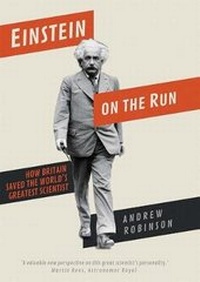
Einstein on the Run
How Britain Saved the World's Greatest Scientist
Published on 24. September 2019
Book
Hardback
376 pages
978-0-300-23476-3 (ISBN)
Description
A "highly readable" (Wall Street Journal) account of the role Britain played in Einstein's life-first by inspiring his teenage passion for physics, then by providing refuge from the Nazis
"A vivid look at how the U.K. affected the German-born physicist's life and thinking." -Publishers Weekly
"Robinson has that rare knack for presenting a near-encyclopedic volume of historical information, anecdotes and contemporaneous accounts in a thoroughly delightful fashion."-Ian Randall, Physics World
In autumn 1933, Albert Einstein found himself living alone in an isolated holiday hut in rural England. There, he toiled peacefully at mathematics while occasionally stepping out for walks or to play his violin. But how had Einstein come to abandon his Berlin home and go '"on the run"?
In this lively account, Andrew Robinson tells the story of the world's greatest scientist and Britain for the first time, showing why Britain was the perfect refuge for Einstein from rumored assassination by Nazi agents. Young Einstein's passion for British physics, epitomized by Newton, had sparked his scientific development around 1900. British astronomers had confirmed his general theory of relativity, making him internationally famous in 1919. Welcomed by the British people, who helped him campaign against Nazi anti-Semitism, he even intended to become a British citizen. So why did Einstein then leave Britain, never to return to Europe?
"A vivid look at how the U.K. affected the German-born physicist's life and thinking." -Publishers Weekly
"Robinson has that rare knack for presenting a near-encyclopedic volume of historical information, anecdotes and contemporaneous accounts in a thoroughly delightful fashion."-Ian Randall, Physics World
In autumn 1933, Albert Einstein found himself living alone in an isolated holiday hut in rural England. There, he toiled peacefully at mathematics while occasionally stepping out for walks or to play his violin. But how had Einstein come to abandon his Berlin home and go '"on the run"?
In this lively account, Andrew Robinson tells the story of the world's greatest scientist and Britain for the first time, showing why Britain was the perfect refuge for Einstein from rumored assassination by Nazi agents. Young Einstein's passion for British physics, epitomized by Newton, had sparked his scientific development around 1900. British astronomers had confirmed his general theory of relativity, making him internationally famous in 1919. Welcomed by the British people, who helped him campaign against Nazi anti-Semitism, he even intended to become a British citizen. So why did Einstein then leave Britain, never to return to Europe?
Reviews / Votes
"Highly readable." -Andrew Crumey, Wall Street Journal"Deeply interesting"-Naomi Pasachoff, Metascience
"Robinson's evocative account of a transitional phase in Einstein's life offers a valuable new perspective on this great scientist's personality."-Martin Rees, Astronomer Royal and former president of the Royal Society
"A well-researched and very readable book about a less well-known period in Einstein's life - his contact with England and English scientists."-Jocelyn Bell Burnell, Visiting Professor of Astrophysics, University of Oxford
"I absolutely adore this book - it's insightful and very well-written. Einstein's time in and relation to Britain from an Anglophile perspective is a new and valuable contribution. Robinson is also a very fine storyteller."-Steven Gimbel, author of Einstein: His Space and Times
"The very first study of its kind. It wears its thorough and conscientious scholarship lightly on its sleeve--a splendidly entertaining read."-Ze'ev Rosenkranz, editor of The Travel Diaries of Albert Einstein
"A compelling tale of Einstein's reception in Britain. Robinson casts in bold relief important insights into the nature and character of British and German societies in the interwar period."-Robert Schulmann, Former head of the Einstein Papers Project
More details
Language
English
Place of publication
United States
Product notice
Cloth over boards
Illustrations
33 b-w illus.
Dimensions
Height: 216 mm
Width: 140 mm
Thickness: 25 mm
ISBN-13
978-0-300-23476-3 (9780300234763)
Copyright in bibliographic data and cover images is held by Nielsen Book Services Limited or by the publishers or by their respective licensors: all rights reserved.
Schweitzer Classification
Other editions
Additional editions
E-Book
10/2019
1st Edition
Yale University Press
€18.18
Available for download
Person
Andrew Robinson has written more than twenty-five books including Einstein: A Hundred Years of Relativity, The Last Man Who Knew Everything, and Genius: A Very Short Introduction.