

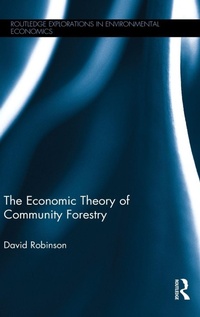
The Economic Theory of Community Forestry
1st Edition
Published on 2. June 2016
Book
Hardback
230 pages
978-1-138-10072-5 (ISBN)
Description
Community forestry is an expanding model of forest management around the world. Over a quarter of forests in developing countries are now owned by or assigned to communities and there is a growing community forestry movement in developed countries such as Canada and the USA. There is, however, no economic theory of community forestry and no systematic treatment of the potential economic advantages of promoting Community forestry in developed countries. As a result much of the policy debate over forest management and forest tenure rests on confused and often erroneous views held by policy makers and encouraged by the dominant forestry industry.
The Economic Theory of Community Forestry aims to address this gap and provides the tools for understanding community forestry movement as an alternative form of ownership that can mobilize community resources and encourage innovation. It uses a wide range of economic principles to show how community forestry can be economically superior to conventional forestry; provides examples from Canadian practice; and discusses the regulatory regime that policy makers must put in place to benefit from community forestry.
This book will be of interest to policy makers, activists, community forestry managers and members, foresters and forestry students.
The Economic Theory of Community Forestry aims to address this gap and provides the tools for understanding community forestry movement as an alternative form of ownership that can mobilize community resources and encourage innovation. It uses a wide range of economic principles to show how community forestry can be economically superior to conventional forestry; provides examples from Canadian practice; and discusses the regulatory regime that policy makers must put in place to benefit from community forestry.
This book will be of interest to policy makers, activists, community forestry managers and members, foresters and forestry students.
More details
Series
Language
English
Place of publication
London
United Kingdom
Publishing group
Taylor & Francis Ltd
Target group
College/higher education
Illustrations
44 s/w Abbildungen, 3 s/w Photographien bzw. Rasterbilder, 41 s/w Zeichnungen
41 Line drawings, black and white; 3 Halftones, black and white; 44 Illustrations, black and white
Dimensions
Height: 240 mm
Width: 161 mm
Thickness: 17 mm
Weight
517 gr
ISBN-13
978-1-138-10072-5 (9781138100725)
Copyright in bibliographic data and cover images is held by Nielsen Book Services Limited or by the publishers or by their respective licensors: all rights reserved.
Schweitzer Classification
Other editions
Additional editions
David Robinson
The Economic Theory of Community Forestry
Book
04/2018
1st Edition
Routledge
€68.30
Shipment within 10-20 days
David Robinson
The Economic Theory of Community Forestry
E-Book
05/2016
Routledge
€61.99
Available for download
David Robinson
The Economic Theory of Community Forestry
E-Book
05/2016
Routledge
€61.99
Available for download
Person
David Robinson teaches resource economics, econometrics and game theory in the School of Northern and Community Studies at Laurentian University in Northern Ontario, Canada.
Content
Contents
Foreword
1 The Plan of the Book
I SETTING THE SCENE
2 What is Community Forestry?
3 Traditional Territories, Industrial Forestry, and the Community Forest
4 Tenure, Property Rights, Community Rights
II ECONOMIC THEORY
5 Forests and Joint Production
6 Human Capital and Social Capital
7 The Efficiency of Community Forestry
8 Externalities and Community Forestry
9 Public goods and public forests
III COMMUNITY
10 Transaction cost theory applied to community forestry
11 The Creative Potential of Community Forestry: the small world phenomenon
12 Coops, worker managed firms and community forests
13 Community Forestry and the Professional Forester
14 Conclusions and Policy Advice
Appendices
Foreword
1 The Plan of the Book
I SETTING THE SCENE
2 What is Community Forestry?
3 Traditional Territories, Industrial Forestry, and the Community Forest
4 Tenure, Property Rights, Community Rights
II ECONOMIC THEORY
5 Forests and Joint Production
6 Human Capital and Social Capital
7 The Efficiency of Community Forestry
8 Externalities and Community Forestry
9 Public goods and public forests
III COMMUNITY
10 Transaction cost theory applied to community forestry
11 The Creative Potential of Community Forestry: the small world phenomenon
12 Coops, worker managed firms and community forests
13 Community Forestry and the Professional Forester
14 Conclusions and Policy Advice
Appendices