

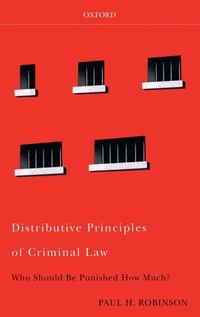
Distributive Principles of Criminal Law
Who Should be Punished How Much?
Published on 25. September 2008
Book
Hardback
288 pages
978-0-19-536575-7 (ISBN)
Description
The rules governing who will be punished and how much determine a society's success in two of its most fundamental functions: doing justice and protecting citizens from crime. Drawing from the existing theoretical literature and adding to it recent insights from the social sciences, Paul Robinson describes the nature of the practical challenge in setting rational punishment principles, how past efforts have failed, and the alternatives that have been tried. He ultimately proposes a principle for distributing criminal liability and punishment that will be most likely to do justice and control crime.
Paul Robinson, is one of the world's leading criminal law experts. He has been writing about criminal liability and punishment issues for three decades, and has published dozens of influential articles in the best scholarly journals. This long-awaited volume is a brilliant synthesis of social science research and legal reasoning that brings together three decades of work in a compelling line of argument that addresses all of the important issues in assessing liability and punishment.
Paul Robinson, is one of the world's leading criminal law experts. He has been writing about criminal liability and punishment issues for three decades, and has published dozens of influential articles in the best scholarly journals. This long-awaited volume is a brilliant synthesis of social science research and legal reasoning that brings together three decades of work in a compelling line of argument that addresses all of the important issues in assessing liability and punishment.
More details
Language
English
Place of publication
New York
United States
Target group
College/higher education
Professional and scholarly
Dimensions
Height: 240 mm
Width: 161 mm
Thickness: 20 mm
Weight
596 gr
ISBN-13
978-0-19-536575-7 (9780195365757)
Copyright in bibliographic data and cover images is held by Nielsen Book Services Limited or by the publishers or by their respective licensors: all rights reserved.
Schweitzer Classification
Other editions
Additional editions
E-Book
09/2008
OUP eBook
€51.49
Available for download
E-Book
09/2008
1st Edition
OUP eBook
€40.49
Available for download
Person
Paul H. Robinson, the Colin S. Diver Professor of Law at the University of Pennsylvania, is one of the world's leading experts on criminal law. Holding law degrees from U.C.L.A., Harvard, and Cambridge, he served as a federal prosecutor, as counsel for the U.S. Senate Subcommittee on Criminal Law, and as one of the original commissioners of the U.S. Sentencing Commission, where he was the lone dissenter to promulgation of what are the current federal sentencing
guidelines. Among his dozen books are the standard lawyer's reference book on criminal law defenses, an internationally known Oxford monograph on criminal law theory, a highly-regarded criminal law
treatise, a popular innovative case studies course book, and a ground-breaking empirical study of the conflict between criminal law rules and lay intuitions of justice. He also has published scholarly articles in nearly ever top law review. Robinson, who has given scholarly lectures and assisted in criminal code reform throughout the world, led two recent criminal code reform projects in the United States and, under United Nations sponsorship, directed the effort in producing the first
Islamic criminal code to use a modern code format.
guidelines. Among his dozen books are the standard lawyer's reference book on criminal law defenses, an internationally known Oxford monograph on criminal law theory, a highly-regarded criminal law
treatise, a popular innovative case studies course book, and a ground-breaking empirical study of the conflict between criminal law rules and lay intuitions of justice. He also has published scholarly articles in nearly ever top law review. Robinson, who has given scholarly lectures and assisted in criminal code reform throughout the world, led two recent criminal code reform projects in the United States and, under United Nations sponsorship, directed the effort in producing the first
Islamic criminal code to use a modern code format.
Content
Chapter 1. Distributing Criminal Liability and Punishment ; Chapter 2. The Need for an Articulated Distributive Principle ; Chapter 3. Does Criminal Law Deter? ; Chapter 4. Deterrence as a Distributive Principle ; Chapter 5. Rehabilitation ; Chapter 6. Incapacitation of the Dangerous ; Chapter 7. Competing Conceptions of Desert: Vengeful, Deontological, and Empirical ; Chapter 8. The Utility of Desert ; Chapter 9. Restorative Justice ; Chapter 10.The Strengths & Weaknesses of Alterative Distributive Principles ; Chapter 11.Hybrid Distributive Principles ; Chapter 12. A Practical Theory of Justice: Proposal for a Hybrid Distributive Principle Centered on Empirical Desert ; Index