

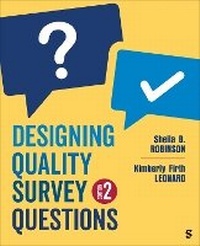
Designing Quality Survey Questions
2nd Edition
Published on 12. May 2025
Book
Paperback/Softback
272 pages
978-1-0719-1818-0 (ISBN)
Description
Designing Quality Survey Questions, Second Edition shows readers how to craft precisely worded survey questions with appropriate response options that provide useful data to help answer research questions. The Second Edition offers more detail on survey question design, rating scales, open-ended questions, and more guidance on cultural responsiveness, use of inclusive language, how to survey youth, and a deeper discussion on asking questions about sex and gender and disability.
More details
Edition
2nd Revised edition
Language
English
Place of publication
Thousand Oaks
United States
Target group
College/higher education
Edition type
Revised edition
Dimensions
Height: 232 mm
Width: 187 mm
Weight
552 gr
ISBN-13
978-1-0719-1818-0 (9781071918180)
Copyright in bibliographic data and cover images is held by Nielsen Book Services Limited or by the publishers or by their respective licensors: all rights reserved.
Schweitzer Classification
Other editions
Previous edition
Sheila B. Robinson | Kimberly Firth Leonard
Designing Quality Survey Questions
Book
08/2018
1st Edition
SAGE Publications Inc
€91.80
Article exhausted; check for reprint
Persons
Sheila B. Robinson, Ed.D is an educator, program evaluator, and professional development workshop facilitator whose survey design experience began with assessment design in K12 public education. She is often an invited keynote speaker and workshop presenter at professional conferences, consultant with educational and other organizations on survey design and program evaluation, and adjunct professor of graduate courses in both program evaluation and professional development design and evaluation. Sheila is an active member of the American Evaluation Association (AEA); she is past chair of AEA's Pre-K12 Educational Evaluation Topical Interest Group, Lead Curator for AEA's blog Tip-a-Day-by and For Evaluators, and Coordinator of AEA's Potent Presentations Initiative. Sheila and her husband live in Rochester, NY.
Kimberly Firth Leonard, MPA, has built, administered, and taught others about surveys for more than a decade, primarily in the context of program evaluation. Kim is currently the Senior Evaluation Officer at the Oregon Community Foundation where she manages evaluations of several large grant-making initiatives, each of which includes at least one survey-based data collection component. Kim is an active member of the American Evaluation Association (AEA) and was president of the Oregon Program Evaluators Network in 2013. Kim lives in Portland, Oregon, with her husband, their new baby girl, two dogs and cat.
Kimberly Firth Leonard, MPA, has built, administered, and taught others about surveys for more than a decade, primarily in the context of program evaluation. Kim is currently the Senior Evaluation Officer at the Oregon Community Foundation where she manages evaluations of several large grant-making initiatives, each of which includes at least one survey-based data collection component. Kim is an active member of the American Evaluation Association (AEA) and was president of the Oregon Program Evaluators Network in 2013. Kim lives in Portland, Oregon, with her husband, their new baby girl, two dogs and cat.
Content
Chapter 1 * WHY Quality Surveys and Questions Matter
What Is a Quality Survey?
Why Does Quality Matter?
Why Do We Need a Purposeful Survey Design Process?
Applying Design Thinking to Survey Research
A Purposeful Survey Design Process
An Iterative Process
Part I * WHAT to Consider Before Drafting Survey Questions
Purposeful Survey Design
Chapter 2 * Planning and Predrafting
Why Survey? The Importance of Establishing Purpose
What Will Be Measured? Understanding Constructs and Indicators
Wait, Do You Really Need a Survey?
What Can Be Measured With a Survey?
What Are the Advantages and Limitations of Surveys?
Chapter 3 * Understanding Respondents
Cognitive Tasks Involved in Answering Questions
Respondent Willingness and Ability to Participate in a Survey
Context and Culture
Part II * HOW to Develop Survey Questions and Response Options
Purposeful Survey Design
Chapter 4 * Sourcing and Crafting Questions
Sourcing Survey Questions
Composing Question Stems
Avoiding Problematic Wording and Question Types
Open-Ended Questions
What to Do When You Have Too Many Open-Ended Questions
Closed-Ended Questions
Questions With Special Purposes
Chapter 5 * Constructing Response Options
Determining Appropriate Response Options
Strategies for Designing Response Options
Chapter 6 * Demographic and Other Sensitive Questions
Sensitive Questions
Demographic Questions
Part III * Knowing WHEN a Survey Is Ready for Use
Purposeful Survey Design
Chapter 7 * Finalizing Questions and Using Pretesting Strategies
Why Pretest Surveys and Their Questions?
How Can Surveys and Their Questions Be Tested Prior to Use?
Chapter 8 * Pulling It All Together to Maximize Response
Survey Instructions
Order Effects
Formatting the Survey
Contacting Potential Respondents
Planning for Administration
Appendix: Checklist for Quality Question Design
Glossary
References
Index
What Is a Quality Survey?
Why Does Quality Matter?
Why Do We Need a Purposeful Survey Design Process?
Applying Design Thinking to Survey Research
A Purposeful Survey Design Process
An Iterative Process
Part I * WHAT to Consider Before Drafting Survey Questions
Purposeful Survey Design
Chapter 2 * Planning and Predrafting
Why Survey? The Importance of Establishing Purpose
What Will Be Measured? Understanding Constructs and Indicators
Wait, Do You Really Need a Survey?
What Can Be Measured With a Survey?
What Are the Advantages and Limitations of Surveys?
Chapter 3 * Understanding Respondents
Cognitive Tasks Involved in Answering Questions
Respondent Willingness and Ability to Participate in a Survey
Context and Culture
Part II * HOW to Develop Survey Questions and Response Options
Purposeful Survey Design
Chapter 4 * Sourcing and Crafting Questions
Sourcing Survey Questions
Composing Question Stems
Avoiding Problematic Wording and Question Types
Open-Ended Questions
What to Do When You Have Too Many Open-Ended Questions
Closed-Ended Questions
Questions With Special Purposes
Chapter 5 * Constructing Response Options
Determining Appropriate Response Options
Strategies for Designing Response Options
Chapter 6 * Demographic and Other Sensitive Questions
Sensitive Questions
Demographic Questions
Part III * Knowing WHEN a Survey Is Ready for Use
Purposeful Survey Design
Chapter 7 * Finalizing Questions and Using Pretesting Strategies
Why Pretest Surveys and Their Questions?
How Can Surveys and Their Questions Be Tested Prior to Use?
Chapter 8 * Pulling It All Together to Maximize Response
Survey Instructions
Order Effects
Formatting the Survey
Contacting Potential Respondents
Planning for Administration
Appendix: Checklist for Quality Question Design
Glossary
References
Index