

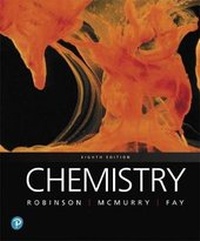
Chemistry Plus Mastering Chemistry with Pearson eText -- Access Card Package
8th Edition
Published on 6. June 2019
Book
Mixed media product
9998 pages
978-0-13-520506-8 (ISBN)
Description
NOTE: Before purchasing, check with your instructor to ensure you select the correct ISBN. Several versions of the MyLab (TM) and Mastering (TM) platforms exist for each title, and registrations are not transferable. To register for and use MyLab or Mastering, you may also need a Course ID, which your instructor will provide.
Used books, rentals, and purchases made outside of Pearson
If purchasing or renting from companies other than Pearson, the access codes for the Mastering may not be included, may be incorrect, or may be previously redeemed. Check with the seller before completing your purchase.
For two-semester general chemistry courses (science majors).
This package includes Mastering Chemistry.
Give students a robust conceptual foundation while building critical problem solving skills
Robinson/McMurry/Fay's Chemistry, known for a concise and united author voice, conceptual focus, extensive worked examples, and thoroughly constructed connections between organic, biological, and general chemistry, highlights the application of chemistry to students' lives and careers. Lead author Jill Robinson strengthens the student orientation by creating more engaging, active learning opportunities for students and faculty.
With the 8th Edition, Robinson draws upon her exceptional teaching skills to provide new interactive experiences that help identify and address students' preconceptions. Robinson complements active engagement in the text with a new media program that increases student awareness of their learning process via Mastering Chemistry and the Pearson eText, allowing instructors to choose the level of interactivity appropriate for their classroom. Interactive experiences include activities that guide students in how to actively read a science text and address common preconceptions, giving students opportunities to cultivate and practice problem-solving skills.
Personalize learning with Mastering Chemistry
By combining trusted author content with digital tools and a flexible platform, Mastering personalizes the learning experience and improves results for each student. The fully integrated and complete media package allows instructors to engage students before they come to class, hold them accountable for learning during class, and then confirm that learning after class.
0135205069 / 9780135205068 Chemistry Plus Mastering Chemistry with Pearson eText -- Access Card Package
Package consists of:
0134856236 / 9780134856230 Chemistry
0135204631 / 9780135204634 Mastering Chemistry with Pearson eText -- ValuePack Access Card -- for Chemistry
Used books, rentals, and purchases made outside of Pearson
If purchasing or renting from companies other than Pearson, the access codes for the Mastering may not be included, may be incorrect, or may be previously redeemed. Check with the seller before completing your purchase.
For two-semester general chemistry courses (science majors).
This package includes Mastering Chemistry.
Give students a robust conceptual foundation while building critical problem solving skills
Robinson/McMurry/Fay's Chemistry, known for a concise and united author voice, conceptual focus, extensive worked examples, and thoroughly constructed connections between organic, biological, and general chemistry, highlights the application of chemistry to students' lives and careers. Lead author Jill Robinson strengthens the student orientation by creating more engaging, active learning opportunities for students and faculty.
With the 8th Edition, Robinson draws upon her exceptional teaching skills to provide new interactive experiences that help identify and address students' preconceptions. Robinson complements active engagement in the text with a new media program that increases student awareness of their learning process via Mastering Chemistry and the Pearson eText, allowing instructors to choose the level of interactivity appropriate for their classroom. Interactive experiences include activities that guide students in how to actively read a science text and address common preconceptions, giving students opportunities to cultivate and practice problem-solving skills.
Personalize learning with Mastering Chemistry
By combining trusted author content with digital tools and a flexible platform, Mastering personalizes the learning experience and improves results for each student. The fully integrated and complete media package allows instructors to engage students before they come to class, hold them accountable for learning during class, and then confirm that learning after class.
0135205069 / 9780135205068 Chemistry Plus Mastering Chemistry with Pearson eText -- Access Card Package
Package consists of:
0134856236 / 9780134856230 Chemistry
0135204631 / 9780135204634 Mastering Chemistry with Pearson eText -- ValuePack Access Card -- for Chemistry
More details
Edition
8th edition
Language
English
Place of publication
United States
Publishing group
Pearson Education (US)
Target group
College/higher education
Dimensions
Height: 100 mm
Width: 100 mm
Thickness: 100 mm
Weight
100 gr
ISBN-13
978-0-13-520506-8 (9780135205068)
Copyright in bibliographic data and cover images is held by Nielsen Book Services Limited or by the publishers or by their respective licensors: all rights reserved.
Schweitzer Classification
Other editions
Previous edition
John E. Mcmurry | Robert C. Fay | Jill Kirsten Robinson
Chemistry Plus Mastering Chemistry with Etext -- Access Card Package
Book
01/2015
7th Edition
Pearson
€306.63
Article exhausted; check for reprint
Persons
Jill K. Robinson received her Ph.D. in analytical and atmospheric chemistry from the University of Colorado at Boulder. She is a senior lecturer at Indiana University and teaches general, analytical, and environmental chemistry courses. Her clear and relatable teaching style has been honored with several awards including the President's Award for Distinguished Teaching at Indiana University and the J. Calvin Giddings Award for Excellence in Education from the American Chemical Society Division of Analytical Chemistry. She leads workshops to help faculty transition from lecture-based instruction to student-centered pedagogies.
John McMurry, educated at Harvard and Columbia, has taught more than 20,000 students in general and organic chemistry over a 40-year period. An emeritus professor of chemistry at Cornell University, Dr. McMurry previously spent 13 years on the faculty at the University of California at Santa Cruz. He has received numerous awards, including the Alfred P. Sloan Fellowship (1969-71), the National Institute of Health Career Development Award (1975-80), the Alexander von Humboldt Senior Scientist Award (1986-87), and the Max Planck Research Award (1991).
Robert C. Fay, professor emeritus at Cornell University, taught general and inorganic chemistry at Cornell for 45 years beginning in 1962. Known for his clear, well-organized lectures, Dr. Fay was the 1980 recipient of the Clark Distinguished Teaching Award. He has also taught as a visiting professor at Harvard University and the University of Bologna (Italy). A Phi Beta Kappa graduate of Oberlin College, Dr. Fay received his Ph.D. from the University of Illinois. He has been an NSF Science Faculty Fellow at the University of East Anglia and the University of Sussex (England) and a NATO/Heineman Senior Fellow at Oxford University.
John McMurry, educated at Harvard and Columbia, has taught more than 20,000 students in general and organic chemistry over a 40-year period. An emeritus professor of chemistry at Cornell University, Dr. McMurry previously spent 13 years on the faculty at the University of California at Santa Cruz. He has received numerous awards, including the Alfred P. Sloan Fellowship (1969-71), the National Institute of Health Career Development Award (1975-80), the Alexander von Humboldt Senior Scientist Award (1986-87), and the Max Planck Research Award (1991).
Robert C. Fay, professor emeritus at Cornell University, taught general and inorganic chemistry at Cornell for 45 years beginning in 1962. Known for his clear, well-organized lectures, Dr. Fay was the 1980 recipient of the Clark Distinguished Teaching Award. He has also taught as a visiting professor at Harvard University and the University of Bologna (Italy). A Phi Beta Kappa graduate of Oberlin College, Dr. Fay received his Ph.D. from the University of Illinois. He has been an NSF Science Faculty Fellow at the University of East Anglia and the University of Sussex (England) and a NATO/Heineman Senior Fellow at Oxford University.
Content
1. Chemical Tools: Experimentation and Measurement?
2. Atoms, Molecules, and Ions?
3. Mass Relationships in Chemical Reactions?
4. Reactions in Aqueous Solution?
5. Periodicity and the Electronic Structure of Atoms?
6. Ionic Compounds: Periodic Trends and Bonding Theory?
7. Covalent Bonding and Electron-Dot Structures?
8. Covalent Compounds: Bonding Theories and Molecular Structure?
9. Thermochemistry: Chemical Energy?
10. Gases: Their Properties and Behavior?
11. Liquids and Phase Changes?
12. Solids and Solid-State Materials?
13. Solutions and Their Properties?
14. Chemical Kinetics ?
15. Chemical Equilibrium ?
16. Aqueous Equilibria: Acids and Bases ?
17. Applications of Aqueous Equilibria ?
18. Thermodynamics: Entropy, Free Energy, and Spontaneity
19. Electrochemistry ?
20. Nuclear Chemistry ?
21. Transition Elements and Coordination Chemistry?
22. The Main-Group Elements?
23. Organic and Biological Chemistry?
2. Atoms, Molecules, and Ions?
3. Mass Relationships in Chemical Reactions?
4. Reactions in Aqueous Solution?
5. Periodicity and the Electronic Structure of Atoms?
6. Ionic Compounds: Periodic Trends and Bonding Theory?
7. Covalent Bonding and Electron-Dot Structures?
8. Covalent Compounds: Bonding Theories and Molecular Structure?
9. Thermochemistry: Chemical Energy?
10. Gases: Their Properties and Behavior?
11. Liquids and Phase Changes?
12. Solids and Solid-State Materials?
13. Solutions and Their Properties?
14. Chemical Kinetics ?
15. Chemical Equilibrium ?
16. Aqueous Equilibria: Acids and Bases ?
17. Applications of Aqueous Equilibria ?
18. Thermodynamics: Entropy, Free Energy, and Spontaneity
19. Electrochemistry ?
20. Nuclear Chemistry ?
21. Transition Elements and Coordination Chemistry?
22. The Main-Group Elements?
23. Organic and Biological Chemistry?