

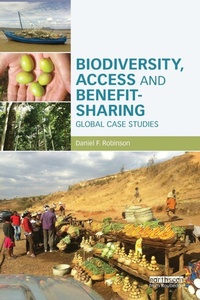
Biodiversity, Access and Benefit-Sharing
Global Case Studies
1st Edition
Published on 16. June 2017
Book
Paperback/Softback
228 pages
978-1-138-30452-9 (ISBN)
Description
The Nagoya Protocol to the Convention on Biological Diversity (CBD) is rapidly receiving signatures and ratifications. Many countries are preparing to implement the protocol through national research permit systems and/or biodiversity laws. Yet there is still considerable confusion about how to implement the Protocol, regarding access and benefit-sharing (ABS) procedures, and minimal experience in many countries. This book seeks to remedy this gap in understanding by analysing a number of ABS case studies in light of the Nagoya Protocol.
The case studies are wide-ranging, with examples of plants for medicinal, cosmetic, biotech and food products from or for development in Australia, North Africa, Madagascar, Switzerland, Thailand, USA and Oceania. These will encourage countries to develop national systems which maximise their benefits (both monetary and non-monetary) towards conservation and support for local communities that hold traditional knowledge. In addition, the author analyses new expectations raised by the Nagoya Protocol, such as the encouragement of the development of community protocols by indigenous and local communities. As a result, stakeholders and policy-makers will be able to learn the steps involved in establishing ABS agreements, issues that arise between stakeholders, and the types of benefits that might be realistic.
The case studies are wide-ranging, with examples of plants for medicinal, cosmetic, biotech and food products from or for development in Australia, North Africa, Madagascar, Switzerland, Thailand, USA and Oceania. These will encourage countries to develop national systems which maximise their benefits (both monetary and non-monetary) towards conservation and support for local communities that hold traditional knowledge. In addition, the author analyses new expectations raised by the Nagoya Protocol, such as the encouragement of the development of community protocols by indigenous and local communities. As a result, stakeholders and policy-makers will be able to learn the steps involved in establishing ABS agreements, issues that arise between stakeholders, and the types of benefits that might be realistic.
Reviews / Votes
"Robinson's meticulous analysis is a valuable contribution to discussion on how to achieve fairness in both bioprospecting projects and genetic resource access regulation, and whether such an aspiration is even possible. The numerous case studies are fascinating and the analysis is unfailingly authoritative, making the book essential reading for scholars and policymakers." - Graham Dutfield, Professor of International Governance, University of Leeds, UK"Overall, this is a useful reference book and a reminder that biodiversity is much, much more than a carbon sink." - Royal Society of Biology, Dr. A M Mannion
"In this book, Robinson masterfully combines his vast experience in human geography and environmental law with his meticulous and extensive research methods to present a set of important case studies and discussions for further reflection and pragmatic thinking on core issues relating to the implementation of the ABS regime...In all, Robinson's research is deep and expansive." - Intellectual Property Journal, Oluwatobiloba Moody, Center for International Governance Innovation
More details
Language
English
Place of publication
London
United Kingdom
Publishing group
Taylor & Francis Ltd
Target group
College/higher education
Postgraduate and Undergraduate
Illustrations
25 s/w Abbildungen, 19 s/w Photographien bzw. Rasterbilder, 6 s/w Tabellen
6 Tables, black and white; 19 Halftones, black and white; 25 Illustrations, black and white
Dimensions
Height: 234 mm
Width: 156 mm
Thickness: 13 mm
Weight
357 gr
ISBN-13
978-1-138-30452-9 (9781138304529)
Copyright in bibliographic data and cover images is held by Nielsen Book Services Limited or by the publishers or by their respective licensors: all rights reserved.
Schweitzer Classification
Other editions
Additional editions
E-Book
11/2014
1st Edition
Routledge
€67.49
Available for download
E-Book
11/2014
1st Edition
Routledge
€67.49
Available for download
Book
11/2014
1st Edition
Routledge
€233.10
Shipment within 15-20 days
Person
Daniel F. Robinson is Senior Lecturer at the Institute of Environmental Studies, University of New South Wales, Australia, and Visiting Research Fellow, International Centre for Trade and Sustainable Development (ICTSD), Geneva, Switzerland. He is author of Confronting Biopiracy (Earthscan, 2010).
Content
Part 1: Access and Benefit Sharing 1. Introduction, Context, Methods and Trends 2. The Nagoya Protocol Part 2: Biodiscovery Access and Benefit Sharing Case Studies 3. The ICBG Madagascar Project 4. ABS Agreements in Thailand 5. The Samoan Mamala Case 6. The Moroccan Argan Case 7. The Australian ABS System and Examples 8. The Santo 2006 Global Biodiversity Expedition, Vanuatu 9. The ICBG Papua New Guinea Project 10. The ICBG Panama Project Part 3: Overview, Discussions and Themes 11. Discussions and Themes 12. Conclusions