

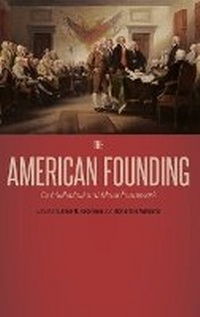
The American Founding
Its Intellectual and Moral Framework
Published on 28. June 2012
Book
Hardback
192 pages
978-1-4411-4070-8 (ISBN)
Description
America's Founding Fathers shared similar beliefs on the nature of civic life and the character of those supposed to be able to self-govern. Although they studied the failed republics of the ancient world, they believed that classical ideals were still applicable to politics. This unique contribution to the literature on American Founding gathers leading thinkers who set out not to relate its history, but its intellectual underpinnings. They explore the Founding Fathers' assumptions about civic life, human nature, political institutions, private morality, aesthetics, education, and history. Chapters on natural law, the Judeo-Christian conception of human nature, the influence of Aristotle and Cicero, the symbolic role of architecture, and the importance of education help understand the foundations that led to the Declaration of Independence and a constitutional charter that aimed to be universal in its human aspirations. This authoritative work provides a conservative response to more liberal interpretations of America. It will enrich the debate on civic life and be a key resource to anyone interested in America's "experiment in ordered liberty."
Reviews / Votes
"This is an impressive collection of essays by leading scholars investigating different aspects of the American Founding. The editors and contributors affirm the importance of engaging foundational themes and questions in studying the civic life of the United States. The book will be accessible to non-scholars and should stimulate further reading, reflection, and discussion." -David L. Tubbs, King's College, New York City "Professors Robinson and Williams have brought together an all-star group of scholars to tackle in the round a vexing question for anyone who cares about America's democracy: how are we to revive the founders' defining belief that our political regime depends upon the presence of a virtuous citizenry. Sometime in the last fifty or so years too many Americans -- especially those in government and in the universities -- forgot what the founders knew must always be kept in mind. This volume is an especially timely and valuable primer on how we might recover our tradition." -Gerard V. Bradley, Professor of Law, University of Notre DameMore details
Language
English
Place of publication
New York
United States
Target group
College/higher education
ISBN-13
978-1-4411-4070-8 (9781441140708)
Copyright in bibliographic data and cover images is held by Nielsen Book Services Limited or by the publishers or by their respective licensors: all rights reserved.
Schweitzer Classification
Other editions
Additional editions
E-Book
06/2012
1st Edition
Bloomsbury Continuum
€33.49
Available for download
Persons
Richard N. Williams is Associate Academic Vice President and Wheatley Institution Director at Brigham Young University, USA. He has been a visiting faculty member at Duquesne University and at Georgetown University, USA and is the author of numerous books and journal articles. Daniel N. Robinson is Professor of Philosophy at the University of Oxford, UK, and Distinguished Professor Emeritus at Georgetown University, USA.
Content
1. Natural Law, God and Dignity; Robert George; 2. The Jewish and Christian Principles of the Founders; Michael Novak; 3. The Classical Roots of the American Founding; Carl Richard; 4. The Universal Principles of the American Founding; Thomas G. West; 5. City as Teacher; Carroll William Westfall; 6. The Founders' Conception of Education for Civic Life; Daniel N. Robinson; 7. Constitutionalism and Its Presuppositions; Hadley Arkes.