

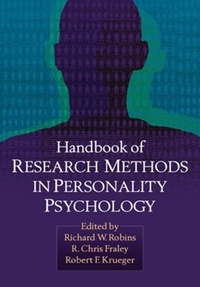
Handbook of Research Methods in Personality Psychology
1st Edition
Published on 21. June 2007
Book
Hardback
721 pages
978-1-59385-111-8 (ISBN)
Description
Bringing together leading investigators, this comprehensive handbook is a one-stop reference for anyone planning or conducting research on personality. It provides up-to-date analyses of the rich array of methodological tools available today, giving particular attention to real-world theoretical and logistical challenges and how to overcome them. In chapters filled with detailed, practical examples, readers are shown step by step how to formulate a suitable research design, select and use high-quality measures, and manage the complexities of data analysis and interpretation. Coverage ranges from classic methods like self-report inventories and observational procedures to such recent innovations as neuroimaging and genetic analyses.
Reviews / Votes
"Edited and written by experienced, distinguished scholars, this handbook encompasses the remarkable breadth of research venues, assessment methods, and data-analytic approaches embraced by modern personality psychology. The quality and accessibility of the contents make this volume an indispensable guide for undergraduate and graduate students who are serious about personality science. It will surely become a standard reference for all personologists."--Auke Tellegen, PhD, Department of Psychology (Emeritus), University of Minnesota"There is nothing more essential to good science than good methods, and personality research is no exception to this fundamental rule. This handbook is a landmark collection of defining statements on the diverse methods available to researchers in the field. It is a 'must read' for experienced and novice researchers alike, and will surely advance the state of the scientific study of personality."--Mark Snyder, PhD, Department of Psychology, University of Minnesota
"This is a 'must-have,' 'must-read' handbook for personality researchers at all levels of the game. The outstanding, award-winning editors have produced a superb textbook and reference for graduate and undergraduate students just entering the field and hoping to conduct their own research. The book is essential for seasoned personality researchers too, because it covers exciting new methods that didn't exist when we veterans were trained. Beyond its great value for anyone wishing to understand, critique, or conduct modern personality research, the Handbook is emblematic of a research field that is experiencing a dramatic upswing in self-confidence and influence. The sophistication, scope, and engaging prose style of this volume reflect the vitality of the field itself."--Phillip R. Shaver, PhD, Distinguished Professor Emeritus of Psychology, University of California, Davis
- Impressive, both in scope and quality. Sixty-nine authors, many of whom represent the widely acknowledged authority or are the pioneering authors on their topics, contributed to this collection of 37 chapters....The editors of this handbook set out to assemble a comprehensive resource and the depth and breadth of coverage, including even the most esoteric and recently adopted methods, is impressive. The fact that no model for a comprehensive personality research methods resource existed before this handbook makes the accomplishment even more impressive still. The editors should also be commended for their care in assigning and structuring largely mutually exclusive chapter topics, and avoiding significant redundancy....This is a text written by scholars for a scholarly audience of personality, social, and clinical psychologists, and thus it is a resource that will prove useful to researchers at the front lines, first and foremost, but the Handbook would also be an effective text for a specialized graduate seminar....The efforts of the editors and authors are to be applauded for providing a significant contribution to psychological science. The volume will find a place on the shelves and desks of many personality researchers for years to come. --Journal of Social and Clinical Psychology, 12/11/2009?? Provides very thoughtful explorations and descriptions of three sets of topics that by and large represent a coherent system of research in personality psychology: design, measurement, and analysis. Although these topics are discussed in the context of personality research, I was immediately impressed by the book's applicability to research in other fields of the social sciences, including education....What I like about the book is that each chapter is concise and right to the point; since many different areas of design and measurement are covered, it provides an excellent reference for researchers. From this perspective, the book is a worthwhile possession for researchers wanting an up-to-date survey of relevant measurement methods as they apply to personality research as well as research in other fields. Researchers lacking statistical background could benefit from the conceptual discussions and the guides to some thorny issues such as sample size requirement....Researchers who are savvy with statistics could also benefit from discovering the latest advances described within the personality psychology context....Researchers who are interested in issues in designing research, measuring behaviors, and analyzing data can benefit from conceptual, as well as pragmatic, considerations offered in the book, whether for personality research or for research in other fields. --PsycCRITIQUES, 12/11/2009?? This is an exceptional addition to the field. Researchers and students will find answers to almost any personality research question, whether it involves methodology, measurement techniques, or statistical analyses. The suggestions are immensely useful and, if followed, can clearly lead to well designed studies for both personality researchers and researchers in related fields. Weighted Numerical Score: 96 - 4 Stars! --Doody's Review Service, 12/11/2009
More details
Language
English
Place of publication
New York
United States
Target group
College/higher education
Professional and scholarly
Dimensions
Height: 246 mm
Width: 174 mm
Weight
1434 gr
ISBN-13
978-1-59385-111-8 (9781593851118)
Copyright in bibliographic data and cover images is held by Nielsen Book Services Limited or by the publishers or by their respective licensors: all rights reserved.
Schweitzer Classification
Other editions
Additional editions
Richard W. Robins | R. Chris Fraley | Robert F. Krueger
Handbook of Research Methods in Personality Psychology
Book
07/2010
1st Edition
Guilford Publications
€74.00
Article not available at the moment
Persons
Edited by Richard W. Robins, PhD, University of California, USA Davis; R. Chris Fraley, PhD, University of Illinois at Urbana-Champaign, USA; and Robert F. Krueger, PhD, University of Minnesota, USA
Content
Part 1. Designing a Personality Study. D.P. McAdams, J.L. Pals, The Role of Theory in Personality Assessment. M.B. Donnellan, R.D. Conger, Designing and Implementing Longitudinal Studies. W. Revelle, Experimental Approaches to the Study of Personality. R.F. Krueger, J.L. Tackett, Behavior Genetic Designs. T.S. Conner, L.Feldman Barrett, M.M. Tugade, H. Tennen, Idiographic Personality: The Theory and Practice of Experience Sampling. A.C. Elms, Psychobiography and Case Study Methods. P. Cramer, Mining Archival Data. R.C. Fraley, Using the Internet for Personality Research: What Can Be Done, How to Do It, and Some Concerns. R.C. Fraley, M.J. Marks, The Null Hypothesis Significance-Testing Debate and Its Implications for Personality Research. V. Benet-Martinez, Cross-Cultural Personality Research: Conceptual and Methodological Issues. S. Vazire, S.D. Gosling, A.S. Dickey, S.J. Shapiro, Measuring Personality in Nonhuman Animals. Part 2. Methods for Assessing Personality at Different Levels of Analysis. K.H. Craik, Taxonomies, Trends, and Integration. D.L. Paulhus, S. Vazire, The Self-Report Method. L.J. Simms, D. Watson, The Construct Validation Approach to Personality Scale Construction. R.R. McCrae, A. Weiss, Observer Ratings of Personality. R.M. Furr, D.C. Funder, Behavior Observation. B.A. Woike, Content Coding of Open-Ended Responses. A.V. Song, D.K. Simonton, Personality Assessment at a Distance. O.C. Schultheiss, J.S. Pang, Measuring Implicit Motives. M.D. Robinson, Lives Lived in Milliseconds: Using Cognitive Methods in Personality Research. J.S. Beer, M.V. Lombardo, Patient and Neuroimaging Methodologies. L.M. Diamond, K. Otter-Henderson, Physiological Measures. R.P. Ebstein, R. Bachner-Melman, S. Israel, L. Nemanov, I. Gritsenko, The Human Genome Project and Personality: What We Can Learn about Our Inner and Outer Selves through Our Genes. Part 3. Analyzing and Interpreting Personality Data. J. Morizot, A.T. Ainsworth, S.P. Reise, Toward Modern Psychometrics: Application of Item Response Theory Models in Personality Research. K. Lee, M.C. Ashton, Factor Analysis in Personality Research. R.H. Hoyle, Applications of Structural Equation Modeling in Personality Research. O.P. John, C.J. Soto, The Importance of Being Valid: Reliability and the Process of Construct Validation. D.J. Ozer, Evaluating Effect Size in Personality Research. J.B. Nezlek, Multilevel Modeling in Personality Research. W. Fleeson, Studying Personality Processes: Explaining Change in Between-Person Longitudinal and Within-Person Multilevel Models. D.K. Mroczek, The Analysis of Longitudinal Data in Personality Research. J.W. Grice, Person-Centered Structural Analyses. S.G. West, L.S. Aiken, W. Wu, A.B. Taylor, Multiple Regression: Applications of the Basics and Beyond in Personality Research. W.F. Chaplin, Moderator and Mediator Models in Personality Research: A Basic Introduction. Y. Shoda, Computational Modeling of Personality as a Dynamical System. B.W. Roberts, N.R. Kuncel, W. Viechtbauer, T. Bogg, Meta-Analysis in Personality Psychology: A Primer. R.W. Robins, J.L. Tracy, J.W. Sherman, What Makes a Personality Psychologist? A Survey of Journal Editors and Editorial Board Members.