

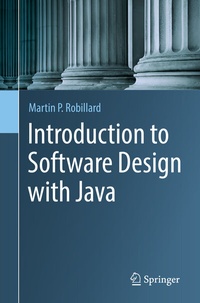
Introduction to Software Design with Java
Published on 17. July 2019
Book
Paperback/Softback
XII, 297 pages
978-3-030-24093-6 (ISBN)
Description
This textbook provides an in-depth introduction to software design, with a focus on object-oriented design, and using the Java programming language. Its goal is to help readers learn software design by discovering the experience of the design process. To this end, a narrative is used that introduces each element of design know-how in context, and explores alternative solutions in that context. The narrative is supported by hundreds of code fragments and design diagrams.
The first chapter is a general introduction to software design. The subsequent chapters cover design concepts and techniques, which are presented as a continuous narrative anchored in specific design problems. The design concepts and techniques covered include effective use of types and interfaces, encapsulation, composition, inheritance, design patterns, unit testing, and many more. A major emphasis is placed on coding and experimentation as a necessary complement to reading the text. To support this aspect of the learning process, a companion website with practice problems is provided, and three sample applications that capture numerous design decisions are included. Guidance on these sample applications is provided in a section called "Code Exploration" at the end of each chapter. Although the Java language is used as a means of conveying design-related ideas, the book's main goal is to address concepts and techniques that are applicable in a host of technologies.
This book is intended for readers who have a minimum of programming experience and want to move from writing small programs and scripts to tackling the development of larger systems. This audience naturally includes students in university-level computer science and software engineering programs. As the prerequisites to specific computing concepts are kept to a minimum, the content is also accessible to programmers without a primary training in computing. In a similar vein, understanding the code fragments requires only a minimal grasp of the language, such as would be taught in an introductory programming course.
The first chapter is a general introduction to software design. The subsequent chapters cover design concepts and techniques, which are presented as a continuous narrative anchored in specific design problems. The design concepts and techniques covered include effective use of types and interfaces, encapsulation, composition, inheritance, design patterns, unit testing, and many more. A major emphasis is placed on coding and experimentation as a necessary complement to reading the text. To support this aspect of the learning process, a companion website with practice problems is provided, and three sample applications that capture numerous design decisions are included. Guidance on these sample applications is provided in a section called "Code Exploration" at the end of each chapter. Although the Java language is used as a means of conveying design-related ideas, the book's main goal is to address concepts and techniques that are applicable in a host of technologies.
This book is intended for readers who have a minimum of programming experience and want to move from writing small programs and scripts to tackling the development of larger systems. This audience naturally includes students in university-level computer science and software engineering programs. As the prerequisites to specific computing concepts are kept to a minimum, the content is also accessible to programmers without a primary training in computing. In a similar vein, understanding the code fragments requires only a minimal grasp of the language, such as would be taught in an introductory programming course.
More details
Edition
1st ed. 2019
Language
English
Place of publication
Cham
Switzerland
Publishing group
Springer International Publishing
Target group
Professional and scholarly
Illustrations
100
100 s/w Abbildungen
XII, 297 p. 100 illus.
Dimensions
Height: 23.5 cm
Width: 15.5 cm
Weight
480 gr
ISBN-13
978-3-030-24093-6 (9783030240936)
DOI
10.1007/978-3-030-24094-3
Schweitzer Classification
Other editions
New editions
Martin P. Robillard
Introduction to Software Design with Java
Book
01/2026
3rd Edition
Springer
€58.84
Shipment within 15-20 days
Martin P. Robillard
Introduction to Software Design with Java
Book
05/2022
2nd Edition
Springer
€48.14
Article exhausted; check for reprint
Additional editions
Martin P. Robillard
Introduction to Software Design with Java
E-Book
07/2019
1st Edition
Springer
€53.49
Available for download
Person
Martin Robillard is a Professor of Computer Science at McGill University. He has been teaching software design with Java since 2005, and has over two decades of programming experience in Java. His current research focuses on problems related to software evolution, architecture and design, and software reuse. Martin served as the Program Co-Chair for the 20th ACM SIGSOFT International Symposium on the Foundations of Software Engineering (FSE 2012) and the 39th ACM/IEEE International Conference on Software Engineering (ICSE 2017).
Content
Introduction.- Encapsulation.- Types and Interfaces.- Object State.- Unit Testing.- Composition.- Inheritance.- Inversion of Control.- Functional Design.