

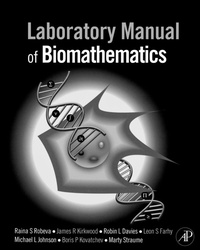
Laboratory Manual of Biomathematics
Published on 5. October 2007
Book
Paperback/Softback
192 pages
978-0-12-374022-9 (ISBN)
Description
Laboratory Manual of Biomathematics is a companion to the textbook An Invitation to Biomathematics. This laboratory manual expertly aids students who wish to gain a deeper understanding of solving biological issues with computer programs.
It provides hands-on exploration of model development, model validation, and model refinement, enabling students to truly experience advancements made in biology by mathematical models. Each of the projects offered can be used as individual module in traditional biology or mathematics courses such as calculus, ordinary differential equations, elementary probability, statistics, and genetics. Biological topics include: Ecology, Toxicology, Microbiology, Epidemiology, Genetics, Biostatistics, Physiology, Cell Biology, and Molecular Biology .
Mathematical topics include Discrete and continuous dynamical systems, difference equations, differential equations, probability distributions, statistics, data transformation, risk function, statistics, approximate entropy, periodic components, and pulse-detection algorithms. It includes more than 120 exercises derived from ongoing research studies.
This text is designed for courses in mathematical biology, undergraduate biology majors, as well as general mathematics. The reader is not expected to have any extensive background in either math or biology.
It provides hands-on exploration of model development, model validation, and model refinement, enabling students to truly experience advancements made in biology by mathematical models. Each of the projects offered can be used as individual module in traditional biology or mathematics courses such as calculus, ordinary differential equations, elementary probability, statistics, and genetics. Biological topics include: Ecology, Toxicology, Microbiology, Epidemiology, Genetics, Biostatistics, Physiology, Cell Biology, and Molecular Biology .
Mathematical topics include Discrete and continuous dynamical systems, difference equations, differential equations, probability distributions, statistics, data transformation, risk function, statistics, approximate entropy, periodic components, and pulse-detection algorithms. It includes more than 120 exercises derived from ongoing research studies.
This text is designed for courses in mathematical biology, undergraduate biology majors, as well as general mathematics. The reader is not expected to have any extensive background in either math or biology.
More details
Language
English
Place of publication
San Diego
United States
Publishing group
Elsevier Science Publishing Co Inc
Target group
College/higher education
Courses in mathematical biology, undergraduate biology majors, as well as general mathematics. The reader is not expected to have any extensive background in either math or biology.
Product notice
Paperback (trade)
Illustrations
Illustrated
Dimensions
Height: 254 mm
Width: 203 mm
Thickness: 10 mm
Weight
386 gr
ISBN-13
978-0-12-374022-9 (9780123740229)
Copyright in bibliographic data and cover images is held by Nielsen Book Services Limited or by the publishers or by their respective licensors: all rights reserved.
Schweitzer Classification
Other editions
Additional editions
Raina Robeva | James R. Kirkwood
Laboratory Manual of Biomathematics
E-Book
08/2007
Academic Press
€21.95
Available for download
Persons
Raina Robeva was born in Sofia, Bulgaria. She holds a Ph.D. in Mathematics from the University of Virginia and is a Professor of Mathematics and a Karl E. Peace Fellow in Mathematics at Randolph-Macon College in the United States. Her current research is in the broad fields of mathematical and systems biology. In addition to editing this second edition, she has authored and edited several books, including A Bridge to Higher Mathematics (CRC Press, 2024), Algebraic and Combinatorial Computational Biology (Academic Press, 2019), and Algebraic and Discrete Mathematical Methods for Modern Biology (Academic Press, 2015). She has chaired the Advisory Board of the National Institute for Mathematical and Biological Synthesis (NIMBioS), led the Committee on Special Interest Groups of the Mathematical Association of America, and served for over a decade as the founding Editor-in-Chief of Frontiers in Systems Biology.
Content
Preface Laboratory 1 Exploring Berkeley Madonna in the Context of Single-Species Population DynamicsLaboratory 2 Logistic Models of Single-Species Population Dynamics, Equilibrium States, and Long-Term BehaviorLaboratory 3 Physiological Mechanisms of Drug Elimination from the Bloodstream and Optimal Drug Intake RegimensLaboratory 4 Epidemic ModelsLaboratory 5 Predator-Prey ModelsLaboratory 6 Selection in Genetics: The Effect of A Maladaptive or Lethal GeneLaboratory 7 Quantitative Genetics and StatisticsLaboratory 8 Blood Glucose Fluctuation Characteristics in Type I versus Type II Diabetes MellitusLaboratory 9 Using Heartbeat Characteristics and Patterns to Predict Sepsis in NeonatesLaboratory 10 Hormone Pulsatility in Reproductive EndocrinologyLaboratory 11 Endocrine Oscillators: Modeling and Analysis of the Growth Hormone NetworkLaboratory 12 Chemical Perturbation on the Operations of Circadian Clocks