

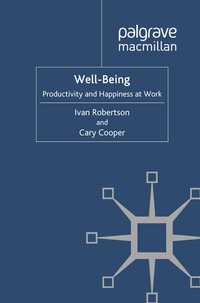
Well-being
Productivity and Happiness at Work
Published on 27. April 2011
Book
Paperback/Softback
XV, 224 pages
978-1-349-32103-2 (ISBN)
Description
High levels of well-being at work is good for the employee and the organization. It means lower sickness-absence levels, better retention and more satisfied customers. People with higher levels of well-being live longer, have happier lives and are easier to work with. This book shows how to improve well-being in your organization.
Reviews / Votes
"Robertson and Cooper's work is a book which fills a gap. . The book tells us about the new findings and knowledge about this topic in a clear, transparent, plain style, but at the same time with scientific standards. . It is a systematic and elaborated work on the topic of workplace PWB. This book could also be a starting point for many researches in this field." (Kinga Bakos, European Journal of Mental Health, Vol. 12, 2017)
More details
Edition
1st ed. 2011
Language
English
Place of publication
London
United Kingdom
Target group
Professional and scholarly
Illustrations
XV, 224 p.
Dimensions
Height: 235 mm
Width: 155 mm
Thickness: 14 mm
Weight
376 gr
ISBN-13
978-1-349-32103-2 (9781349321032)
DOI
10.1057/9780230306738
Schweitzer Classification
Other editions
Additional editions
Book
04/2011
Palgrave Macmillan
€42.79
Article exhausted; check for reprint
Persons
PROFESSOR IVAN ROBERTSON BSc, PhD, FBPsS, FBAM is a Chartered Psychologist, Fellow of the British Psychological Society and Fellow of the British Academy of Management. He holds a chair in Work and Organisational Psychology at Leeds University Business School and is Emeritus Professor at the University of Manchester. He is also Managing Director of Robertson Cooper Ltd - a University of Manchester spin-off business dedicated to improving well-being, performance and leadership. He remains an active researcher and during his career has been responsible for over thirty books on Work & Organizational Psychology and over 150 scholarly articles/conference papers. He is currently a member of Dame Carol Black's Occupational Health Sounding Board and of the Expert Reference Group for the NICE Public Health Advisory Committee work on mental health at work. Ivan's earlier experience included several years in industry and national government working as a psychologist. He has held visiting posts in the USA (Michigan State University, Singapore (National University of Singapore) and Australia (Queensland University of Technology)
SIR CARY COOPER is Professor of Organizational Psychology and Health, Lancaster University Management School and Pro Vice Chancellor (External Relations) at Lancaster University, UK. He is the author of over 100 books (on occupational stress, women at work and industrial and organizational psychology), has written over 400 scholarly articles, and is a frequent contributor to national newspapers, TV and radio. He is a Fellow of the British Academy of Management and also of the Academy of Management (having also won the 1998 Distinguished Service Award). In 2001 he was awarded a CBE in the Queen's Birthday Honours List for his contribution to organizational health. He is Chair of The Sunningdale Institute, a think tank on management/organizational issues, in the National School of Government. He was also the lead scientist to the UK Government Office for Science on their Foresight programme on Mental Capital and Well Being (2007-2008), and was appointed a member of the expert group on establishing guidance for the National Institute for Health and Clinical Excellence on 'promoting mental wellbeing through productive and healthy working conditions', 2009. He is Chair of the UK's Academy of Social Sciences. Professor Cooper is also the President of the Institute of Welfare, President of the British Association of Counselling and Psychotherapy, a national Ambassador of The Samaritans, a Patron of the Anxiety UK, and Patron of the National Bullying Helpline. HR Magazine named him the 6th Most Influential Thinker in HR in 2009.
SIR CARY COOPER is Professor of Organizational Psychology and Health, Lancaster University Management School and Pro Vice Chancellor (External Relations) at Lancaster University, UK. He is the author of over 100 books (on occupational stress, women at work and industrial and organizational psychology), has written over 400 scholarly articles, and is a frequent contributor to national newspapers, TV and radio. He is a Fellow of the British Academy of Management and also of the Academy of Management (having also won the 1998 Distinguished Service Award). In 2001 he was awarded a CBE in the Queen's Birthday Honours List for his contribution to organizational health. He is Chair of The Sunningdale Institute, a think tank on management/organizational issues, in the National School of Government. He was also the lead scientist to the UK Government Office for Science on their Foresight programme on Mental Capital and Well Being (2007-2008), and was appointed a member of the expert group on establishing guidance for the National Institute for Health and Clinical Excellence on 'promoting mental wellbeing through productive and healthy working conditions', 2009. He is Chair of the UK's Academy of Social Sciences. Professor Cooper is also the President of the Institute of Welfare, President of the British Association of Counselling and Psychotherapy, a national Ambassador of The Samaritans, a Patron of the Anxiety UK, and Patron of the National Bullying Helpline. HR Magazine named him the 6th Most Influential Thinker in HR in 2009.
Content
PART I: WHY DOES WELL-BEING MATTER? For Individuals For Organisations Well-Being And Employee Engagement PART II: WHAT IS WELL-BEING? Psychological Well-Being Measuring Well-Being PART III: WHAT INFLUENCES WELL-BEING? The Whole Person And Psychological Well-Being Work And Well-Being PART IV: GETTING THE BENEFIT Improving Well-Being - Building Personal Resilience Improving Well-Being - Building A Healthy Workplace PART V: CASE STUDIES