

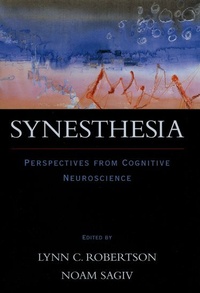
Synesthesia
Perspectives from Cognitive Neuroscience
Published on 11. November 2004
Book
Hardback
304 pages
978-0-19-516623-1 (ISBN)
Description
Owing to its bizarre nature and its implications for understanding how brains work, synesthesia has recently received a lot of attention in the popular press and motivated a great deal of research and discussion among scientists. The questions generated by these two communities are intriguing: Does the synesthetic phenomenon require awareness and attention? How does a feature that is not present become bound to one that is? Does synesthesia develop or is it hard wired? Should it change our way of thinking about perceptual experience in general? What is its value in understanding perceptual systems as a whole?
This volume brings together a distinguished group of investigators from diverse backgrounds--among them neuroscientists, novelists, and synesthetes themselves--who provide fascinating answers to these questions. Although each approaches synesthesia from a very different perspective, and each was curious about and investigated synesthesia for very different reasons, the similarities between their work cannot be ignored. The research presented in this volume demonstrates that it is no longer reasonable to ask whether or not synesthesia is real--we must now ask how we can account for it from cognitive, neurobiological, developmental, and evolutionary perspectives. This book will be important reading for any scientist interested in brain and mind, not to mention synesthetes themselves, and others who might be wondering what all the fuss is about.
This volume brings together a distinguished group of investigators from diverse backgrounds--among them neuroscientists, novelists, and synesthetes themselves--who provide fascinating answers to these questions. Although each approaches synesthesia from a very different perspective, and each was curious about and investigated synesthesia for very different reasons, the similarities between their work cannot be ignored. The research presented in this volume demonstrates that it is no longer reasonable to ask whether or not synesthesia is real--we must now ask how we can account for it from cognitive, neurobiological, developmental, and evolutionary perspectives. This book will be important reading for any scientist interested in brain and mind, not to mention synesthetes themselves, and others who might be wondering what all the fuss is about.
Reviews / Votes
Overall, this work provides a broad cross-section of interest for synaesthesia researchers, and does so in a readable and comprehensive way. The division into subsections makes the relationship between each paper more explicit, and the detailed index is particularly useful. I recommend this book to researchers and students, in philosophy, psychology, or neuroscience, and it is a must-read for those wishing to get acquainted with this unusual and fascinating phenomenon. * Perception, Vol 34 *More details
Language
English
Place of publication
New York
United States
Target group
Professional and scholarly
Developmental, biological and cognitive psychologists, neuroscientists, cognitive scientists, and vision scientists, synesthetes
Illustrations
16pp colour plates, numerous line drawings
Dimensions
Height: 160 mm
Width: 234 mm
Thickness: 20 mm
Weight
578 gr
ISBN-13
978-0-19-516623-1 (9780195166231)
Copyright in bibliographic data and cover images is held by Nielsen Book Services Limited or by the publishers or by their respective licensors: all rights reserved.
Schweitzer Classification
Other editions
Additional editions
E-Book
10/2004
1st Edition
OUP eBook
€60.49
Available for download
Lynn C. Robertson | Noam Sagiv
Synesthesia: Perspectives from Cognitive Neuroscience
E-Book
09/2004
1st Edition
Oxford University Press
€54.59
Available for download
Persons
Lynn Robertson has been studying abnormal perception and attention for over 20 years. Her early experiments in visual spatial deficits and hemispheric asymmetries are now classic, and she was one of the first wave of experimentally trained psychologists to integrate cognitive psychology with human neuropsychology, creating the field that has become known as cognitive neuroscience. Her recent work incorporates the study of unusual developmental
visual phenomena, such as those found in synesthesia.
Noam Sagiv received his Ph.D. from UC Berkeley in cognitive psychology after studying physics, chemistry, and neurobiology at the Hebrew University of Jerusalem. He is now a research fellow at University College London. He studies visual perception in normal subjects, neurological patients and special populations using behavioral, electrophysiological, and neuroimaging methods. He is particularly interested in positive phenomena such as synesthesia, metamorphopsia, and
hallucinations.
visual phenomena, such as those found in synesthesia.
Noam Sagiv received his Ph.D. from UC Berkeley in cognitive psychology after studying physics, chemistry, and neurobiology at the Hebrew University of Jerusalem. He is now a research fellow at University College London. He studies visual perception in normal subjects, neurological patients and special populations using behavioral, electrophysiological, and neuroimaging methods. He is particularly interested in positive phenomena such as synesthesia, metamorphopsia, and
hallucinations.
Content
PART 1: GENERAL OVERVIEW; PART 2: PERCEPTION AND ATTENTION; PART 3: CONSCIOUSNESS AND COGNITION; PART 4: DEVELOPMENT AND LEARNING; PART 5: COMMENTARY