

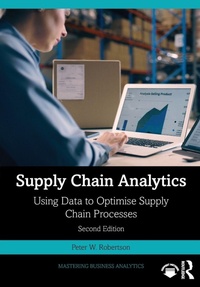
Supply Chain Analytics
Using Data to Optimise Supply Chain Processes
2nd Edition
Published on 3. September 2025
Book
Paperback/Softback
330 pages
978-1-032-76130-5 (ISBN)
Description
Supply Chain Analytics, second edition, introduces the reader to data analytics and demonstrates the value of its effective use in the improvement of supply chain (SC) process performance. By describing four key SC processes and illustrating - through worked examples - how the descriptive, predictive, and prescriptive analytic methods can be applied to enhance those processes, this book presents a more comprehensive learning experience for the reader than has been offered previously.
Key topics and issues are addressed, including the capriciousness of modern SC operating environments; the imperative of SC sustainability; the need for heightened SC risk management; the building of SC resilience; the pursuit of SC optimisation; and the use of big data, data mining, cloud computing, machine learning, artificial intelligence (AI), and importantly the social issues confronting SC analysts in carrying out their work.
The author identifies four core SC processes - strategy, design, execution, and people - to which the analytic techniques explained can be applied to ensure continuous performance improvement and the growth of competitive advantage.
Pedagogy to aid learning is incorporated throughout, including an opening section for each chapter explaining the intended learning outcomes; worked examples illustrating how each analytic technique works, how it is applied, and what to be careful of; tables, diagrams, and equations to help 'visualise' the concepts and methods covered; end-of-chapter case studies; review questions; and assignment tasks.
Providing both management expertise and technical skills, which are essential to decision-makers in the SC, this textbook is an essential reading for advanced undergraduate and postgraduate students of SC analytics, SC leaders, and SC operations management professionals. Its practice-based and applied approach also makes it valuable for teaching academics, organisational trainers and coaches, operating SC practitioners, and those pursuing professional qualifications.
Online resources include chapter-by-chapter PowerPoint slides, tutorial exercises, written assignments, worked examples using Excel, and a test bank of exam questions.
Key topics and issues are addressed, including the capriciousness of modern SC operating environments; the imperative of SC sustainability; the need for heightened SC risk management; the building of SC resilience; the pursuit of SC optimisation; and the use of big data, data mining, cloud computing, machine learning, artificial intelligence (AI), and importantly the social issues confronting SC analysts in carrying out their work.
The author identifies four core SC processes - strategy, design, execution, and people - to which the analytic techniques explained can be applied to ensure continuous performance improvement and the growth of competitive advantage.
Pedagogy to aid learning is incorporated throughout, including an opening section for each chapter explaining the intended learning outcomes; worked examples illustrating how each analytic technique works, how it is applied, and what to be careful of; tables, diagrams, and equations to help 'visualise' the concepts and methods covered; end-of-chapter case studies; review questions; and assignment tasks.
Providing both management expertise and technical skills, which are essential to decision-makers in the SC, this textbook is an essential reading for advanced undergraduate and postgraduate students of SC analytics, SC leaders, and SC operations management professionals. Its practice-based and applied approach also makes it valuable for teaching academics, organisational trainers and coaches, operating SC practitioners, and those pursuing professional qualifications.
Online resources include chapter-by-chapter PowerPoint slides, tutorial exercises, written assignments, worked examples using Excel, and a test bank of exam questions.
More details
Series
Edition
2nd edition
Language
English
Place of publication
London
United Kingdom
Publishing group
Taylor & Francis Ltd
Target group
College/higher education
Professional and scholarly
Postgraduate, Professional Reference, and Undergraduate Advanced
Illustrations
7 s/w Photographien bzw. Rasterbilder, 104 s/w Zeichnungen, 182 s/w Tabellen, 111 s/w Abbildungen
182 Tables, black and white; 104 Line drawings, black and white; 7 Halftones, black and white; 111 Illustrations, black and white
Dimensions
Height: 244 mm
Width: 170 mm
Thickness: 19 mm
Weight
608 gr
ISBN-13
978-1-032-76130-5 (9781032761305)
Copyright in bibliographic data and cover images is held by Nielsen Book Services Limited or by the publishers or by their respective licensors: all rights reserved.
Schweitzer Classification
Other editions
Additional editions
E-Book
09/2025
2nd Edition
Routledge
€61.99
Available for download
E-Book
09/2025
2nd Edition
Routledge
€61.99
Available for download
Book
09/2025
2nd Edition
Routledge
€208.40
Shipment within 10-20 days
Previous edition
Book
11/2020
1st Edition
Routledge
€58.50
Article exhausted; check for reprint
Person
Peter W. Robertson is an Honorary Research Fellow at the University of Wollongong (UOW), Australia.
Content
1. Introduction to Supply Chain Analytics 2. Supply Chain Analytics in Practice 3. Getting Started with SC Analytics 4. Using Supply Chain Analytics to Enhance Supply Chain Strategy Processes 5. Using Supply Chain Analytics to Enhance Supply Chain Design Processes 6. Using Supply Chain Analytics to Enhance Supply Chain Execution Processes 7. Using Supply Cchain Analytics to Enhance Supply Chain People Processes 8. How to Deal Effectively with Organisational Social Issues