

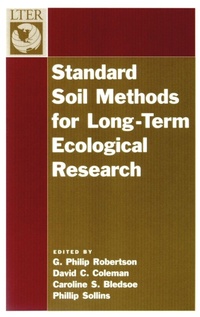
Standard Soil Methods for Long-Term Ecological Research
Published on 4. November 1999
Book
Hardback
480 pages
978-0-19-512083-7 (ISBN)
Description
Standardized methods and measurements are crucial for ecological research, particularly in long-term ecological studies where the projects are by nature collaborative and where it can be difficult to distinguish signs of environmental change from the effects of differing methodologies. This second volume in the Long-Term Ecological Research Network Series addresses these issues directly by providing a comprehensive standardized set of protocols for measuring soil properties. The goal of the volume is to facilitate cross-site synthesis and evaluation of ecosystem processes. Chapters cover methods for studying physical and chemical properties of soils, soil biological properties, and soil organisms, and they include work from many leaders in the field. The book is the first broadly based compendium of standardized soil measurement methods and will be an invaluable resource for ecologists, agronomists, and soil scientists.
Reviews / Votes
"Sure an old farmer can taste the dirt and tell whether to plant cotton or corn, but scientists working on studies that may stretch over decades and will probably include other people need some uniformity in how they take measurements and record the results. So in 1996 a group of scientists began developing a set of common protocols that could be used to characterize the physical, chemical, and biological properties of soil and soil organisms from disparatesites ranging from tundra permafrost to desert aridosols, and with the land use ranging from annual cropping systems to old-growth forest. Their report also includes protocols for soil sampling,
preparation, archiving, and quality control and for characterizing sites and landscapes for ecological studies."--SciTech Book News
"Sure an old farmer can taste the dirt and tell whether to plant cotton or corn, but scientists working on studies that may stretch over decades and will probably include other people need some uniformity in how they take measurements and record the results. So in 1996 a group of scientists began developing a set of common protocols that could be used to characterize the physical, chemical, and biological properties of soil and soil organisms from disparate
sites ranging from tundra permafrost to desert aridosols, and with the land use ranging from annual cropping systems to old-growth forest. Their report also includes protocols for soil sampling,
preparation, archiving, and quality control and for characterizing sites and landscapes for ecological studies."--SciTech Book News
More details
Series
Language
English
Place of publication
New York
United States
Target group
Professional and scholarly
Illustrations
8 halftones, 12 line figures
Dimensions
Height: 240 mm
Width: 161 mm
Thickness: 30 mm
Weight
886 gr
ISBN-13
978-0-19-512083-7 (9780195120837)
Copyright in bibliographic data and cover images is held by Nielsen Book Services Limited or by the publishers or by their respective licensors: all rights reserved.
Schweitzer Classification
Other editions
Additional editions
G. Philip Robertson | David C. Coleman | Caroline S. Bledsoe
Standard Soil Methods for Long-Term Ecological Research
E-Book
10/1999
1st Edition
OUP eBook
€82.99
Available for download
Persons
Editor
Kellog Biological StationKellog Biological Station, Michigan State University
Institute of EcologyInstitute of Ecology, University of Georgia
Department of Land, Air, and Water ResourcesDepartment of Land, Air, and Water Resources, University of California, Davis
Department of Forest ScienceDepartment of Forest Science, Oregon State University
Content
1. Soil Sampling, Preparation, Archiving, and Quality Control ; 2. Site and Landscape Characterization for Ecological Studies ; I. SOIL PHYSICAL PROPERTIES ; 3. Soil Water and Temperature Status ; 4. Soil Structural and Other Physical Properties ; II. SOIL CHEMICAL PROPERTIES ; 5. Soil Carbon and Nitrogen: Pools and Fractions ; 6. Exchangeable Ions, pH, and Cation Exchange Capacity ; 7. Soil Phosphorus: Characterization and Total Elemental Analysis ; 8. Analysis of Detritus and Organic Horizons for Mineral and Organic Constituents ; 9. Collection of Soil Solution ; III. SOIL BIOLOGICAL PROCESSES ; 10. Soil CO[2, N[2O, and CH[4 Exchange ; 11. Measuing Decomposition, Nutrient Turnover, and Stores in Plant Litter ; 12. Dinitrogen Fixation ; 13. Soil Carbon and Nitrogen Availability: Nitrogen Mineralization, Nitrification, and Soil Respiration Potentials ; 14. Denitrification ; IV. SOIL ORGANISMS ; 15. The Determination of Microbial Biomass ; 16. Characterizing Soil Microbial Communities ; 17. Soil Invertebrates ; 18. Methods for Ecological Studies of Mycorrhizae ; 19. Measurement of Static Root Parameters: Biomass, Length, and Distribution in the Soil Profile ; 20. Fine Root Production and Demography