

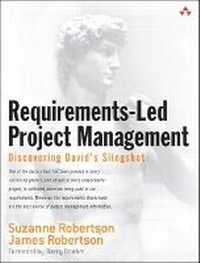
Requirements-Led Project Management
Discovering David's Slingshot
Published on 2. September 2004
Book
Hardback
352 pages
978-0-321-18062-9 (ISBN)
Description
Requirements are a crucial ingredient of any successful project. This is true for any product--software, hardware, consumer appliance, or large-scale construction. You have to understand its requirements--what is needed and desired--if you are to build the right product. Most developers recognize the truth in this statement, even if they don't always live up to it.
Far less obvious, however, is the contribution that the requirements activity makes to project management. Requirements, along with other outputs from the requirements activity, are potent project management tools.
In Requirements-Led Project Management, Suzanne and James Robertson show how to use requirements to manage the development lifecycle. They show program managers, product and project managers, team leaders, and business analysts specifically how to:
Use requirements as input to project planning and decision-making
Determine whether to invest in a project
Deliver more appropriate products with a quick cycle time
Measure and estimate the requirements effort
Define the most effective requirements process for a project
Manage stakeholder involvement and expectations
Set requirements priorities
Manage requirements across multiple domains and technologies
Use requirements to communicate across business and technological boundaries
In their previous book, Mastering the Requirements Process, the Robertsons defined Volere--their groundbreaking and now widely adopted requirements process. In this second book, they look at the outputs from the requirements process and demonstrate how you can take advantage of the all-important links between requirements and project success.
Far less obvious, however, is the contribution that the requirements activity makes to project management. Requirements, along with other outputs from the requirements activity, are potent project management tools.
In Requirements-Led Project Management, Suzanne and James Robertson show how to use requirements to manage the development lifecycle. They show program managers, product and project managers, team leaders, and business analysts specifically how to:
Use requirements as input to project planning and decision-making
Determine whether to invest in a project
Deliver more appropriate products with a quick cycle time
Measure and estimate the requirements effort
Define the most effective requirements process for a project
Manage stakeholder involvement and expectations
Set requirements priorities
Manage requirements across multiple domains and technologies
Use requirements to communicate across business and technological boundaries
In their previous book, Mastering the Requirements Process, the Robertsons defined Volere--their groundbreaking and now widely adopted requirements process. In this second book, they look at the outputs from the requirements process and demonstrate how you can take advantage of the all-important links between requirements and project success.
More details
Language
English
Place of publication
New Jersey
United States
Publishing group
Pearson Education (US)
Target group
Professional and scholarly
Dimensions
Height: 247 mm
Width: 199 mm
Thickness: 27 mm
Weight
948 gr
ISBN-13
978-0-321-18062-9 (9780321180629)
Copyright in bibliographic data and cover images is held by Nielsen Book Services Limited or by the publishers or by their respective licensors: all rights reserved.
Schweitzer Classification
Other editions
New editions
Suzanne Robertson | James C. Robertson
Requirements-Led Project Management
Discovering David's Slingshot (paperback)
Book
08/2009
Addison Wesley
€45.96
Shipment within 10-20 days
Persons
Suzanne Robertson and James Robertson have, over many years, helped hundreds of companies improve their requirements techniques and move into the fast lane of system development. Their courses and seminars on requirements, analysis, and design are widely praised for their innovative approach. The Robertsons are principals of the Atlantic Systems Guild, a well-known consultancy specializing in the human dimensions of complex system building. They are also the coauthors of Requirements-Led Project Management (Addison-Wesley, 2005).
James Robertson and Suzanne Robertson have, over many years, helped hundreds of companies improve their requirements techniques and move into the fast lane of system development. Their courses and seminars on requirements, analysis, and design are widely praised for their innovative approach. The Robertsons are principals of the Atlantic Systems Guild, a well-known consultancy specializing in the human dimensions of complex system building. They are also the coauthors of Requirements-Led Project Management (Addison-Wesley, 2005).
James Robertson and Suzanne Robertson have, over many years, helped hundreds of companies improve their requirements techniques and move into the fast lane of system development. Their courses and seminars on requirements, analysis, and design are widely praised for their innovative approach. The Robertsons are principals of the Atlantic Systems Guild, a well-known consultancy specializing in the human dimensions of complex system building. They are also the coauthors of Requirements-Led Project Management (Addison-Wesley, 2005).
Content
Foreword.
Overture.
Acknowledgments.
1. Requirements and Project Success.
2. Requirements Value.
3. Project Sociology.
4. Learning What People Need.
5. Inventing Requirements.
6. Requirements Simulations.
7. Requirements for Existing Systems.
8. Measuring Requirements.
9. Managing the Requirements.
10. Requirements Meta-Management.
11. Your Requirements Process.
Appendix A. Requirements Knowledge Model.
Appendix B. Volere Requirements Specification Template.
Glossary.
Bibliography.
Index.
Overture.
Acknowledgments.
1. Requirements and Project Success.
2. Requirements Value.
3. Project Sociology.
4. Learning What People Need.
5. Inventing Requirements.
6. Requirements Simulations.
7. Requirements for Existing Systems.
8. Measuring Requirements.
9. Managing the Requirements.
10. Requirements Meta-Management.
11. Your Requirements Process.
Appendix A. Requirements Knowledge Model.
Appendix B. Volere Requirements Specification Template.
Glossary.
Bibliography.
Index.