

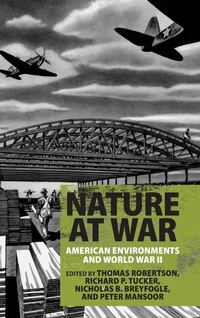
Nature at War
American Environments and World War II
Published on 2. April 2020
Book
Hardback
387 pages
978-1-108-41976-5 (ISBN)
Description
This anthology is the first sustained examination of American involvement in World War II through an environmental lens. World War II was a total and global war that involved the extraction, processing, and use of vast quantities of natural resources. The wartime military-industrial complex, the 'Arsenal of Democracy,' experienced tremendous economic growth and technological development, employing resources at a higher intensity than ever before. The war years witnessed transformations in American agriculture; the proliferation of militarized landscapes; the popularization of chemical and pharmaceutical products; a rapid increase in energy consumption and the development of nuclear energy; a remaking of the nation's transportation networks; a shift in population toward the Sunbelt and the West Coast; a vast expansion in the federal government, in conjunction with industrial firms; and the emergence of environmentalism. World War II represented a quantitative and qualitative leap in resource use, with lasting implications for American government, science, society, health, and ecology.
Reviews / Votes
'Featuring renowned scholars of military and environmental history, Nature at War shows how the mid-century clash between Allied and Axis forces revolutionized every aspect of American life - from the food we eat, to the smoke we breath, to the clothes we wear and the chemicals and drugs that pour through our veins. This impressive volume is long overdue and should be essential reading for anyone interested in the ecological history of the world's 'darkest hour'.' Bart Elmore, The Ohio State University 'Nature at War reveals how World War II was literally a War on the World. While claiming 60 million lives and devastating land, air, and water, WWII also transformed the US by promoting industrial agriculture, chemical pesticides, out-of-control military spending, rampant consumerism, nicotine addiction, and urban smog. A remarkable accounting.' Gar Smith, co-founder of Environmentalists Against War and author of Nuclear Roulette and The War and Environment Reader 'The necessity and even glory of World War II is unquestionable in US culture, and even in this book. Yet this book makes clear that the world could never survive another similar disaster, not only because of the nuclear danger, but also because of the environmental destruction created and unleashed by that war. In fact, the earth-attacking practices of extraction and consumption that grew out of WWII may yet doom us all if not undone and corrected.' David Swanson, author of War Is A Lie 'Nature at War offers the first book length analysis of the environmental developments during World War II in the United States, and raises questions of thunderous importance for the rest of the world as well.' Simo Laakkonen, University of Turku '... an important contribution to histories of World War II, the United States, and the environment.' Scott Kaufman, Journal Of Military History 'Nature at War is a fresh, engaging examination of how the American war effort resulted in an environmental transformation unique in scale and duration. ... This remarkable collection highlights the depth and breadth of the conflict in an environmental context and suggests new ways to think about the intersection of war and environment. ... The authors and editors should be commended for advancing our understanding of the cataclysm of World War II.' J. L. Anderson, Journal of American History 'Nature at War makes an important contribution to the already-rich historiography of World War II on the home front and pushes historians to rethink the ramifications of the war on US citizens' relationship to the natural world. Environmental historians, historians of US foreign relations, historians of twentieth-century US society and culture, and military historians all will find something of interest here. While the chapters in this book often deal with well-known moments in history ... the feat of this volume is reinterpreting these events from an environmental lens, allowing old stories to tell us, as historians, something new.' Christina LeBlanc, H-Net ReviewsMore details
Language
English
Place of publication
Cambridge
United Kingdom
Illustrations
Worked examples or Exercises; 10 Tables, black and white; 6 Maps; 20 Halftones, black and white; 4 Line drawings, black and white
Dimensions
Height: 235 mm
Width: 157 mm
Thickness: 28 mm
Weight
795 gr
ISBN-13
978-1-108-41976-5 (9781108419765)
Copyright in bibliographic data and cover images is held by Nielsen Book Services Limited or by the publishers or by their respective licensors: all rights reserved.
Schweitzer Classification
Other editions
Additional editions
Thomas Robertson | Richard P. Tucker | Nicholas B. Breyfogle
Nature at War
American Environments and World War II
Book
04/2020
Cambridge University Press
€40.50
Shipment within 15-20 days
E-Book
04/2020
Cambridge University Press
€24.49
Available for download
Thomas Robertson | Richard P. Tucker | Nicholas B. Breyfogle
Nature at War
American Environments and World War II
E-Book
03/2020
Cambridge University Press
€27.49
Available for download
Persons
Thomas Robertson is Executive Director of the United States Educational Foundation (USEF) Fulbright in Kathmandu, Nepal and the author of The Malthusian Moment: Global Population Growth and the Birth of American Environmentalism (2012). Richard P. Tucker is Adjunct Professor in the School for Environment and Sustainability at the University of Michigan. He is co-editor of four multi-author books on the environmental history of the two World Wars. His previous publications include Insatiable Appetite: The United States and the Ecological Degradation of the Tropical World (2000). Nicholas B. Breyfogle is Associate Professor of History at The Ohio State University. He is the author/editor of seven volumes, including Water History: Readings and Sources (2020) and Eurasian Environments: Nature and Ecology in Imperial Russian and Soviet History (2018). Peter Mansoor is the General Raymond E. Mason Jr. Chair of Military History at The Ohio State University. He is the author of three books and co-editor of three volumes, including the award-winning The GI Offensive in Europe: The Triumph of American Infantry Divisions, 1941-1945 (1999).
Content
Preface: American environments and the Second World War Peter Mansoor; Acknowledgments; Introduction: total war and American nature Thomas Robertson and Richard P. Tucker; Part I. New Weapons, New Spaces: 1. A war of mobility: transportation, American productive power, and the environment during World War II Thomas Robertson and Christopher W. Wells; 2. For land's sake: World War II military land acquisition and alteration Jean Mansavage; Part II. Military Materials I (Inorganic): 3. 'Tanks Are Born Underground': mining and World War II Kent Curtis; 4. Fueling the 'American Century': establishing the US petroleum imperative Brian Black; Part III. Military Materials II (Organic): 5. Soldiers of the soil: labor, nature, and American agriculture during World War II Kendra Smith-Howard; 6. When meals became weapons: American food in World War II Kellen Backer; 7. From field to foxhole: cigarettes and soldiers in World War II Joel R. Bius; Part IV. New Landscapes: Cities and Coasts: 8. A watery grave?: World War II and the environment on the American Gulf Coast Christopher M. Rein; 9. World War II and the urban environment: redirecting American politics in Los Angeles and beyond Sarah S. Elkind; Part V. New Frontiers: Microbes, Molecules, and Atoms: 10. Battling insects and infection: American chemical and pharmaceutical expansion during World War II Martha N. Gardner; 11. Shattered worlds: place, environment, and militarized landscapes at the dawn of atomic America Ryan H. Edgington; Part VI. Conservation: 12. Total war and the total environment: World War II and the shift from conservation to environmentalism Thomas Robertson; Index.