

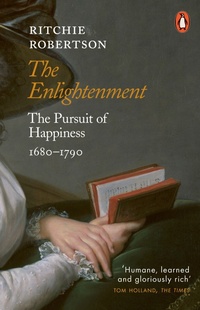
The Enlightenment
The Pursuit of Happiness 1680-1790
Published on 28. April 2022
Book
Paperback/Softback
1008 pages
978-0-14-197940-3 (ISBN)
Description
'The best single-volume study of the Enlightenment that we have' Literary Review
The Enlightenment is one of the formative periods of Western history, yet more than 300 years after it began, it remains controversial. It is often seen as the fountainhead of modern values such as human rights, religious toleration, freedom of thought, scientific thought as an exemplary form of reasoning, and rationality and evidence-based argument. Others accuse the Enlightenment of putting forward a scientific rationality which ignores the complexity and variety of human beings, propagates shallow atheism, and aims to subjugate nature to so-called technical progress.
Answering the question 'what is Enlightenment?' Kant famously urged men and women above all to 'have the courage to use your own understanding'. Robertson shows how the thinkers of the Enlightenment did just that, seeking a rounded understanding of humanity in which reason was balanced with emotion and sensibility. His book goes behind the controversies about the Enlightenment to return to its original texts and to show that above all it sought to increase human happiness in this world by promoting scientific inquiry and reasoned argument. His book overturns many received opinions - for example, that enlightenment necessarily implied hostility to religion (though it did challenge the authority traditionally assumed by the Churches). It is a master-class in 'big picture' history, about one of the foundational epochs of modern times.
The Enlightenment is one of the formative periods of Western history, yet more than 300 years after it began, it remains controversial. It is often seen as the fountainhead of modern values such as human rights, religious toleration, freedom of thought, scientific thought as an exemplary form of reasoning, and rationality and evidence-based argument. Others accuse the Enlightenment of putting forward a scientific rationality which ignores the complexity and variety of human beings, propagates shallow atheism, and aims to subjugate nature to so-called technical progress.
Answering the question 'what is Enlightenment?' Kant famously urged men and women above all to 'have the courage to use your own understanding'. Robertson shows how the thinkers of the Enlightenment did just that, seeking a rounded understanding of humanity in which reason was balanced with emotion and sensibility. His book goes behind the controversies about the Enlightenment to return to its original texts and to show that above all it sought to increase human happiness in this world by promoting scientific inquiry and reasoned argument. His book overturns many received opinions - for example, that enlightenment necessarily implied hostility to religion (though it did challenge the authority traditionally assumed by the Churches). It is a master-class in 'big picture' history, about one of the foundational epochs of modern times.
Reviews / Votes
cogently expressed and scrupulously documented ... The Enlightenment, he believes, has an urgent message for our time -- Keith Thomas * London Review of Books * the book is written out of genuine curiosity and palpable enthusiasm. Robertson's range allows him to make many illuminating comparisons and some provocative juxtapositions ... This is surely the best and most up to date single-volume study of the Enlightenment that we currently possess. It will inform the general reader while also often provoking, delighting and surprising the specialist. -- David Womersley * Standpoint * The Enlightenment by Ritchie Robertson is a fine examination of how the enlightenment changed the world in different ways in different places - scintillating. -- Simon Sebag Montefiore * Aspects of History Books of the Year * a work that is at once readable, authoritative and wide-ranging ... a handsome single volume, complete with nearly 30 images from the great first editions of the period. The author is a professor of German literature and thought at Oxford University, but whatever the specific subject addressed, the quality of scholarship is uniformly high. -- Jesse Norman * Spectator * learned, capacious and gloriously rich ... "The first Quality of an Historian," David Hume wrote to a friend, "is to be true and impartial; the next to be interesting." Judged by such a standard, Robertson must be reckoned a historian of very high quality indeed. His book is not just learned and balanced, it is also - in the noblest tradition of the Enlightenment itself - principled and humane. -- Tom Holland * The Times * Mr. Robertson is a splendid writer, astoundingly versed in European letters and gifted at vividly sketching the views of the "Enlighteners." ... Mr. Robertson, armed with a prodigious knowledge of the Enlightenment's literary output, has captured the tone and spirit of this milieu. -- Jeffrey Collins * Wall Street Journal * Mr. Robertson is a splendid writer, astoundingly versed in European letters and gifted at vividly sketching the views of the "Enlighteners" ... [who] has written a fitting tribute to his subject ... Often characterized as a great philosophical movement, it is better understood as a style, a set of shifting public habits and attitudes. Mr. Robertson, armed with a prodigious knowledge of the Enlightenment's literary output, has captured the tone and spirit of this milieu. -- Jeffrey Collins * Wall Street Journal * Masterly...[an] epic survey of Enlightened minds, ideas and policies across Europe and the Americas...Mr Robertson sweetens erudition with humanity, much as his subjects did. Science and statecraft, which are amply chronicled, yield to compassion, sympathy and a self-critical outlook that welcomes experimentation and changes of mind. Not least among its lessons for today, The Enlightenment shows how its sages learned "to manage even Disputes with Civility". -- The Economist A thoroughly satisfying history of an era that was not solely about reason but was "also the age of feeling, sympathy and sensibility." ... a magisterial history of Europe and the West, featuring more than 100 chapters ... An entirely absorbing doorstop history of ideas. * Kirkus Reviews * The analyst has to stick to the ideas. Robertson does this expansively and lucidly, not just reporting them, but arguing them out in admirable thumbnail sketches, rich in detail, of literary as well as philosophical and also scientific works. -- T.J. Reed * Catholic Herald *More details
Language
English
Place of publication
London
United Kingdom
Target group
College/higher education
Professional and scholarly
Product notice
Paperback (UK-B)
Illustrations
24pp b/w or colour
Dimensions
Height: 198 mm
Width: 129 mm
Thickness: 45 mm
Weight
684 gr
ISBN-13
978-0-14-197940-3 (9780141979403)
Copyright in bibliographic data and cover images is held by Nielsen Book Services Limited or by the publishers or by their respective licensors: all rights reserved.
Schweitzer Classification
Other editions
Additional editions
E-Book
11/2020
1st Edition
Penguin Books Ltd
€12.99
Available for download
Person
Ritchie Robertson is Taylor Professor of German at the University of Oxford. He is a member of the board of the Voltaire Foundation which promotes research on the Enlightenment, and is a frequent reviewer for the Times Literary Supplement.