

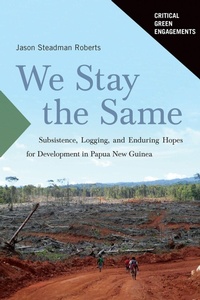
We Stay the Same
Subsistence, Logging, and Enduring Hopes for Development in Papua New Guinea
Published on 30. April 2024
Book
Hardback
264 pages
978-0-8165-4814-9 (ISBN)
Description
On a remote island in the South Pacific, the Lavongai have consistently struggled to obtain development through logging and commercial agriculture. Yet many Lavongai still long to move beyond the grind of subsistence work that has seemingly defined their lives on New Hanover, Papua New Guinea, for generations.
Following a long history of smaller-scale and largely unsuccessful resource development efforts, New Hanover became the site of three multinational-controlled special agricultural and business leases (SABLs) that combined to cover over 75 percent of the island for ninety-nine-year lease terms. These agroforestry projects were part of a national effort to encourage "sustainable" rural development by tapping into the growing global demand for agricultural lands and crops like oil palm and biofuels. They were supposed to succeed where the smaller-scale projects of the past had failed. Unfortunately, these SABLs resulted in significant forest loss and livelihood degradation, while doing little to promote the type of economic development that many Lavongai had been hoping for.
It is within this context that We Stay the Same grounds questions of hope for transformative economic change within Lavongai assessments of the inequitable relationships between global processes of resource development and the local lives that have become increasingly defined by the necessities and failures of these processes.
Written in a clear and relatable style for students, We Stay the Same combines ethnographic and ecological research to show how the Lavongai continue to survive and make meaningful lives in a situation where their own hopes for a better future have often been used against them as a mechanism of a more distantly profitable dispossession.
Following a long history of smaller-scale and largely unsuccessful resource development efforts, New Hanover became the site of three multinational-controlled special agricultural and business leases (SABLs) that combined to cover over 75 percent of the island for ninety-nine-year lease terms. These agroforestry projects were part of a national effort to encourage "sustainable" rural development by tapping into the growing global demand for agricultural lands and crops like oil palm and biofuels. They were supposed to succeed where the smaller-scale projects of the past had failed. Unfortunately, these SABLs resulted in significant forest loss and livelihood degradation, while doing little to promote the type of economic development that many Lavongai had been hoping for.
It is within this context that We Stay the Same grounds questions of hope for transformative economic change within Lavongai assessments of the inequitable relationships between global processes of resource development and the local lives that have become increasingly defined by the necessities and failures of these processes.
Written in a clear and relatable style for students, We Stay the Same combines ethnographic and ecological research to show how the Lavongai continue to survive and make meaningful lives in a situation where their own hopes for a better future have often been used against them as a mechanism of a more distantly profitable dispossession.
Reviews / Votes
"Deftly combining qualitative and quantitative data, Roberts provides an exemplary ethnography of the impacts of logging in New Hanover and of the hope communities have for charting a course in the wake of extraction. Roberts offers readers an important model for how to document the shifting sociocultural ecological relations in Papua New Guinea specifically and the Global South more widely."-Joshua A. Bell, co-editor of Recreating First Contact: Expeditions, Anthropology and Popular Culture"We Stay the Same makes a first-rate contribution to the literature on the relationship of extraction industries to culture at the local level. Its granular ethnography of the ongoing struggles and resiliency of the Lavongai people of Papua New Guinea is an example of contemporary environmental anthropology at its best."-David Lipset, author of Yabar: The Alienations of Murik Men in a Papua New Guinea Modernity
More details
Series
Language
English
Place of publication
Tucson
United States
Target group
Professional and scholarly
Product notice
sewn/stitched
Cloth over boards
Illustrations
19 b&w illustrations, 2 maps, 13 tables
Dimensions
Height: 231 mm
Width: 155 mm
Thickness: 23 mm
Weight
499 gr
ISBN-13
978-0-8165-4814-9 (9780816548149)
Copyright in bibliographic data and cover images is held by Nielsen Book Services Limited or by the publishers or by their respective licensors: all rights reserved.
Schweitzer Classification
Other editions
Additional editions

Jason Roberts
We Stay the Same
Subsistence, Logging, and Enduring Hopes for Development in Papua New Guinea
E-Book
04/2024
1st Edition
University of Arizona Press
€89.99
Available for download
Person
Jason Steadman Roberts is a practicing anthropologist who currently works on subsistence policy and natural resource management issues in Alaska.
Content
Acknowledgements
A Note on Language
Introduction: History, Hope, and Development
1. Staying the Same While Others Prosper
2. The History of the Land is the History of People and the Foundation for Development
3. The Historical and Political Economic Background to SABL Development
4. Sickness of the Skin and Sickness of the Land
5. Maintaining Hope for a New Mode of Subsistence at Narim Village
6. The Land is Sick in the Shadow of Development at Sulava Village
7. SABL Development Has Already Come like a Thief
Conclusion: The Hopeful Pursuit of a Good Change Endures
References
A Note on Language
Introduction: History, Hope, and Development
1. Staying the Same While Others Prosper
2. The History of the Land is the History of People and the Foundation for Development
3. The Historical and Political Economic Background to SABL Development
4. Sickness of the Skin and Sickness of the Land
5. Maintaining Hope for a New Mode of Subsistence at Narim Village
6. The Land is Sick in the Shadow of Development at Sulava Village
7. SABL Development Has Already Come like a Thief
Conclusion: The Hopeful Pursuit of a Good Change Endures
References