

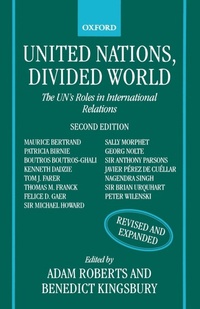
United Nations, Divided World
The UN's Roles in International Relations
2nd Edition
Published on 25. November 1993
Book
Paperback/Softback
606 pages
978-0-19-827926-6 (ISBN)
Description
This book, highly praised as an authoritative assessment of the United Nations and its place in international relations, brings together distinguished academics and senior UN officials in a clear and penetrating examination of how the UN has developed since 1945. It examines the UN's various roles in addressing long-standing and difficult problems in the relations of states in such fields as international security, human rights, international law, and economic development.
The book takes into account a wide range of developments in a world which remains very much divided; the rapid expansion of UN peacekeeping and election-monitoring activities; the consequences of the collapse of communism in eastern Europe and the Soviet Union; the 1990-1 Gulf conflict and its aftermath; attempts at settlement of many regional conflicts; UN involvements in fractured societies, including Cambodia, Somalia, and the former Yugoslavia; and the political and resource limits of the UN's capabilities. This edition also takes full account of new sources, writings, and debates.
There are four completely new chapters, by Patricia Birnie (environmental protection), Sally Morphet (peacekeeping), Brian Urquhart (post-Cold War security), and Peter Wilenski (the UN's structure). An appendix contains the full text of former Secretary-General Boutros-Ghali's important report, An Agenda for Peace, to which he has added an introduction for this book.
United Nations, Divided World is also a key reference work. The appendices include a bibliography and the complete text of the UN Charter, with all amendments. They also include lists of member states and their assessed contributions, Secretaries-General, UN peacekeeping and observer forces, and judgments and opinions of the International Court of Justice.
The book takes into account a wide range of developments in a world which remains very much divided; the rapid expansion of UN peacekeeping and election-monitoring activities; the consequences of the collapse of communism in eastern Europe and the Soviet Union; the 1990-1 Gulf conflict and its aftermath; attempts at settlement of many regional conflicts; UN involvements in fractured societies, including Cambodia, Somalia, and the former Yugoslavia; and the political and resource limits of the UN's capabilities. This edition also takes full account of new sources, writings, and debates.
There are four completely new chapters, by Patricia Birnie (environmental protection), Sally Morphet (peacekeeping), Brian Urquhart (post-Cold War security), and Peter Wilenski (the UN's structure). An appendix contains the full text of former Secretary-General Boutros-Ghali's important report, An Agenda for Peace, to which he has added an introduction for this book.
United Nations, Divided World is also a key reference work. The appendices include a bibliography and the complete text of the UN Charter, with all amendments. They also include lists of member states and their assessed contributions, Secretaries-General, UN peacekeeping and observer forces, and judgments and opinions of the International Court of Justice.
Reviews / Votes
From reviews of the first edition:`excellent ... succeeds both in its appraisal and in its critical assessment' International and Comparative Law Quarterly
More details
Edition
2nd Revised edition
Language
English
Place of publication
Oxford
United Kingdom
Target group
College/higher education
Professional and scholarly
Edition type
Revised edition
Dimensions
Height: 216 mm
Width: 140 mm
Thickness: 35 mm
Weight
843 gr
ISBN-13
978-0-19-827926-6 (9780198279266)
Copyright in bibliographic data and cover images is held by Nielsen Book Services Limited or by the publishers or by their respective licensors: all rights reserved.
Schweitzer Classification
Persons
Content
Introduction: The UN's Roles in a Divided World ; 1. The Historical Development of the UN's Role in International Security ; 2. The UN and International Security after the Cold War ; 3. The UN and the National Interests of States ; 4. The Role of the UN Secretary-General ; 5. The Good Offices Function of the UN Secretary-General ; 6. UN Peacekeeping and Election-Monitoring ; 7. The UN and Human Rights: At the End of the Beginning ; 8. The UN and the Problem of Economic Development ; 9. The UN and the Environment ; 10. The UN and the Development in International Law ; 11. The Historical Development of Efforts to Reform the UN ; 12. The Structure of the UN in the Post-Cold War Period ; Appendices, including: An Agenda for Peace: