

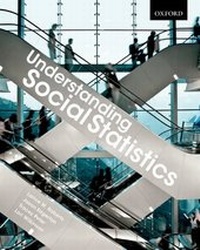
Understanding Social Statistics
A Student's Guide to Navigating the Maze
Published on 19. February 2015
Book
Paperback/Softback
504 pages
978-0-19-544429-2 (ISBN)
Description
Students studying statistics for the first time can often feel confused, disoriented, and lacking direction. Understanding Social Statistics is a text crafted with this reality in mind, that many students feel lost and frustrated when studying statistics-much like being in a maze.
USS acts as both a map and toolkit for navigating the maze of social statistics successfully. At every point in each chapter, students will have a clear idea of where they are and in which direction they are headed. A 5-step learning model applied to each theoretical concept ensures that readers have a predictable and reliable method for approaching every statistical situation they encounter-by working their way through the 5 steps, readers are guaranteed a way forward. Along the way they will collect all the tools they need to perform statistical analysis and learn to use them competently.
Using maps and tools effectively requires practice, which is another key element of USS.
Steps 2 (Learning the Calculations) and 3 (Using Computer Software) in the 5-step learning model provide ample opportunity for students to put learning into practice with sample problems and exercises. In addition, a complement of supportive text pedagogy and ancillary material (including detailed descriptions of the steps involved in arriving at the answers to the text's practice and sample problems) underscore the authors' commitment to providing a practical, easy-to-understand, and effective way to learn social statistics.
USS acts as both a map and toolkit for navigating the maze of social statistics successfully. At every point in each chapter, students will have a clear idea of where they are and in which direction they are headed. A 5-step learning model applied to each theoretical concept ensures that readers have a predictable and reliable method for approaching every statistical situation they encounter-by working their way through the 5 steps, readers are guaranteed a way forward. Along the way they will collect all the tools they need to perform statistical analysis and learn to use them competently.
Using maps and tools effectively requires practice, which is another key element of USS.
Steps 2 (Learning the Calculations) and 3 (Using Computer Software) in the 5-step learning model provide ample opportunity for students to put learning into practice with sample problems and exercises. In addition, a complement of supportive text pedagogy and ancillary material (including detailed descriptions of the steps involved in arriving at the answers to the text's practice and sample problems) underscore the authors' commitment to providing a practical, easy-to-understand, and effective way to learn social statistics.
Reviews / Votes
"The textbook's major strengths lie in its detailed explanations, step-by-step examples, and solid integration of SPSS examples into the text. . . . It really helps to show students how to do calculations by hand and with the use of computing software."--Michelle Maroto, University of Alberta
"I applaud the focus on calculations. . . . I also like the overall organization and the pace."
--Jean Andrey, University of Waterloo
More details
Language
English
Place of publication
Toronto
Canada
Target group
College/higher education
Illustrations
With illustrations
Dimensions
Height: 254 mm
Width: 204 mm
Thickness: 19 mm
Weight
886 gr
ISBN-13
978-0-19-544429-2 (9780195444292)
Copyright in bibliographic data and cover images is held by Nielsen Book Services Limited or by the publishers or by their respective licensors: all rights reserved.
Schweitzer Classification
Persons
Lance W. Roberts is a professor in the sociology department and a fellow of St. John's College at the University of Manitoba. For more than three decades he has taught undergraduate and graduate methods and statistics courses and is the author of several books and dozens of journal articles on topics related to social trends, ethnic relations, education, and inequality. He has co-authored the lab manuals the Statistics Coach and the Methods Coach for OUP Canada.
Jason Edgerton's doctoral thesis at the University of Manitoba, on class and gender disparities in academic achievement, reflects his areas of specialization in research methods, social inequality, stratification, class and power, globalization, comparative social policy, sociology of education and work, race/ethnicity and immigration, and social determinants of health. He has written, published, and presented a number of papers in these areas and currently teaches research methods in the sociology department at the University of Manitoba.
Tracey Peter is an assistant professor in the sociology department at the University of Manitoba. Her areas of specialization include data analysis and syntax programming, skills she advanced during her tenure as a research associate and programming manager with a nationally based evaluation research company. She currently teachers undergraduate and graduate courses in research methods and statistics and is working on several projects in mental health and violence, suicide prevention, education, and immigration. With Lance Roberts she co-authored the OUP Canada manuals the Statistics Coach and the Methods Coach.
Lori Wilkinson is an associate professor of sociology at the University of Manitoba and currently teaches ethnic relations, Canadian society and culture, and research methods. Her area of specialization centres on understanding the integration experiences of migrant youth in Canada as well as the labour market experiences of immigrant women and pedagogical research into new classroom technology. Lori is the Canadian adaptor of Bouma/Ling/Wilkinson, The Research Process, now in its second edition.
Jason Edgerton's doctoral thesis at the University of Manitoba, on class and gender disparities in academic achievement, reflects his areas of specialization in research methods, social inequality, stratification, class and power, globalization, comparative social policy, sociology of education and work, race/ethnicity and immigration, and social determinants of health. He has written, published, and presented a number of papers in these areas and currently teaches research methods in the sociology department at the University of Manitoba.
Tracey Peter is an assistant professor in the sociology department at the University of Manitoba. Her areas of specialization include data analysis and syntax programming, skills she advanced during her tenure as a research associate and programming manager with a nationally based evaluation research company. She currently teachers undergraduate and graduate courses in research methods and statistics and is working on several projects in mental health and violence, suicide prevention, education, and immigration. With Lance Roberts she co-authored the OUP Canada manuals the Statistics Coach and the Methods Coach.
Lori Wilkinson is an associate professor of sociology at the University of Manitoba and currently teaches ethnic relations, Canadian society and culture, and research methods. Her area of specialization centres on understanding the integration experiences of migrant youth in Canada as well as the labour market experiences of immigrant women and pedagogical research into new classroom technology. Lori is the Canadian adaptor of Bouma/Ling/Wilkinson, The Research Process, now in its second edition.
Author
ProfessorProfessor, Department of Sociology, University of Manitoba
Assistant ProfessorAssistant Professor, Department of Sociology, University of Manitoba
Associate ProfessorAssociate Professor, Department of Sociology , University of Manitoba
ProfessorProfessor, Department of Sociology, University of Manitoba
Content
C BRIEF CONTENTS ; Contents ; Preface ; Acknowledgements ; PART I: GENERAL ORIENTATION ; 1. The Location and Limits of Quantitative Analysis ; 2. The Logic of Social Statistics ; 3. Calculations and Computers ; PART II: UNIVARIATE ANALYSIS ; 4 Introducing Univariate Analysis ; 5. Measures of Central Tendency ; 6. Measures of Dispersion ; 7. Charts and Graphs ; 8. The Normal Curve ; PART III: BIVARIATE ANALYSIS ; 9. Understanding Relationships ; 10. Bivariate Tables ; 11. Scatterplot Analysis ; 12. Proportional Reduction in Error Statistics ; 13. Statistics for Categorical Relationships ; 14. Statistics for Continuous Connections ; PART IV: MULTIVARIATE ANALYSIS ; 15. Taking Additional Variables into Account ; 16. The Elaboration Model ; 17. Multiple Regression ; PART V: SAMPLING AND INFERENCE ; 18. Samples and Populations ; 19. Point Estimates, Confidence Intervals, and Confidence Levels ; 20. Hypothesis Testing ; 21. Various Significance Tests ; Epilogue: A Few Final Words ; Appendix A: Chi-Square Table ; Appendix B: The Student's t-Table ; Appendix C: Areas under the Normal Curve ; Answer Key ; Glossary ; Notes ; References ; Index