

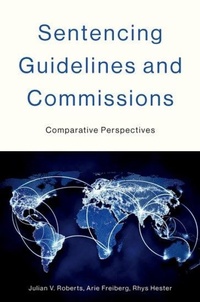
Sentencing Guidelines and Commissions
Comparative Perspectives
Published on 8. October 2025
Book
Hardback
312 pages
978-0-19-764479-9 (ISBN)
Description
Since the 1970s, sentencing in many countries has evolved from a system in which courts enjoyed wide discretion to one where courts must follow or at least consider guideline recommendations. This movement towards greater structure has also led to the creation of independent bodies-sentencing commissions or councils-which now sit alongside courts of appeal and play a pivotal role in guiding courts, advising legislators, and communicating with the public. Sentencing commissions and councils perform a wide range of other functions including increasing transparency and promoting fairness, consistency, and public confidence in the courts.
In Sentencing Guidelines and Commissions, Julian V. Roberts, Arie Freiberg, and Rhys Hester synthesize existing literature on commissions and guidelines, identify key issues and problems, and clarify the future of commissions and guidelines since the creation of the first commissions in 1980. Drawing upon almost fifty years of additional developments and accumulated research on guidelines, commissions, and councils, the authors explore the benefits of sentencing councils and commissions and sentencing guidelines. Further, the authors look back to the cumulative experience around the world since the first guidelines were created and propose a model regime for legislatures to consider.
The first book on sentencing guidelines and commissions to take an international perspective, Sentencing Guidelines and Commissions aims to determine whether and how guidelines may solve, or at least mitigate, some of the problems of current sentencing practice.
In Sentencing Guidelines and Commissions, Julian V. Roberts, Arie Freiberg, and Rhys Hester synthesize existing literature on commissions and guidelines, identify key issues and problems, and clarify the future of commissions and guidelines since the creation of the first commissions in 1980. Drawing upon almost fifty years of additional developments and accumulated research on guidelines, commissions, and councils, the authors explore the benefits of sentencing councils and commissions and sentencing guidelines. Further, the authors look back to the cumulative experience around the world since the first guidelines were created and propose a model regime for legislatures to consider.
The first book on sentencing guidelines and commissions to take an international perspective, Sentencing Guidelines and Commissions aims to determine whether and how guidelines may solve, or at least mitigate, some of the problems of current sentencing practice.
More details
Series
Language
English
Place of publication
New York
United States
Target group
Professional and scholarly
Product notice
sewn/stitched
Cloth over boards
Dimensions
Height: 239 mm
Width: 160 mm
Thickness: 35 mm
Weight
552 gr
ISBN-13
978-0-19-764479-9 (9780197644799)
Copyright in bibliographic data and cover images is held by Nielsen Book Services Limited or by the publishers or by their respective licensors: all rights reserved.
Schweitzer Classification
Other editions
Additional editions
Julian V. Roberts | Arie Freiberg | Rhys Hester
Sentencing Guidelines and Commissions
Comparative Perspectives
E-Book
07/2025
OUP eBook
€32.99
Available for download
Julian V. Roberts | Arie Freiberg | Rhys Hester
Sentencing Guidelines and Commissions
Comparative Perspectives
E-Book
07/2025
OUP eBook
€32.99
Available for download
Persons
Julian V. Roberts is Emeritus Professor at the University of Oxford and Executive Director of the Sentencing Academy. In 2022, he was appointed Kings Counsel (Honoris Causa) for his contributions to sentencing. In 2021, he was awarded the American Society of Criminology Sellin-Glueck Award for comparative criminal justice scholarship. Roberts was a member of the Canadian Sentencing Commission (1984-1987); the Sentencing Council of England and Wales (2010-2018); and a foreign advisor to the Model Penal Code Sentencing project. He has authored, co-authored, or edited thirty-four books on sentencing and criminal justice.
Arie Freiberg is an Emeritus Professor at Monash University, Melbourne Australia. He was Foundation Chair and Head of the Department of Criminology (1991-2002) and Dean of the Faculty of Arts (2003) at the University of Melbourne and Dean of the Faculty of Law at Monash University (2004-2012). He was the Inaugural Chair of the Victorian Sentencing Advisory Council
(2004-2022) and Chair of the Tasmania Sentencing Advisory Council (2013-2021). He has authored over 190 publications in areas relating to sentencing, regulation, and non-adversarial justice.
Rhys Hester is an associate professor at Clemson University where he teaches in the areas of criminal law, courts, and criminal procedure. He is the former Deputy Director of the Pennsylvania Commission on Sentencing. Hester is a contractor for the National Institute of Justice and the United States Department of Justice on a project related to the review and revalidation of the PATTERN risk assessment tool. His research has been published in Criminology, Journal of Quantitative Criminology, Crime & Delinquency, and Crime and Justice: A Review of Research.
Arie Freiberg is an Emeritus Professor at Monash University, Melbourne Australia. He was Foundation Chair and Head of the Department of Criminology (1991-2002) and Dean of the Faculty of Arts (2003) at the University of Melbourne and Dean of the Faculty of Law at Monash University (2004-2012). He was the Inaugural Chair of the Victorian Sentencing Advisory Council
(2004-2022) and Chair of the Tasmania Sentencing Advisory Council (2013-2021). He has authored over 190 publications in areas relating to sentencing, regulation, and non-adversarial justice.
Rhys Hester is an associate professor at Clemson University where he teaches in the areas of criminal law, courts, and criminal procedure. He is the former Deputy Director of the Pennsylvania Commission on Sentencing. Hester is a contractor for the National Institute of Justice and the United States Department of Justice on a project related to the review and revalidation of the PATTERN risk assessment tool. His research has been published in Criminology, Journal of Quantitative Criminology, Crime & Delinquency, and Crime and Justice: A Review of Research.
Content
Acknowledgements
Foreword by Michael Tonry
Chapter 1: The Origins of Structured Sentencing
Chapter 2: The Evolution of Sentencing Commissions and Guidelines
Chapter 3: Sentencing Guidelines in the US State and Federal Jurisdictions (by Rhys Hester and Richard Frase)
Chapter 4: Sentencing Councils and Guidelines in the United Kingdom
Chapter 5: The 'Third Generation' Sentencing Guidelines
Chapter 6: Beyond Guidelines: The Unfulfilled Potential of Sentencing Commissions
Chapter 7: The Role of Commissions and Guidelines in Addressing Racial and Ethnic Disparities at Sentencing
Chapter 8: Revisiting the Role of Criminal History in the US Sentencing Guidelines
Chapter 9: Features and Functions of a Model Sentencing Commission
Chapter 10: Key Elements of a Successful Sentencing Guideline Regime
References
Index
Foreword by Michael Tonry
Chapter 1: The Origins of Structured Sentencing
Chapter 2: The Evolution of Sentencing Commissions and Guidelines
Chapter 3: Sentencing Guidelines in the US State and Federal Jurisdictions (by Rhys Hester and Richard Frase)
Chapter 4: Sentencing Councils and Guidelines in the United Kingdom
Chapter 5: The 'Third Generation' Sentencing Guidelines
Chapter 6: Beyond Guidelines: The Unfulfilled Potential of Sentencing Commissions
Chapter 7: The Role of Commissions and Guidelines in Addressing Racial and Ethnic Disparities at Sentencing
Chapter 8: Revisiting the Role of Criminal History in the US Sentencing Guidelines
Chapter 9: Features and Functions of a Model Sentencing Commission
Chapter 10: Key Elements of a Successful Sentencing Guideline Regime
References
Index