

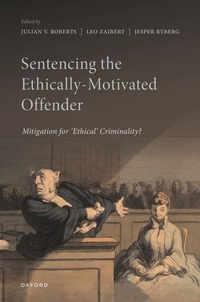
Sentencing the Ethically-Motivated Offender
Mitigation for 'Ethical' Criminality?
Will be published approx. on 8. October 2026
Book
Hardback
296 pages
978-0-19-899301-8 (ISBN)
Description
From climate change protests in the West, to pro-democracy demonstrations in Asia, in recent years we have witnessed a global rise in offending motivated by a 'just cause'. This book argues that the conventional criminal law and sentencing frameworks where the offender is seen as malignantly motivated and punished accordingly is inappropriate here. Legislatures, courts, sentencing councils and commissions must now confront the question: should people convicted of ethically-motivated crimes benefit from mitigation at sentencing?
Bringing together contributors from Europe, Asia, and Latin America, Sentencing the Ethically-Motivated Offender: Mitigation for 'Ethical' Criminality? explores various criminal acts which might be perceived to be ethically defensible, and what the appropriate criminal law responses should be. Bridging the gap between theory and practice, the book contains a number of case histories, examining how the courts in a range of countries sentence environmental, political, and other offenders. Part I of the volume addresses a range of cross-cutting questions which apply across many forms of 'ethical offending'. Part II contains a series of jurisdiction-specific analyses which reveal the diversity of approaches to sentencing offenders who act from an honourable motive.
Sitting at the intersection of criminal law, criminal justice and philosophy, this volume represents the first scholarly effort towards clarifying the principles and practices relevant to sentencing the ethically-motivated defendant.
Bringing together contributors from Europe, Asia, and Latin America, Sentencing the Ethically-Motivated Offender: Mitigation for 'Ethical' Criminality? explores various criminal acts which might be perceived to be ethically defensible, and what the appropriate criminal law responses should be. Bridging the gap between theory and practice, the book contains a number of case histories, examining how the courts in a range of countries sentence environmental, political, and other offenders. Part I of the volume addresses a range of cross-cutting questions which apply across many forms of 'ethical offending'. Part II contains a series of jurisdiction-specific analyses which reveal the diversity of approaches to sentencing offenders who act from an honourable motive.
Sitting at the intersection of criminal law, criminal justice and philosophy, this volume represents the first scholarly effort towards clarifying the principles and practices relevant to sentencing the ethically-motivated defendant.
More details
Language
English
Place of publication
Oxford
United Kingdom
Product notice
sewn/stitched
Cloth over boards
Dimensions
Height: 234 mm
Width: 156 mm
ISBN-13
978-0-19-899301-8 (9780198993018)
Copyright in bibliographic data and cover images is held by Nielsen Book Services Limited or by the publishers or by their respective licensors: all rights reserved.
Schweitzer Classification
Persons
Julian V. Roberts is Emeritus Professor at the University of Oxford. In 2022 he was appointed Kings Counsel (Honoris Causa). In 2021 he was awarded the American Society of Criminology Sellin-Glueck Award for comparative scholarship. Julian was a member of the English Sentencing Council (2010-2018). As a Foreign Advisor, his research fed into the American Law Institute's Model Sentencing Code (2017). He has authored, co-authored, or edited 24 books on criminal justice. An academic festschrift volume in his honour was published by OUP in 2025, Sentencing, Public Opinion, and Criminal Justice: Essays in Honour of Julian V Roberts.
Leo Zaibert is Andreas von Hirsch Professor of Penal Theory and Ethics, and Director of the Centre for Penal Theory and Ethics at the University of Cambridge. He is the author of numerous books and articles, and an editor (or co-editor) of several volumes. He has held visiting posts at Oxford University, the University of Geneva, New York University, Amherst College, and was a Humboldt Fellow at the Universities of Leipzig and of Saarbruecken.
Jesper Ryberg is Professor of Ethics and Philosophy of Law at Roskilde University, Denmark. He is head of the Center for Criminal Justice and Artificial Intelligence and the Research Group for Criminal Justice Ethics. He has been awarded the Elite Research Prize (by the Danish Ministry of Science) and the Carlsberg Foundation Research Prize. He has also received the Danish Research Communication Prize.
Leo Zaibert is Andreas von Hirsch Professor of Penal Theory and Ethics, and Director of the Centre for Penal Theory and Ethics at the University of Cambridge. He is the author of numerous books and articles, and an editor (or co-editor) of several volumes. He has held visiting posts at Oxford University, the University of Geneva, New York University, Amherst College, and was a Humboldt Fellow at the Universities of Leipzig and of Saarbruecken.
Jesper Ryberg is Professor of Ethics and Philosophy of Law at Roskilde University, Denmark. He is head of the Center for Criminal Justice and Artificial Intelligence and the Research Group for Criminal Justice Ethics. He has been awarded the Elite Research Prize (by the Danish Ministry of Science) and the Carlsberg Foundation Research Prize. He has also received the Danish Research Communication Prize.
Volume editor
Emeritus ProfessorEmeritus Professor, University of Oxford
Andreas von Hirsch Professor of Penal Theory and EthicsAndreas von Hirsch Professor of Penal Theory and Ethics, University of Cambridge
Professor of Ethics and Philosophy of LawProfessor of Ethics and Philosophy of Law, Roskilde University