

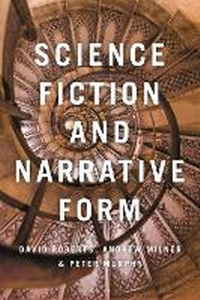
Science Fiction and Narrative Form
Published on 23. February 2023
Book
Hardback
240 pages
978-1-350-35074-8 (ISBN)
Description
Establishing science fiction as its own distinct and increasingly important narrative form, this book explores how the genre challenges pervasive perceptions of society as they appear in the conventional modern novel. Inspired by, and building upon, Georg Lukacs's criticism of the orthodox novel for its depiction of life as alienating and disjointed, Milner, Murphy and Roberts demonstrate that science fiction steps beyond this contemporary form to be a more constructive form of literature, one able to conceive of society as complete, integrated and well-rounded. Taking stock of three kinds of science fiction which lie outside the scope of the modern novel - theological/ ontological science fiction, the science fiction of future history and epic science fiction - this book demonstrates the genre's unique capacity to encapsulate the whole world, persons and events, things and objects in a glance, and address the motive behind the longing for meaningful totality.
With reference to a vast array of works by authors such as Michel Houellebecq, Elias Canetti, Isaac Asimov, Jules Verne, H. G. Wells, Aldous Huxley, Marge Piercy, Iain M. Banks, Margaret Atwood, Ursula K. Le Guin, William Gibson, Dirk C. Fleck, Philip K. Dick, George Orwell and Kazuo Ishiguro, this book offers a compelling argument for rethinking the position and potential of the science fiction novel and to challenge the way we perceive our culture.
With reference to a vast array of works by authors such as Michel Houellebecq, Elias Canetti, Isaac Asimov, Jules Verne, H. G. Wells, Aldous Huxley, Marge Piercy, Iain M. Banks, Margaret Atwood, Ursula K. Le Guin, William Gibson, Dirk C. Fleck, Philip K. Dick, George Orwell and Kazuo Ishiguro, this book offers a compelling argument for rethinking the position and potential of the science fiction novel and to challenge the way we perceive our culture.
Reviews / Votes
Innovative, provocative, and at a level of intellectual seriousness far too rare. ... It should stand as a striking and essential contribution to the long-running debate about sf and form. * Science Fiction Studies * Science Fiction and Narrative Form argues that, amid escalating anthropogenic crises, science fiction is essential: only the genre's historicizing imperative and epic scale, its peculiar temporalities and world-building strategies, its absent gods and invisible hands, can make up for the parochial, exhausted literary novel. Magisterial, nuanced - and highly recommended. * Mark Bould, Reader in Film & Literature, Faculty of Arts, Creative Industries, and Education, University of West England, UK *More details
Language
English
Place of publication
London
United Kingdom
Publishing group
Bloomsbury Publishing PLC
Target group
Professional and scholarly
Dimensions
Height: 234 mm
Width: 156 mm
ISBN-13
978-1-350-35074-8 (9781350350748)
Copyright in bibliographic data and cover images is held by Nielsen Book Services Limited or by the publishers or by their respective licensors: all rights reserved.
Schweitzer Classification
Other editions
Additional editions
David Roberts | Andrew Milner | Peter Murphy
Science Fiction and Narrative Form
E-Book
02/2023
1st Edition
Bloomsbury Academic
€32.99
Available for download
Persons
Andrew Milner is Emeritus Professor at Monash University, Australia. His publications include Locating Science Fiction (2012), Again, Dangerous Visions: Essays in Cultural Materialism (2018), (with J. R. Burgmann) Science Fiction and Climate Change: A Sociological Approach (2020).
Peter Murphy is Adjunct Professor at La Trobe University and James Cook University, Australia. His publications include The Political Economy of Prosperity: Successful Societies and Productive Cultures (2020), The Collective Imagination: The Creative Spirit of Free Societies (2012) and Dialectic of Romanticism: A Critique of Modernism (2004).
David Roberts is Emeritus Professor, School of Languages and Cultures, Monash University, Australia. His publications include History of the Present: The Contemporary and its Culture (2021), The Total Work of Art in European Modernism (2011) and Dialectic of Romanticism: A Critique of Modernism (2004).
Peter Murphy is Adjunct Professor at La Trobe University and James Cook University, Australia. His publications include The Political Economy of Prosperity: Successful Societies and Productive Cultures (2020), The Collective Imagination: The Creative Spirit of Free Societies (2012) and Dialectic of Romanticism: A Critique of Modernism (2004).
David Roberts is Emeritus Professor, School of Languages and Cultures, Monash University, Australia. His publications include History of the Present: The Contemporary and its Culture (2021), The Total Work of Art in European Modernism (2011) and Dialectic of Romanticism: A Critique of Modernism (2004).
Content
Introduction
Part One: From the Epic to Science Fiction, David Roberts
1. From Epic to Novel
2. From the Novel to Science Fiction
3. A Theory of Science Fiction
4. The God in the Machine
Part Two: Science Fiction and the Historical Novel, Andrew Milner
5. Lukacs, the Historical Novel and Science Fiction
6. Climate Fiction as the Future Historical Novel
Part Three: Epic Science Fiction, Peter Murphy
7. The Hidden God
8. Galaxia
Part Four: World Science Fiction, Andrew Milner
9. History or apocalypse?
Conclusion
Bibliography
Index
Part One: From the Epic to Science Fiction, David Roberts
1. From Epic to Novel
2. From the Novel to Science Fiction
3. A Theory of Science Fiction
4. The God in the Machine
Part Two: Science Fiction and the Historical Novel, Andrew Milner
5. Lukacs, the Historical Novel and Science Fiction
6. Climate Fiction as the Future Historical Novel
Part Three: Epic Science Fiction, Peter Murphy
7. The Hidden God
8. Galaxia
Part Four: World Science Fiction, Andrew Milner
9. History or apocalypse?
Conclusion
Bibliography
Index