

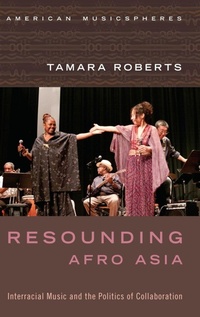
Resounding Afro Asia
Interracial Music and the Politics of Collaboration
Published on 7. April 2016
Book
Hardback
248 pages
978-0-19-937740-4 (ISBN)
Description
Though cultural hybridity is celebrated as a hallmark of U.S. American music and identity, hybrid music is all too often marked and marketed under a single racial label.Tamara Roberts' book Resounding Afro Asia examines music projects that foreground racial mixture in players, audiences, and sound in the face of the hypocrisy of the culture industry. Resounding Afro Asia traces a genealogy of black/Asian engagements through four contemporary case studies from Chicago, New York, and California: Funkadesi (Indian/funk/reggae), Yoko Noge (Japanese folk/blues), Fred Ho and the Afro Asian Music Ensemble (jazz/various Asian and African traditions), and Red Baraat (Indian brass band and New Orleans second line).
Roberts investigates Afro Asian musical settings as part of a genealogy of cross-racial culture and politics. These musical settings are sites of sono-racial collaboration: musical engagements in which participants pointedly use race to form and perform interracial politics. When musicians collaborate, they generate and perform racially marked sounds that do not conform to their racial identities, thus splintering the expectations of cultural determinism. The dynamic social, aesthetic, and sonic practices construct a forum for the negotiation of racial and cultural difference and the formation of inter-minority solidarities. Through improvisation and composition, artists can articulate new identities and subjectivities in conversation with each other.
Resounding Afro Asia offers a glimpse into how artists live multiracial lives in which they inhabit yet exceed multicultural frameworks built on racial essentialism and segregation. It joins a growing body of literature that seeks to write Asian American artists back into U.S. popular music history and will surely appeal to students of music, ethnomusicology, race theory, and politics, as well as those curious about the relationship between race and popular music.
Roberts investigates Afro Asian musical settings as part of a genealogy of cross-racial culture and politics. These musical settings are sites of sono-racial collaboration: musical engagements in which participants pointedly use race to form and perform interracial politics. When musicians collaborate, they generate and perform racially marked sounds that do not conform to their racial identities, thus splintering the expectations of cultural determinism. The dynamic social, aesthetic, and sonic practices construct a forum for the negotiation of racial and cultural difference and the formation of inter-minority solidarities. Through improvisation and composition, artists can articulate new identities and subjectivities in conversation with each other.
Resounding Afro Asia offers a glimpse into how artists live multiracial lives in which they inhabit yet exceed multicultural frameworks built on racial essentialism and segregation. It joins a growing body of literature that seeks to write Asian American artists back into U.S. popular music history and will surely appeal to students of music, ethnomusicology, race theory, and politics, as well as those curious about the relationship between race and popular music.
Reviews / Votes
"Roberts' work offers vital insights into constructs and consequences of race and identity in music in the US and suggests more nuances articulations of the inherent complexities of this music. Readers unfamiliar with the US context still will find this work valuable as it provides a solid and accesible approach to ideas that, in some previous research, are oversimplified and lack Robert's rigour. Roberts also takes great care not to present false equivalencesbetween the two minority groups, nor does she avoid diligent consideration of problematic definitions, tensions, exoticization, sensitivities, stereotypes, and more. In doing so, this work may carry
broader implications as she presents a thorough and useful way to interrogate racial systems in their entirety, all while advancing discourses on hybridity, multiculturalism, and identity in an ever-shifting world." --2017 Yearbook For Traditional Music
More details
Product info
Print PDF
Series
Language
English
Place of publication
New York
United States
Target group
College/higher education
Professional and scholarly
Illustrations
18
Dimensions
Height: 240 mm
Width: 161 mm
Thickness: 18 mm
Weight
543 gr
ISBN-13
978-0-19-937740-4 (9780199377404)
Schweitzer Classification
Other editions
Additional editions
Book
04/2016
Oxford University Press Inc
€31.50
Shipment within 15-20 days
E-Book
02/2016
1st Edition
OUP eBook
€14.49
Available for download
E-Book
02/2016
1st Edition
OUP eBook
€16.49
Available for download
Person
Tamara Roberts Assistant Professor of Music at University of California, Berkeley, where she teaches courses on popular music and politics. Other publications include Yellow Power, Yellow Soul: The Radical Art of Fred Ho (co-edited with Roger Buckley) and articles and essays in multiple journals and anthologies.
Content
Introduction: Echoes of the Future
Chapter 1: This Strange Amalgamation: Afro Asian Roots
Chapter 2: Becoming Afro Asian: Yoko Noge's Jazz Me Blues and Japanesque
Chapter 3: Articulating Interracial Space: Funkadesi's "One Family"
Chapter 4: Sonic Identity Politics: Fred Ho's Afro Asian Music Ensemble
Chapter 5: Toward An Afro Asian Theory of Critique: The "Addictive" Case
Conclusion" Reverberations
Notes
References
Index
Chapter 1: This Strange Amalgamation: Afro Asian Roots
Chapter 2: Becoming Afro Asian: Yoko Noge's Jazz Me Blues and Japanesque
Chapter 3: Articulating Interracial Space: Funkadesi's "One Family"
Chapter 4: Sonic Identity Politics: Fred Ho's Afro Asian Music Ensemble
Chapter 5: Toward An Afro Asian Theory of Critique: The "Addictive" Case
Conclusion" Reverberations
Notes
References
Index