

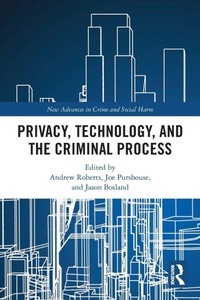
Privacy, Technology, and the Criminal Process
1st Edition
Published on 14. April 2025
Book
Paperback/Softback
308 pages
978-0-367-62853-6 (ISBN)
Description
This collection considers the implications for privacy of the utilisation of new technologies in the criminal process. In most modern liberal democratic states, privacy is considered a basic right. Many national constitutions, and almost all international human rights instruments, include some guarantee of privacy. Yet privacy interests appear to have had relatively little influence on criminal justice policy making. The threat that technology poses to these interests demands critical re-evaluation of current law, policy, and practice. This is provided by the contributions to this volume. They offer legal, criminological, philosophical, and comparative perspectives. The book will be of interest to legal and criminological scholars and postgraduate students. Its interdisciplinary methodology and focus on the intersection between law and technology make it also relevant for philosophers and those interested in science and technology studies.
More details
Series
Language
English
Place of publication
London
United Kingdom
Publishing group
Taylor & Francis Ltd
Target group
College/higher education
Professional and scholarly
Academic and Postgraduate
Illustrations
1 s/w Tabelle
1 Tables, black and white
Dimensions
Height: 234 mm
Width: 156 mm
Thickness: 17 mm
Weight
491 gr
ISBN-13
978-0-367-62853-6 (9780367628536)
Copyright in bibliographic data and cover images is held by Nielsen Book Services Limited or by the publishers or by their respective licensors: all rights reserved.
Schweitzer Classification
Other editions
Additional editions
Andrew Roberts | Joe Purshouse | Jason Bosland
Privacy, Technology, and the Criminal Process
Book
07/2023
1st Edition
Routledge
€206.90
Shipment within 15-20 days
Andrew Roberts | Joe Purshouse | Jason Bosland
Privacy, Technology, and the Criminal Process
E-Book
07/2023
1st Edition
Routledge
€60.49
Available for download
Andrew Roberts | Joe Purshouse | Jason Bosland
Privacy, Technology, and the Criminal Process
E-Book
07/2023
1st Edition
Routledge
€60.49
Available for download
Persons
Andrew Roberts is Professor at Melbourne Law School, The University of Melbourne.
Joe Purshouse is Senior Lecturer in Criminal Law and Justice at the University of Sheffield.
Jason Bosland is Associate Professor and Director of the Media and Communications Law Research Network at Melbourne Law School.
Joe Purshouse is Senior Lecturer in Criminal Law and Justice at the University of Sheffield.
Jason Bosland is Associate Professor and Director of the Media and Communications Law Research Network at Melbourne Law School.
Content
Notes on Contributors
Introduction: Criminal Justice, Technology, and the Future of Privacy
JOE PURSHOUSE AND ANDREW ROBERTS
1 Exploring Algorithmic Justice for Policing Data Analytics in the United Kingdom
JAMIE GRACE
2 Police Use of Intrusive Technology: Freedom, Privacy, and Political Legitimacy
ANDREW ROBERTS
3 Private Policing in the Data-Driven Society: The Flexible State Monopoly on Force Challenged but Not Abandoned
MAGDALENA BREWCZYNSKA AND PAUL DE HERT
4 Citizen-Led Policing in the Digital Age and the Right to Respect for Private Life
JOE PURSHOUSE
5 Biometric Forensic Identity Databases in Europe: Precariously Balanced or Faulty Scales?
CAROLE MCCARTNEY, RAFAELA GRANJA, AND ERIC TOEPFER
6 Facial Recognition Technology: The Particular Impacts on Children
NESSA LYNCH, FAITH GORDON, AND LIZ CAMPBELL
7 Knowing Without Entering: How Remote Police Surveillance Affects Privacy of the Home
IVAN SKORVANEK AND BERT-JAAP KOOPS
8 Frontline Perceptions of Body-Worn Cameras: Tools for Transparency in British Policing?
DIANA MIRANDA
9 Apples, Oranges, and Time Machines: Regulating Police Use of Body-Worn Cameras in Europe and the United States
BRYCE CLAYTON NEWELL AND ELENI KOSTA
10 Investigating Rape Allegations: Artificial Intelligence and the 'Digital Strip-Search'
HANNAH QUIRK
11 Reporting Crime in the Wake of the Human Rights Act 1998: Privacy, Criminal Justice, and the Media in England & Wales
JASON BOSLAND AND JUDITH TOWNEND
12 Privacy and Rehabilitation after a Criminal Conviction in the Digital Age
SARAH ESTHER LAGESON
Index
Introduction: Criminal Justice, Technology, and the Future of Privacy
JOE PURSHOUSE AND ANDREW ROBERTS
1 Exploring Algorithmic Justice for Policing Data Analytics in the United Kingdom
JAMIE GRACE
2 Police Use of Intrusive Technology: Freedom, Privacy, and Political Legitimacy
ANDREW ROBERTS
3 Private Policing in the Data-Driven Society: The Flexible State Monopoly on Force Challenged but Not Abandoned
MAGDALENA BREWCZYNSKA AND PAUL DE HERT
4 Citizen-Led Policing in the Digital Age and the Right to Respect for Private Life
JOE PURSHOUSE
5 Biometric Forensic Identity Databases in Europe: Precariously Balanced or Faulty Scales?
CAROLE MCCARTNEY, RAFAELA GRANJA, AND ERIC TOEPFER
6 Facial Recognition Technology: The Particular Impacts on Children
NESSA LYNCH, FAITH GORDON, AND LIZ CAMPBELL
7 Knowing Without Entering: How Remote Police Surveillance Affects Privacy of the Home
IVAN SKORVANEK AND BERT-JAAP KOOPS
8 Frontline Perceptions of Body-Worn Cameras: Tools for Transparency in British Policing?
DIANA MIRANDA
9 Apples, Oranges, and Time Machines: Regulating Police Use of Body-Worn Cameras in Europe and the United States
BRYCE CLAYTON NEWELL AND ELENI KOSTA
10 Investigating Rape Allegations: Artificial Intelligence and the 'Digital Strip-Search'
HANNAH QUIRK
11 Reporting Crime in the Wake of the Human Rights Act 1998: Privacy, Criminal Justice, and the Media in England & Wales
JASON BOSLAND AND JUDITH TOWNEND
12 Privacy and Rehabilitation after a Criminal Conviction in the Digital Age
SARAH ESTHER LAGESON
Index