

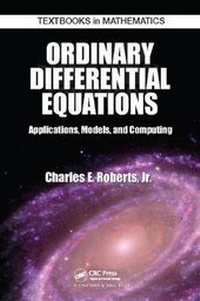
Ordinary Differential Equations
Applications, Models, and Computing
1st Edition
Published on 15. June 2018
Book
Paperback/Softback
600 pages
978-1-138-11821-8 (ISBN)
Description
In the traditional curriculum, students rarely study nonlinear differential equations and nonlinear systems due to the difficulty or impossibility of computing explicit solutions manually. Although the theory associated with nonlinear systems is advanced, generating a numerical solution with a computer and interpreting that solution are fairly elementary. Bringing the computer into the classroom, Ordinary Differential Equations: Applications, Models, and Computing emphasizes the use of computer software in teaching differential equations.
Providing an even balance between theory, computer solution, and application, the text discusses the theorems and applications of the first-order initial value problem, including learning theory models, population growth models, epidemic models, and chemical reactions. It then examines the theory for n-th order linear differential equations and the Laplace transform and its properties, before addressing several linear differential equations with constant coefficients that arise in physical and electrical systems. The author also presents systems of first-order differential equations as well as linear systems with constant coefficients that arise in physical systems, such as coupled spring-mass systems, pendulum systems, the path of an electron, and mixture problems. The final chapter introduces techniques for determining the behavior of solutions to systems of first-order differential equations without first finding the solutions.
Designed to be independent of any particular software package, the book includes a CD-ROM with the software used to generate the solutions and graphs for the examples. The appendices contain complete instructions for running the software. A solutions manual is available for qualifying instructors.
Providing an even balance between theory, computer solution, and application, the text discusses the theorems and applications of the first-order initial value problem, including learning theory models, population growth models, epidemic models, and chemical reactions. It then examines the theory for n-th order linear differential equations and the Laplace transform and its properties, before addressing several linear differential equations with constant coefficients that arise in physical and electrical systems. The author also presents systems of first-order differential equations as well as linear systems with constant coefficients that arise in physical systems, such as coupled spring-mass systems, pendulum systems, the path of an electron, and mixture problems. The final chapter introduces techniques for determining the behavior of solutions to systems of first-order differential equations without first finding the solutions.
Designed to be independent of any particular software package, the book includes a CD-ROM with the software used to generate the solutions and graphs for the examples. The appendices contain complete instructions for running the software. A solutions manual is available for qualifying instructors.
Reviews / Votes
Roberts gives a clear, detailed introduction to ordinary differential equations for students who have completed the full calculus sequence. ... the book's exercises and examples ... are independent of any particular software-a very nice feature. Roberts provides a good balance between theoretical and applied material. ... The work is very readable and offers instructors much material to work with in their courses. Summing Up: Recommended.-CHOICE, December 2010
More details
Series
Language
English
Place of publication
London
United Kingdom
Publishing group
Taylor & Francis Ltd
Target group
College/higher education
Undergraduate and junior college students in mathematics and engineering; physicists and engineers.
Illustrations
149 s/w Abbildungen, 13 s/w Tabellen
Equation heavy manuscript; 13 Tables, black and white; 149 Illustrations, black and white
Dimensions
Height: 297 mm
Width: 210 mm
Weight
866 gr
ISBN-13
978-1-138-11821-8 (9781138118218)
Copyright in bibliographic data and cover images is held by Nielsen Book Services Limited or by the publishers or by their respective licensors: all rights reserved.
Schweitzer Classification
Other editions
New editions

Book
01/2023
2nd Edition
Chapman & Hall/CRC
€81.99
Article exhausted; check different version
Additional editions
Book
03/2010
1st Edition
Taylor & Francis
€84.17
Article exhausted; check for reprint
Person
Charles E. Roberts, Jr. is a professor in the Department of Mathematics and Computer Science at Indiana State University.
Content
Introduction
Historical Prologue
Definitions and Terminology
Solutions and Problems
A Nobel Prize Winning Application
The Initial Value Problem y' = f (x, y); y(c) =d
Direction Fields
Fundamental Theorems
Solution of Simple First-Order Differential Equations
Numerical Solution
Applications of the Initial Value Problem y' = f (x, y); y(c) =d
Calculus Revisited
Learning Theory Models
Population Models
Simple Epidemic Models
Falling Bodies
Mixture Problems
Curves of Pursuit
Chemical Reactions
N-th Order Linear Differential Equations
Basic Theory
Roots of Polynomials
Homogeneous Linear Equations with Constant Coefficients
Nonhomogeneous Linear Equations with Constant Coefficients
Initial Value Problems
The Laplace Transform Method
The Laplace Transform and Its Properties
Using the Laplace Transform and Its Inverse to Solve Initial Value Problems
Convolution and the Laplace Transform
The Unit Function and Time-Delay Functions
Impulse Functions
Applications of Linear Differential Equations with Constant Coefficients
Second-Order Differential Equations
Higher Order Differential Equations
Systems of First-Order Differential Equations
Linear Systems of First-Order Differential Equations
Matrices and Vectors
Eigenvalues and Eigenvectors
Linear Systems with Constant Coefficients
Applications of Linear Systems with Constant Coefficients
Coupled Spring-Mass Systems
Pendulum Systems
The Path of an Electron
Mixture Problems
Applications of Systems of Equations
Richardson's Arms Race Model
Phase-Plane Portraits
Modified Richardson's Arms Race Models
Lanchester's Combat Models
Models for Interacting Species
Epidemics
Pendulums
Duffing's Equation
Van der Pol's Equation
Mixture Problems
The Restricted Three-Body Problem
Appendix A: CSODE User's Guide
Appendix B: PORTRAIT User's Guide
Appendix C: Laplace Transforms
Answers to Selected Exercises
References
Index
Historical Prologue
Definitions and Terminology
Solutions and Problems
A Nobel Prize Winning Application
The Initial Value Problem y' = f (x, y); y(c) =d
Direction Fields
Fundamental Theorems
Solution of Simple First-Order Differential Equations
Numerical Solution
Applications of the Initial Value Problem y' = f (x, y); y(c) =d
Calculus Revisited
Learning Theory Models
Population Models
Simple Epidemic Models
Falling Bodies
Mixture Problems
Curves of Pursuit
Chemical Reactions
N-th Order Linear Differential Equations
Basic Theory
Roots of Polynomials
Homogeneous Linear Equations with Constant Coefficients
Nonhomogeneous Linear Equations with Constant Coefficients
Initial Value Problems
The Laplace Transform Method
The Laplace Transform and Its Properties
Using the Laplace Transform and Its Inverse to Solve Initial Value Problems
Convolution and the Laplace Transform
The Unit Function and Time-Delay Functions
Impulse Functions
Applications of Linear Differential Equations with Constant Coefficients
Second-Order Differential Equations
Higher Order Differential Equations
Systems of First-Order Differential Equations
Linear Systems of First-Order Differential Equations
Matrices and Vectors
Eigenvalues and Eigenvectors
Linear Systems with Constant Coefficients
Applications of Linear Systems with Constant Coefficients
Coupled Spring-Mass Systems
Pendulum Systems
The Path of an Electron
Mixture Problems
Applications of Systems of Equations
Richardson's Arms Race Model
Phase-Plane Portraits
Modified Richardson's Arms Race Models
Lanchester's Combat Models
Models for Interacting Species
Epidemics
Pendulums
Duffing's Equation
Van der Pol's Equation
Mixture Problems
The Restricted Three-Body Problem
Appendix A: CSODE User's Guide
Appendix B: PORTRAIT User's Guide
Appendix C: Laplace Transforms
Answers to Selected Exercises
References
Index