

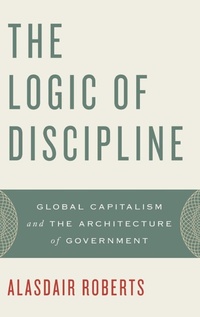
The Logic of Discipline
Global Capitalism and the Architecture of Government
1st Edition
Published on 27. May 2010
Book
Hardback
216 pages
978-0-19-537498-8 (ISBN)
Description
The era of economic liberalization, spanning 1978 to 2008, is often regarded as a period in which government was simply dismantled. In fact, government was reconstructed to meet the needs of a globalized economy. Central banking, fiscal control, tax collection, regulation, port and airport management, infrastructure development-in all of these areas, radical reforms were made to the architecture of government.
A common philosophy shaped all of these reforms: the logic of discipline. It was premised on deep skepticism about the ability of democratic processes to make sensible policy choices. It sought to impose constraints on elected officials and citizens, often by shifting power to technocrat-guardians who were shielded from political influence. It placed great faith in the power of legal changes--new laws, treaties, and contracts--to produce significant alterations in the performance of governmental systems Even before the global economic crisis of 2007-2009, the logic of discipline was under assault. Faced with many failed reform projects, advocates of discipline realized that they had underestimated the complexity of governmental change. Opponents of discipline emphasized the damage to democratic values that followed from the empowerment of new groups of technocrat-guardians.
The financial crisis did further damage to the logic of discipline, as governments modified their attitudes about central bank independence and fiscal control, and global financial and trade flows declined. It was the market that now appeared to behave myopically and erratically--and which now insisted that governments should abandon precepts about the role of government that it had once insisted were inviolable.
A sweeping account of neoliberal governmental restructuring across the world, The Logic of Discipline offers a powerful analysis of how this undemocratic model is unraveling in the face of a monumental--and ongoing--failure of the market.
A common philosophy shaped all of these reforms: the logic of discipline. It was premised on deep skepticism about the ability of democratic processes to make sensible policy choices. It sought to impose constraints on elected officials and citizens, often by shifting power to technocrat-guardians who were shielded from political influence. It placed great faith in the power of legal changes--new laws, treaties, and contracts--to produce significant alterations in the performance of governmental systems Even before the global economic crisis of 2007-2009, the logic of discipline was under assault. Faced with many failed reform projects, advocates of discipline realized that they had underestimated the complexity of governmental change. Opponents of discipline emphasized the damage to democratic values that followed from the empowerment of new groups of technocrat-guardians.
The financial crisis did further damage to the logic of discipline, as governments modified their attitudes about central bank independence and fiscal control, and global financial and trade flows declined. It was the market that now appeared to behave myopically and erratically--and which now insisted that governments should abandon precepts about the role of government that it had once insisted were inviolable.
A sweeping account of neoliberal governmental restructuring across the world, The Logic of Discipline offers a powerful analysis of how this undemocratic model is unraveling in the face of a monumental--and ongoing--failure of the market.
Reviews / Votes
This concise and provocative book has a readability that belies its dense subject matter. The evidence produced by Roberts to support his points is thorough and compelling, but rarely overdone. * Jonathan Pearson, Times Literary Supplement *More details
Language
English
Place of publication
New York
United States
Target group
College/higher education
Professional and scholarly
Students and scholars of public administration, public policy, public administration (comparative), political science, and political economy; governance specialists in development agencies and international organizations.
Dimensions
Height: 240 mm
Width: 161 mm
Thickness: 16 mm
Weight
490 gr
ISBN-13
978-0-19-537498-8 (9780195374988)
Copyright in bibliographic data and cover images is held by Nielsen Book Services Limited or by the publishers or by their respective licensors: all rights reserved.
Schweitzer Classification
Other editions
Additional editions
Book
09/2011
1st Edition
Oxford University Press Inc
€55.70
Shipment within 15-20 days
E-Book
04/2010
1st Edition
OUP eBook
€25.49
Available for download
E-Book
04/2010
1st Edition
OUP eBook
€25.49
Available for download
Person
Alasdair Roberts is the Jerome L. Rappaport Professor of Law and Public Policy at Suffolk University Law School. He is also a Fellow of the US National Academy of Public Administration and an Honorary Senior Research Fellow of the School of Public Policy, University College London. Professor Roberts received his law degree from the University of Toronto and his PhD in public policy from Harvard University. He is co-editor of the journal Governance.
Content
LIST OF FIGURES; ACKNOWLEDGEMENTS; APPENDIX: NOTES AND SOURCES FOR FIGURES; NOTES; INDEX