

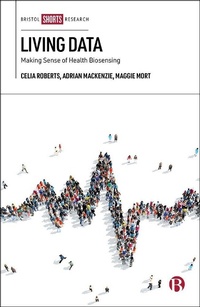
Living Data
Making Sense of Health Biosensing
1st Edition
Published on 24. July 2019
Book
Hardback
208 pages
978-1-5292-0750-7 (ISBN)
Description
As individuals increasingly seek ways of accessing, understanding and sharing data about their own bodies, this book offers a critique of the popular claim that 'more information' equates to 'better health'. In a study that redefines the public, academic and policy related debates around health, bodies, information and data, the authors consider the ways in which the phenomenon of self-diagnosis has created alternative worlds of knowledge and practises which are often at odds with professional medical advice. With a focus on data that concerns significant life changes, this book explores the potential challenges related to people's changing relationships with traditional health systems as access to, and control over, data shifts.
Reviews / Votes
"This is an original and timely text - an absolute pleasure to read and a unique contribution to the field." Emma Rich, University of Bath ''This book presents a compelling account of people's engagements with biosensors. Drawing on their long history of research in science and technology studies, the authors elucidate how people can be helped or disappointed by these new technologies.'' Deborah Lupton, University of New South WalesMore details
Edition
First Edition
Language
English
Place of publication
Bristol
United Kingdom
Target group
Professional and scholarly
Product notice
Unsewn / adhesive bound
Cloth over boards
Illustrations
3 s/w Tabellen, 11 s/w Abbildungen
3 Tables, black and white; 11 Illustrations, black and white
Dimensions
Height: 201 mm
Width: 130 mm
Thickness: 18 mm
Weight
340 gr
ISBN-13
978-1-5292-0750-7 (9781529207507)
Copyright in bibliographic data and cover images is held by Nielsen Book Services Limited or by the publishers or by their respective licensors: all rights reserved.
Schweitzer Classification
Other editions
Additional editions
E-Book
07/2019
1st Edition
Bristol University Press
€28.99
Available for download
Persons
Celia Roberts is a Professor of Gender and Science Studies in the Department of Sociology at Lancaster University.
Adrian Mackenzie is a Professor of Technological Cultures in the Department of Sociology at Lancaster University.
Maggie Mort is a Professor of Sociology in the Department of Sociology at Lancaster University. She is also the Coordinator of the EC Horizon 2020 project, CUIDAR: Cultures of Disaster Resilience among children and young people.
Adrian Mackenzie is a Professor of Technological Cultures in the Department of Sociology at Lancaster University.
Maggie Mort is a Professor of Sociology in the Department of Sociology at Lancaster University. She is also the Coordinator of the EC Horizon 2020 project, CUIDAR: Cultures of Disaster Resilience among children and young people.
Content
Introduction: What Does Biosensing Do?
Fertility Biosensing
Biosensing Stress
Platform Biosensing and Post- Genomic Relatedness
Biosensing in Old Age
Conclusion: What Might Biosensing Do?
Fertility Biosensing
Biosensing Stress
Platform Biosensing and Post- Genomic Relatedness
Biosensing in Old Age
Conclusion: What Might Biosensing Do?