

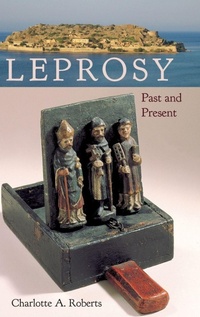
Leprosy
Past and Present
Published on 30. October 2020
Book
Hardback
450 pages
978-1-68340-184-1 (ISBN)
Description
Through an unprecedented multidisciplinary and global approach, this book documents the dramatic several-thousand-year history of leprosy using bioarchaeological, clinical, and historical information from a wide variety of contexts, dispelling many long-standing myths about the disease.
Drawing on her 30 years of research on the infection, Charlotte Roberts begins by outlining its bacterial causes, how it spreads, and how it affects the body. She then considers its diagnosis and treatment, both historically and in the present. She also looks at the methods and tools used by paleopathologists to identify signs of leprosy in skeletons. Examining evidence in human remains from many countries, particularly in Europe and including Britain, Hungary, and Sweden, Roberts demonstrates that those affected were usually buried in the same cemeteries as their communities, contrary to the popular belief that they were all ostracized or isolated from society into leprosy hospitals. Other myths addressed by Roberts include the assumptions that leprosy can't be cured, that leprosy is no longer a problem today, and that what is called "leprosy" in the Bible is the same illness as the disease with that name now. Roberts concludes by projecting the future of leprosy, arguing that researchers need to study the disease through an ethically grounded evolutionary perspective. Importantly, she advises against use of the word "leper" to avoid perpetuating stigma today surrounding people with the infection and resulting disabilities. Leprosy will stand as the authoritative source on the subject for years to come.
A volume in the series Bioarchaeological Interpretations of the Human Past: Local, Regional, and Global Perspectives, edited by Clark Spencer Larsen.
Drawing on her 30 years of research on the infection, Charlotte Roberts begins by outlining its bacterial causes, how it spreads, and how it affects the body. She then considers its diagnosis and treatment, both historically and in the present. She also looks at the methods and tools used by paleopathologists to identify signs of leprosy in skeletons. Examining evidence in human remains from many countries, particularly in Europe and including Britain, Hungary, and Sweden, Roberts demonstrates that those affected were usually buried in the same cemeteries as their communities, contrary to the popular belief that they were all ostracized or isolated from society into leprosy hospitals. Other myths addressed by Roberts include the assumptions that leprosy can't be cured, that leprosy is no longer a problem today, and that what is called "leprosy" in the Bible is the same illness as the disease with that name now. Roberts concludes by projecting the future of leprosy, arguing that researchers need to study the disease through an ethically grounded evolutionary perspective. Importantly, she advises against use of the word "leper" to avoid perpetuating stigma today surrounding people with the infection and resulting disabilities. Leprosy will stand as the authoritative source on the subject for years to come.
A volume in the series Bioarchaeological Interpretations of the Human Past: Local, Regional, and Global Perspectives, edited by Clark Spencer Larsen.
More details
Series
Language
English
Place of publication
Florida
United States
Target group
Professional and scholarly
Illustrations
84 black & white illustrations, 13 tables, 4 appendixes
Dimensions
Height: 240 mm
Width: 161 mm
Thickness: 29 mm
Weight
840 gr
ISBN-13
978-1-68340-184-1 (9781683401841)
Copyright in bibliographic data and cover images is held by Nielsen Book Services Limited or by the publishers or by their respective licensors: all rights reserved.
Schweitzer Classification
Other editions
Additional editions
E-Book
09/2020
1st Edition
University of Florida Press
€127.99
Available for download
Person
Charlotte A. Roberts is professor of archaeology at Durham University and a trained nurse. She is the author of Human Remains in Archaeology: A Handbook, and coauthor of The Bioarchaeology of Tuberculosis: A Global View on a Reemerging Disease and The Archaeology of Disease, among many other books.