

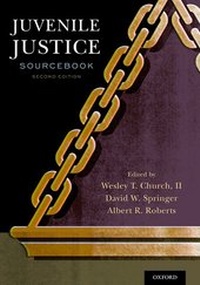
Juvenile Justice Sourcebook
Past, Present, and Future
2nd Edition
Published on 22. May 2014
Book
Hardback
704 pages
978-0-19-932461-3 (ISBN)
Description
Several million reported and unreported delinquent acts take place each year. In fact, according to the U.S. Department of Justice and the U.S. Bureau of Justice Statistics, juvenile delinquency, acting-out and oppositional behavior, illegal drugs, guns, and youth violence are pervasive throughout American society. Juvenile Justice Sourcebook is the first comprehensive volume devoted exclusively to the biopsychosocial assessment, police and juvenile court processing, and institutional and community-based treatment and rehabilitation of juvenile offenders. The overriding objective of this sourcebook is to trace the tremendous progress achieved toward resolving juvenile justice issues, dilemmas, and controversies, while providing futuristic visions for the juvenile justice field. Each chapter, authored by preeminent expert practitioners and researchers, explores topics ranging from innovative counseling and multisystemic programs, to restorative justice, to rehabilitation programs such as aggression replacement training, wilderness programs, family treatment, substance abuse treatment, restitution, and aftercare.
This volume, grounded in history and exhaustive research, presents the latest evidence-based policies, programs, and innovative treatment alternatives. Examining the entire juvenile justice system, including juvenile law, policies, practices, and research, the Juvenile Justice Sourcebook will be invaluable to all juvenile justice practitioners, policy analysts, researchers, and students.
This volume, grounded in history and exhaustive research, presents the latest evidence-based policies, programs, and innovative treatment alternatives. Examining the entire juvenile justice system, including juvenile law, policies, practices, and research, the Juvenile Justice Sourcebook will be invaluable to all juvenile justice practitioners, policy analysts, researchers, and students.
Reviews / Votes
"This volume forces readers to critically analyze the current discourse on how to respond to the offenses committed by youthful offenders and the needs of special populations within the juvenile justice system; it is an exceptionally comprehensive and well-researched look at the subject. This sourcebook offers both hope and concern about current policy and practice in the field of juvenile justice, while demonstrating how and why a multidisciplinary analysisof juvenile justice is needed, and providing a detailed look at how society has responded to youthful offenders throughout the history of the United States. This new edition upholds its undisputed
standing as a reference for all those with an interest in juvenile justice and is a continued tribute to memory of Albert Roberts and the many contributions he made to the science of juvenile justice and reform." -Jose B. Ashford, PhD, Professor & Director of Office of Forensic SW Research &Training at Arizona State University
"This book is 'must reading' for students, practitioners, policymakers, and researchers interested in the juvenile justice system. Church, Springer, and Roberts have assembled an impressive group of scholars who describe evidence pertaining to the onset, prevention, and treatment of delinquency; and identify cutting-edge issues confronting the nation's juvenile justice system. This book offers a single source of information for readers interested in
understanding the complexities associated with delinquent behavior, and for anyone interested in improving programs and policies aimed at enhancing the well-being of young people. This is a fantastic and
comprehensive volume!" -Jeffrey M. Jenson, PhD, Philip D. & Eleanor G. Winn Professor for Children and Youth Graduate School of Social Work, University of Denver
"The Juvenile Justice Sourcebook (2nd ed.), which provides an in-depth look at the concepts and practices related to the juvenile justice system, is one of the most comprehensive and progressive sources available. Discussions of evidence-based treatment models, the uses and abuses of the latest adolescent brain research, drug and mental health courts for youths, gender- and culturally- specific models, restorative justice, and other innovative
developments are highlighted by intriguing case examples. I highly recommend this book to faculty teaching in the juvenile/criminal justice and social work fields." -Katherine van Wormer, PhD, Professor of Social Work
at the University of Northern Iowa; author of Working with Female Offenders: A Gender-Sensitive Approach
More details
Edition
2nd Revised edition
Language
English
Place of publication
New York
United States
Target group
College/higher education
Professional and scholarly
Edition type
Revised edition
Illustrations
20 halftones, 19 line illus.
Dimensions
Height: 180 mm
Width: 254 mm
Thickness: 38 mm
Weight
1361 gr
ISBN-13
978-0-19-932461-3 (9780199324613)
Copyright in bibliographic data and cover images is held by Nielsen Book Services Limited or by the publishers or by their respective licensors: all rights reserved.
Schweitzer Classification
Other editions
Additional editions
E-Book
03/2014
2nd Edition
OUP eBook
€100.99
Available for download
E-Book
02/2014
2nd Edition
OUP eBook
€100.99
Available for download
Persons
Wesley T. Church II, PhD, is Associate Professor and Chair, PhD Program at The University of Alabama School of Social Work.
David W. Springer, PhD, is Dean and Professor, Dean & Professor, School of Social Work at Portland State University.
Albert R. Roberts, PhD, was Professor of Criminal Justice at Rutgers University.
David W. Springer, PhD, is Dean and Professor, Dean & Professor, School of Social Work at Portland State University.
Albert R. Roberts, PhD, was Professor of Criminal Justice at Rutgers University.
Editor
Professor of Ciminal Justice and Social WorkProfessor of Ciminal Justice and Social Work, Rutgers University
Associate Professor & Chair, PhD ProgramAssociate Professor & Chair, PhD Program, The University of Alabama School of Social Work
Dean & Professor, School of Social WorkDean & Professor, School of Social Work, Portland State University
Content
Foreword-Kevin Corcoran ; Preface-Wesley T. Church II & David W. Springer ; Section I - Overview, Trends, and Critical Issues in Juvenile Justice ; 1. Overview of Juvenile Justice and Juvenile Delinquency ; Albert R. Roberts and Katherine L. Montgomery) ; 2. Juvenile Justice Policy: Current Trends and 21st-Century Issues ; C. Aaron McNeece and Tiffany Ryan) ; 3. The Second American Crime Drop: Trends in Juvenile and Youth Violence ; Jeffrey A. Butt and Douglas N. Evans) ; 4. Theories of Juvenile Crime and Delinquency ; Cesar J. Rebellon ; 5. Risk and Protective Factors for Involvement in Juvenile Justice: Implications for Prevention ; Traci L. Wike and Caren L. Putzu ; 6. Brain Science and Juvenile Justice: Questions for Policy and Practice ; Alexandra Cox ; Section II - Juvenile Justice Processing ; 7. Police Work with Juveniles ; Jeremiah Jaggers, Sarah Young, & Wesley T. Church II ; 8. Juveniles' Competence and Procedural Rights in Juvenile Court ; Barry C. Feld ; 9. Juvenile Detention ; David E. Roush, Michelle Brazeal, and Wesley T. Church II ; 10. Juvenile Drug Courts, Juvenile Mental Health Courts, and Teen Courts ; Matthew L. Hiller and Christine A. Saum) ; 11. Waivers and Transfers of Juveniles to the Adult Court: Treating Juveniles Like Adult Criminals ; Michelle Dietch and Neelum Arya ; Section III - School- and Community-Based Programs ; 12. Marginalized Students, School Exclusion, and the School to Prison Pipeline ; Michael P. Krezmein, Peter E. Leone, and Michael G. Wilson ; 13. School-Based Delinquency Prevention ; Katherine L. Montgomery ; 14. Community Based Treatment Interventions ; Robert Butters ; 15. Neighborhood Street Gangs: Patterns, Activities, and Community-Based Programs ; Paul D. Steele ; 16. Re-entry and Aftercare ; Laura S. Abrams ; Section IV - Evidence-Based Assessment and Treatment with Juvenile Delinquents ; 17. Risk Assessment with Juvenile Offenders ; Henrika McCoy, Joshua P. Mersky, John Leverso, and Elizabeth A. Bowen ; 18. Mental Health and Youth in the Juvenile Justice System: Current Status and Evidence Informed Future Directions ; Cynthia Weaver, Edward Byrnes, and Wesley T. Church II ; 19. Family-based interventions for juvenile offenders ; Stephanie C. Kennedy and Stephen J. Tripodi ; Section V-Special Issues and Populations ; 20. Homelessness and Juvenile Justice ; Sarah Young, Jeremiah Jaggers, and David Pollio ; 21. Disproportionate Minority Contact (DMC) in the U.S. Juvenile Justice System ; Susan A. McCarter ; 22. The Wayward Girl in the 21st Century: Female Pathways to Delinquency ; Lisa Pasko, Scott K. Okamoto, and Meda Chesney-Lind ; 23. Juvenile Sex Offenders: History, Policies, and Assessment ; Megan Schlegel ; 24. Serious, Chronic, and Violent Offenders ; Bryanna Hahn Fox, Wesley G. Jennings, and Alex R. Piquero) ; 25. Gender, Racially, and Culturally Grounded Practice ; Keva M. Miller and Ben Anderson-Nathe, and Jana L. Meinhold ; Section V - Juvenile Justice Reform ; 26. The Road Ahead: Progressive Possibilities and Challenges for Juvenile Justice Reform ; Laura Burney Nissen