

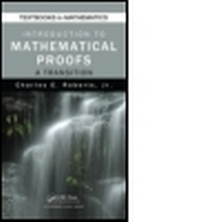
Introduction to Mathematical Proofs
A Transition
1st Edition
Published on 3. July 2009
Book
Hardback
433 pages
978-1-4200-6955-6 (ISBN)
Description
Shows How to Read & Write Mathematical Proofs
Ideal Foundation for More Advanced Mathematics Courses
Introduction to Mathematical Proofs: A Transition facilitates a smooth transition from courses designed to develop computational skills and problem solving abilities to courses that emphasize theorem proving. It helps students develop the skills necessary to write clear, correct, and concise proofs.
Unlike similar textbooks, this one begins with logic since it is the underlying language of mathematics and the basis of reasoned arguments. The text then discusses deductive mathematical systems and the systems of natural numbers, integers, rational numbers, and real numbers. It also covers elementary topics in set theory, explores various properties of relations and functions, and proves several theorems using induction. The final chapters introduce the concept of cardinalities of sets and the concepts and proofs of real analysis and group theory. In the appendix, the author includes some basic guidelines to follow when writing proofs.
Written in a conversational style, yet maintaining the proper level of mathematical rigor, this accessible book teaches students to reason logically, read proofs critically, and write valid mathematical proofs. It will prepare them to succeed in more advanced mathematics courses, such as abstract algebra and geometry.
Ideal Foundation for More Advanced Mathematics Courses
Introduction to Mathematical Proofs: A Transition facilitates a smooth transition from courses designed to develop computational skills and problem solving abilities to courses that emphasize theorem proving. It helps students develop the skills necessary to write clear, correct, and concise proofs.
Unlike similar textbooks, this one begins with logic since it is the underlying language of mathematics and the basis of reasoned arguments. The text then discusses deductive mathematical systems and the systems of natural numbers, integers, rational numbers, and real numbers. It also covers elementary topics in set theory, explores various properties of relations and functions, and proves several theorems using induction. The final chapters introduce the concept of cardinalities of sets and the concepts and proofs of real analysis and group theory. In the appendix, the author includes some basic guidelines to follow when writing proofs.
Written in a conversational style, yet maintaining the proper level of mathematical rigor, this accessible book teaches students to reason logically, read proofs critically, and write valid mathematical proofs. It will prepare them to succeed in more advanced mathematics courses, such as abstract algebra and geometry.
More details
Series
Language
English
Place of publication
United Kingdom
Publishing group
Taylor & Francis Ltd
Target group
College/higher education
Product notice
Paper over boards
Illustrations
40 s/w Abbildungen, 14 s/w Tabellen
14 Tables, black and white; 40 Illustrations, black and white
Dimensions
Height: 234 mm
Width: 156 mm
Weight
748 gr
ISBN-13
978-1-4200-6955-6 (9781420069556)
Copyright in bibliographic data and cover images is held by Nielsen Book Services Limited or by the publishers or by their respective licensors: all rights reserved.
Schweitzer Classification
Other editions
New editions
Charles E. Roberts Jr.
Introduction to Mathematical Proofs
A Transition to Advanced Mathematics, Second Edition
Book
12/2014
2nd Edition
Chapman & Hall/CRC
€146.80
Article not available for order
Person
Charles E. Roberts, Jr. is a professor of mathematics and computer science at Indiana State University.
Content
Logic
Statements, Negation, and Compound Statements
Truth Tables and Logical Equivalences
Conditional and Biconditional Statements
Logical Arguments
Open Statements and Quantifiers
Deductive Mathematical Systems and Proofs
Deductive Mathematical Systems
Mathematical Proofs
Set Theory
Sets and Subsets
Set Operations
Additional Set Operations
Generalized Set Union and Intersection
Relations
Relations
The Order Relations <, =, >, =
Reflexive, Symmetric, Transitive, and Equivalence Relations
Equivalence Relations, Equivalence Classes, and Partitions
Functions
Functions
Onto Functions, One-to-One Functions, and One-to-One Correspondences
Inverse of a Function
Images and Inverse Images of Sets
Mathematical Induction
Mathematical Induction
The Well-Ordering Principle and the Fundamental Theorem of Arithmetic
Cardinalities of Sets
Finite Sets
Denumerable and Countable Sets
Uncountable Sets
Proofs from Real Analysis
Sequences
Limit Theorems for Sequences
Monotone Sequences and Subsequences
Cauchy Sequences
Proofs from Group Theory
Binary Operations and Algebraic Structures
Groups
Subgroups and Cyclic Groups
Appendix: Reading and Writing Mathematical Proofs
Answers to Selected Exercises
References
Index
Statements, Negation, and Compound Statements
Truth Tables and Logical Equivalences
Conditional and Biconditional Statements
Logical Arguments
Open Statements and Quantifiers
Deductive Mathematical Systems and Proofs
Deductive Mathematical Systems
Mathematical Proofs
Set Theory
Sets and Subsets
Set Operations
Additional Set Operations
Generalized Set Union and Intersection
Relations
Relations
The Order Relations <, =, >, =
Reflexive, Symmetric, Transitive, and Equivalence Relations
Equivalence Relations, Equivalence Classes, and Partitions
Functions
Functions
Onto Functions, One-to-One Functions, and One-to-One Correspondences
Inverse of a Function
Images and Inverse Images of Sets
Mathematical Induction
Mathematical Induction
The Well-Ordering Principle and the Fundamental Theorem of Arithmetic
Cardinalities of Sets
Finite Sets
Denumerable and Countable Sets
Uncountable Sets
Proofs from Real Analysis
Sequences
Limit Theorems for Sequences
Monotone Sequences and Subsequences
Cauchy Sequences
Proofs from Group Theory
Binary Operations and Algebraic Structures
Groups
Subgroups and Cyclic Groups
Appendix: Reading and Writing Mathematical Proofs
Answers to Selected Exercises
References
Index