

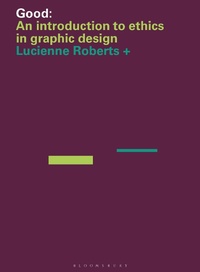
Good: An Introduction to Ethics in Graphic Design
Published on 23. January 2020
Book
Paperback/Softback
200 pages
978-1-350-16172-6 (ISBN)
Description
Consider this simple conundrum: is it possible to be a bad good designer or a good bad designer for that matter? If the answer is yes then which is preferable and what does this reveal about the relationship between ethics and design practice? Good: An Introduction to Ethics in Graphic Design seeks to answer these questions.
Graphic design is in ethical flux. Good comes at a time of growing disenchantment with style-led design solutions and the pursuit of self-expression alone and yet vacuous design judgements are still made without any real analysis of the criteria used. The terms good and bad are repeatedly applied without qualification whilst the relationship between personal and professional ethics is far too contentious to do any more than give cursory consideration. Despite recent manifestos and themed publications on design for good graphic designers have yet to examine what such terms really mean: in a time of relativism it has been far too divisive to do so.
Good takes philosophy as its starting point but is not a philosophy book. It seeks to marry abstract ideas with practical application, removing some of the mystique that surrounds philosophy and highlighting its relevance for us all. Designers are people. This book seeks to engage designers in a debate about their profession and in an analysis of their value and worth. The decisions we make define us, in our ethical choices we reveal who we are.
Graphic design is in ethical flux. Good comes at a time of growing disenchantment with style-led design solutions and the pursuit of self-expression alone and yet vacuous design judgements are still made without any real analysis of the criteria used. The terms good and bad are repeatedly applied without qualification whilst the relationship between personal and professional ethics is far too contentious to do any more than give cursory consideration. Despite recent manifestos and themed publications on design for good graphic designers have yet to examine what such terms really mean: in a time of relativism it has been far too divisive to do so.
Good takes philosophy as its starting point but is not a philosophy book. It seeks to marry abstract ideas with practical application, removing some of the mystique that surrounds philosophy and highlighting its relevance for us all. Designers are people. This book seeks to engage designers in a debate about their profession and in an analysis of their value and worth. The decisions we make define us, in our ethical choices we reveal who we are.
Reviews / Votes
The book and the social issue mapping system it proposes are definitely something design teachers should consider introducing to their students as a way to start a conversation on the larger ethical concerns of the field. * Another Limited Rebellion Blog * Beautifully designed book, with such clarity and structure that it is assessable and challenging. I thought it was a fascinating and broad collection of people, ideas, comment, research and once I read it I couldn't believe that it has taken this long for such a book to come about. Its timing/content is crucial with Graphic Design Education. And its great to see it in the context of social, political and cultural discussion. * Falmouth University College, UK * Great design and great size. * Stephanie Whitehouse, Manitoba University, Canada * I found the book really interesting and enjoyed the theory aspects supported by the case studies, which I could use as good teaching examples. The content was particularly useful for certain students who were interested in the subject matter for their final dissertation. * Philip Long, Southampton Solent University, UK * I like the mix of theory and practice, the cross referencing system and the design of the book... The interviews with designers will hopefully provoke self questioning and debate. I love this book and think it will be very important book for students. * Bournemouth Arts University College, UK * Accessible and well-designed, with text broken up into manageable chunks. An excellent text for lecturers and undergraduates. * Dave Caton, Swindon College, UK * Whether you wrap on a toga or take our a pipe, you'll discover that Good, like most items philosophical, promotes the journey - not the destination - as its aim. Let the debate begin. * Step Inside Design Magazine, March/April 2007 *More details
Series
Language
English
Place of publication
London
United Kingdom
Publishing group
Bloomsbury Publishing PLC
Target group
College/higher education
Professional and scholarly
Product notice
Paperback (trade)
Unsewn / adhesive bound
Illustrations
200 colour illus
Dimensions
Height: 297 mm
Width: 218 mm
Thickness: 13 mm
Weight
726 gr
ISBN-13
978-1-350-16172-6 (9781350161726)
Copyright in bibliographic data and cover images is held by Nielsen Book Services Limited or by the publishers or by their respective licensors: all rights reserved.
Schweitzer Classification
Other editions
Additional editions
Lucienne Roberts
Good: An Introduction to Ethics in Graphic Design
E-Book
01/2019
1st Edition
Bloomsbury Visual Arts
€30.99
Available for download
Person
Lucienne Roberts is a graphic designer who allies a commitment to accessible, engaging graphic design with a socially aware agenda. Her studio, LucienneRoberts+, specialises in design for the voluntary, charity and arts sectors. She was a signatory of the First Things First 2000 manifesto, which called for greater design responsibility, and writes, lectures and publishes on her subject. She is external examiner of BA Typography and Graphic Communication at Reading University, spoke at TYPO London 2012 and has been invited to speak at the POINT conference in 2013.
Content
Using this book
Declaring an interest
Some useful definitions
The parameters of this book
Introduction
Section 1: Making good
Issues raised
Section 2: Approaching good
Philosophy: Anthony Grayling
The law: Jacqueline Roach
Theology: Richard Holloway
Politics: Delyth Morgan
Issues raised
Glossary of ethical thought:
Naomi Goulder
Frederik Willemarck
Human Rights Act, 1998
The Convention Rights
Section 3: Debating good
Should I be nice to everyone?
Who should I work for?
Is it okay to be happy?
Who has the right to judge?
What is it worth?
Issues raised
Section 4: Being good
Furniture and product design/ exhibition design/installations
Michael Marriott
Are you a good designer?
Paula Scher, Oded Ezer, Divya Chadha
Architecture
Billie Tsien
Are you a good designer?
Will Holder
Editorial design
Simon Esterson
Are you a good designer?
Thomas Matthews, James Victore
Photojournalism
Chris de Bode
Are you a good designer?
Deborah Szebeko
Graphic design/public art
Sheila Levrant de Bretteville
Are you a good designer?
Ali Rashidi, Luba Lukova, Susanne Dechant
Issues raised
Examples
Section 5: Doing good
Sustainability Issue Mapping
Case studies
Ken Garland
Violetta Boxill
Pat Kahn
Dan Eatock
Issues raised
Reference
Declaring an interest
Some useful definitions
The parameters of this book
Introduction
Section 1: Making good
Issues raised
Section 2: Approaching good
Philosophy: Anthony Grayling
The law: Jacqueline Roach
Theology: Richard Holloway
Politics: Delyth Morgan
Issues raised
Glossary of ethical thought:
Naomi Goulder
Frederik Willemarck
Human Rights Act, 1998
The Convention Rights
Section 3: Debating good
Should I be nice to everyone?
Who should I work for?
Is it okay to be happy?
Who has the right to judge?
What is it worth?
Issues raised
Section 4: Being good
Furniture and product design/ exhibition design/installations
Michael Marriott
Are you a good designer?
Paula Scher, Oded Ezer, Divya Chadha
Architecture
Billie Tsien
Are you a good designer?
Will Holder
Editorial design
Simon Esterson
Are you a good designer?
Thomas Matthews, James Victore
Photojournalism
Chris de Bode
Are you a good designer?
Deborah Szebeko
Graphic design/public art
Sheila Levrant de Bretteville
Are you a good designer?
Ali Rashidi, Luba Lukova, Susanne Dechant
Issues raised
Examples
Section 5: Doing good
Sustainability Issue Mapping
Case studies
Ken Garland
Violetta Boxill
Pat Kahn
Dan Eatock
Issues raised
Reference