

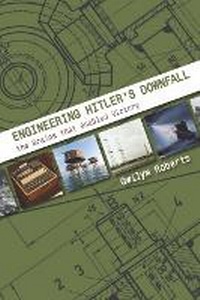
Engineering Hitler's Downfall
the Brains that Enabled Victory
Published on 10. October 2018
Book
Paperback/Softback
240 pages
978-1-84995-386-3 (ISBN)
Description
Whilst living in Liverpool, Britain's second most heavily bombed city during World War II, the author experienced at first-hand the terrible effects of the war on the civilian population and when studying at Cambridge he witnessed the American heavy bombers and their fighter escorts flying to attack targets in Germany and occupied Europe.
Serving as an engineering officer in the Royal Navy in HMS Sheffield provided first-hand realisation of the importance of engineering and emphasised that victories achieved in the Battle of Britain and other campaigns were made possible by newly-developed machines, equipment or techniques. These innovations gave the Allied forces a significant advantage and helped ensure eventual victory.
Engineering Hitler's Downfall features numerous inventions such as the decoding machines developed at Bletchley Park; the hand-held mine detectors that cleared pathways through enemy minefields, firstly at the Battle of el Alamein but also in most subsequent actions; the newly-located factories and tanks that enabled the Russians to repulse the German invasion; the escort carriers and long range aircraft that enabled U-boats to be attacked in the mid-Atlantic; the 4000 plus Bailey bridges that allowed narrow ravines and rivers as wide as the Rhine to be crossed; the Mulberry harbours through which the D-Day bridgehead was reinforced and supplied and the pipelines under the ocean that supplied fuel for invading troops. These and many other examples illustrate what was achieved under such immense pressure.
The book includes timelines to set it all in context with respect to the course of the war.
Serving as an engineering officer in the Royal Navy in HMS Sheffield provided first-hand realisation of the importance of engineering and emphasised that victories achieved in the Battle of Britain and other campaigns were made possible by newly-developed machines, equipment or techniques. These innovations gave the Allied forces a significant advantage and helped ensure eventual victory.
Engineering Hitler's Downfall features numerous inventions such as the decoding machines developed at Bletchley Park; the hand-held mine detectors that cleared pathways through enemy minefields, firstly at the Battle of el Alamein but also in most subsequent actions; the newly-located factories and tanks that enabled the Russians to repulse the German invasion; the escort carriers and long range aircraft that enabled U-boats to be attacked in the mid-Atlantic; the 4000 plus Bailey bridges that allowed narrow ravines and rivers as wide as the Rhine to be crossed; the Mulberry harbours through which the D-Day bridgehead was reinforced and supplied and the pipelines under the ocean that supplied fuel for invading troops. These and many other examples illustrate what was achieved under such immense pressure.
The book includes timelines to set it all in context with respect to the course of the war.
Reviews / Votes
`...Gwilym Robert's takes an insightful look at hese milestones and the individuals behind them that played such a pivotal role in successof the war effort. ...takes a walk through the technical development of the Second World Warthat will both enthrall and fascinate the reader into mysteries of the engineering mind'. Civil Engineering Surveyor -------------------- `...is lavishly illustrated with photographs, maps and diagram. Each chapter covers a single campaign, such as `Radar, Battle in the Air' and `Atlantic Agonies' so that by the end we have, in effect, a potted history of the war from the British perspective'. Warship World -------------------- `It's a fascinating read that includes time-lines of key events... A lasting tribute to the remarkable ingenuity and invention of these amazing scientists'. Sea Breezes -------------------- `I have, to be honest, become a little fed up with WW2 books and Hitler in general. That was until this wee gem of a book arrived. I rate this book very highly for bringing to us the science of war engineering in such a clear and enjoyable way, every time you pick it up you will learn something new... Definitely a keeper and will go into my library under "read here for fantastic facts"... ...a great read'. Army Rumour ServiceMore details
Language
English
Place of publication
United Kingdom
Publishing group
Porto Press Ltd
Illustrations
100 b&w illustrations and 8pp colour section
Dimensions
Height: 235 mm
Width: 155 mm
Thickness: 15 mm
Weight
522 gr
ISBN-13
978-1-84995-386-3 (9781849953863)
Copyright in bibliographic data and cover images is held by Nielsen Book Services Limited or by the publishers or by their respective licensors: all rights reserved.
Schweitzer Classification
Person
The author is a former President of the Institution of Civil Engineers, the Smeatonian Society of Civil Engineers and is an Honorary Fellow of Sidney Sussex College, Cambridge, UK. He has had numerous articles and books published and in 2004 was named as one of Britain's four leading international engineers of the 20th century in The Sunday Times magazine.
Content
God, Churchill, and the Engineers; A Battle of Wits; Land Battles Lead to Dunkirk Evacuation; Radar, Battles in the Air, and the Blitz; Women at War; Atlantic Agonies; The Worst Journey in the World; The End of the Beginning; The Beginning of the End; Southeast Asia and the Bellicose Pacific; The 3 Rs of the Post-war World