

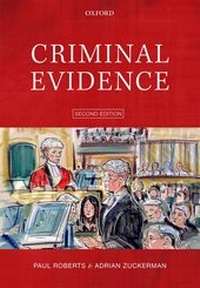
Criminal Evidence
2nd Edition
Published on 26. August 2010
Book
Paperback/Softback
776 pages
978-0-19-923164-5 (ISBN)
Description
Criminal Evidence presents a critical commentary on the rules and principles regulating the admissibility of evidence and the processes of fact-finding in English criminal trials. The existing legal rules and their underlying values are fully contextualised and evaluated, and opportunities for reform are systematically examined.
Practical issues of inference and fact-finding are covered in detail, as are the moral and political foundations of evidentiary rules. Theoretical and doctrinal innovation in the presumption of innocence, privilege against self-incrimination, improperly obtained evidence, witness examination, hearsay, character, and the law of corroboration are considered, taking full account of the statutory reforms of the Criminal Justice Act 2003 and subsequent case law.
As a contribution to procedural scholarship, Criminal Evidence presents a distinctive vision and stakes out new territory in the law of evidence and proof. Highly engaging, stimulating and provocative, Criminal Evidence provides the ideal text for any student who wishes to gain a detailed understanding of the principles that underlie the law of criminal procedure and evidence. It also provides a valuable source of analysis and commentary for legal practitioners and scholars specializing in
criminal litigation, and contributes towards a critical evaluation of recent statutory reforms and their judicial interpretation.
Practical issues of inference and fact-finding are covered in detail, as are the moral and political foundations of evidentiary rules. Theoretical and doctrinal innovation in the presumption of innocence, privilege against self-incrimination, improperly obtained evidence, witness examination, hearsay, character, and the law of corroboration are considered, taking full account of the statutory reforms of the Criminal Justice Act 2003 and subsequent case law.
As a contribution to procedural scholarship, Criminal Evidence presents a distinctive vision and stakes out new territory in the law of evidence and proof. Highly engaging, stimulating and provocative, Criminal Evidence provides the ideal text for any student who wishes to gain a detailed understanding of the principles that underlie the law of criminal procedure and evidence. It also provides a valuable source of analysis and commentary for legal practitioners and scholars specializing in
criminal litigation, and contributes towards a critical evaluation of recent statutory reforms and their judicial interpretation.
Reviews / Votes
If you want to pursue the law of criminal evidence as an intellectual inquiry, you will be hard pressed to find a better textbook than this...An admirably wide range of materials is covered and thought-provoking comments can be found at every turn. * Hock Law Ho, Criminal Law and Philosophy *More details
Edition
2nd Revised edition
Language
English
Place of publication
Oxford
United Kingdom
Target group
College/higher education
Undergraduate students studying LLB modules on the law of evidence. Also postgraduates studying towards the Bar Vocational Course.
Edition type
Revised edition
Dimensions
Height: 246 mm
Width: 171 mm
Thickness: 38 mm
Weight
1382 gr
ISBN-13
978-0-19-923164-5 (9780199231645)
Copyright in bibliographic data and cover images is held by Nielsen Book Services Limited or by the publishers or by their respective licensors: all rights reserved.
Schweitzer Classification
Other editions
Previous edition
A. A. S. Zuckerman
Criminal Evidence
Book
05/2004
2nd Edition
Oxford University Press
€40.84
Article exhausted; check for reprint
Persons
Paul Roberts is Professor of Criminal Jurisprudence at the University of Nottingham School of Law.
Adrian Zuckerman is Professor of Civil Procedure at the University of Oxford, and a Fellow of University College, Oxford.
Adrian Zuckerman is Professor of Civil Procedure at the University of Oxford, and a Fellow of University College, Oxford.
Content
1. Understanding criminal evidence ; 2. The procedural framework of adversarial jury trial ; 3. Sources of information and proof requirements ; 4. Relevance, admissibility and fact-finding ; 5. Fair trial ; 6. Burdens and presumptions ; 7. The principle of orality ; 8. Examination-in-chief and cross-examination ; 9. Hearsay ; 10. Vulnerable and intimidated witnesses ; 11. Expert evidence ; 12. Confessions ; 13. The privilege against self-incrimination ; 14. The accused's character and extraneous misconduct ; 15. Corroboration and forensic reasoning rules ; 16. Criminal evidence - retrospective and prospects