

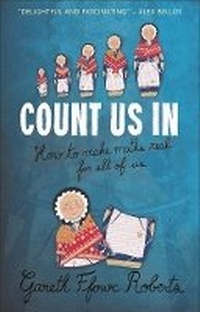
Count Us In
How to Make Maths Real for All of Us
Published on 15. February 2016
Book
Paperback/Softback
144 pages
978-1-78316-796-8 (ISBN)
Description
Mathematics, like language, is a universal experience. Every society counts and is empowered by its ability to count and to measure. The mathematical processes developed within various cultures differ widely, and Count Us In explores these cultural links, drawing examples from the author's personal experiences. The process of counting, like the process of communicating with words, is common to all societies worldwide but, just as there is a rich variety of languages, so too is there a rich variety in methods of counting and of recording numbers - methods that have developed over centuries to meet the needs of various groups of people. The narrative of this book takes the form of a collection of short stories based on the author's personal experience, linked together by a number of sub-themes.
As a popular book on mathematics and on the personalities who created that mathematics, there are no prerequisites beyond the reader's rudimentary and possibly hazy recollection of primary-school mathematics and a curiosity to know more.
As a popular book on mathematics and on the personalities who created that mathematics, there are no prerequisites beyond the reader's rudimentary and possibly hazy recollection of primary-school mathematics and a curiosity to know more.
Reviews / Votes
'A delightful and fascinating read about the role of maths in Wales, and the role of Wales in maths. Anyone with an interest in Welsh culture, maths history or education will love this book.' - Guardian blogger Alex Bellos, author of Alex's Adventures in Numberland and Alex Through the Looking-Glass; 'Count us in presents a highly accessible sequence of insights into the ways in which individuals engage with number, along with some fascinating perspectives on the connections between mathematics and culture.' - Gareth Pierce, Chief Executive, Welsh Joint Education Committee; 'This engaging book informs with a light touch, and shows not only how to set subjects like mathematics in their cultural context but also why it is important to do so. It is a fascinating read for anyone who has ever struggled with sums, because it actually makes maths fun!' - Dr Elin Jones, historian and broadcasterMore details
Language
English
Place of publication
Wales
United Kingdom
Target group
Professional and scholarly
Illustrations
8 Illustrations, color; 12 Illustrations, black and white
Dimensions
Height: 216 mm
Width: 138 mm
ISBN-13
978-1-78316-796-8 (9781783167968)
DOI
10.1234/b10224
Copyright in bibliographic data and cover images is held by Nielsen Book Services Limited or by the publishers or by their respective licensors: all rights reserved.
Schweitzer Classification
Other editions
Additional editions
E-Book
02/2016
1st Edition
University of Wales Press
€11.49
Available for download
E-Book
02/2016
1st Edition
University of Wales Press
€43.99
Available for download
Person
This is a popular book about culture, identity and mathematics. It will appeal to a wide readership, including, and in particular, those who are hesitant about the place of mathematics within a traditional perspective of what constitutes culture.
Content
Figures and plates
Acknowledgements
Foreword
1 More cabbage, anyone?
2 Meeting of minds
3 Nothing will come of nothing
4 Setting the Recorde straight
5 Neither a borrower nor a lender be
6 Amazing Mayans
7 What do you reckon?
8 Prairie power
9 Putting down digital roots
10 Areas of (mis)understanding
11 Cracking the code
12 Does mathematics have a gender?
13 How to make maths real for all of us
Appendix
Answers to Puzzles
Notes on Chapters
Further Reading
Acknowledgements
Foreword
1 More cabbage, anyone?
2 Meeting of minds
3 Nothing will come of nothing
4 Setting the Recorde straight
5 Neither a borrower nor a lender be
6 Amazing Mayans
7 What do you reckon?
8 Prairie power
9 Putting down digital roots
10 Areas of (mis)understanding
11 Cracking the code
12 Does mathematics have a gender?
13 How to make maths real for all of us
Appendix
Answers to Puzzles
Notes on Chapters
Further Reading