

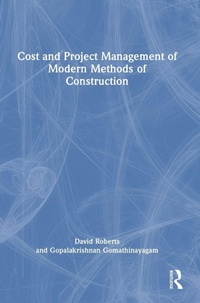
Cost and Project Management of Modern Methods of Construction
1st Edition
Will be published approx. on 26. June 2026
Book
Hardback
188 pages
978-1-032-94381-7 (ISBN)
Description
This textbook is aimed at providing students with an insight into the complexities of project management and cost management when working with Modern Methods of Construction (MMC) such as off-site and volumetric construction.
The book begins with an introduction to the MMC sector and educates readers on what is meant by modern methods of construction. Chapters then cover procurement, supply chain management, quality management, and time management. The book then delves into the detail of cost management by introducing the basics of construction economics, cost variable analysis and the overall impact of introducing MMC into cost management.
Through a series of easy-to-follow discussions, case studies from real-life industry experience, the authors clearly communicate the complexities of finance, contract, and project management when using modern methods of construction.
Cost and Project Management of Modern Methods of Construction is an essential new textbook for undergraduate and further education students on construction, architecture, built environment, and quantity surveying courses, but is also a handy guide for practicing quality surveyors and project managers dealing with an increasingly MMC focused industry.
The book begins with an introduction to the MMC sector and educates readers on what is meant by modern methods of construction. Chapters then cover procurement, supply chain management, quality management, and time management. The book then delves into the detail of cost management by introducing the basics of construction economics, cost variable analysis and the overall impact of introducing MMC into cost management.
Through a series of easy-to-follow discussions, case studies from real-life industry experience, the authors clearly communicate the complexities of finance, contract, and project management when using modern methods of construction.
Cost and Project Management of Modern Methods of Construction is an essential new textbook for undergraduate and further education students on construction, architecture, built environment, and quantity surveying courses, but is also a handy guide for practicing quality surveyors and project managers dealing with an increasingly MMC focused industry.
More details
Language
English
Place of publication
London
United Kingdom
Publishing group
Taylor & Francis Ltd
Target group
College/higher education
Further/Vocational Education and Undergraduate Core
Illustrations
7 s/w Tabellen, 6 s/w Abbildungen, 6 s/w Zeichnungen
7 Tables, black and white; 6 Line drawings, black and white; 6 Illustrations, black and white
Dimensions
Height: 246 mm
Width: 174 mm
ISBN-13
978-1-032-94381-7 (9781032943817)
Copyright in bibliographic data and cover images is held by Nielsen Book Services Limited or by the publishers or by their respective licensors: all rights reserved.
Schweitzer Classification
Other editions
Additional editions
David Roberts | Gopalakrishnan Gomathinayagam
Cost and Project Management of Modern Methods of Construction
Book
approx. 06/2026
1st Edition
Routledge
€56.00
Not yet published
David Roberts | Gopalakrishnan Gomathinayagam
Cost and Project Management of Modern Methods of Construction
E-Book
approx. 06/2026
Routledge
€59.49
Available for download
David Roberts | Gopalakrishnan Gomathinayagam
Cost and Project Management of Modern Methods of Construction
E-Book
approx. 06/2026
Routledge
€59.49
Available for download
Persons
David Roberts has several years' experience working in the modern construction methods sector and in higher education. He worked in industry for over 15 years, eventually owning and running two business that were related to modern methods of construction, a timber frame manufacturing and installation company and a modular company start up. Since working in the higher education sector, he has worked delivering quantity surveying, cost management and project management degrees and higher degrees. Recent areas of research have focused on modern methods of construction, particularly modular production and its financial impact and costs surrounding the industry.
Gopalakrishnan Gomathinayagam is BIM Manager at L&Q and was course director for the BSc Construction Management, lecturer in Construction at Coventry University, and online tutor for the MSc Project Management for Construction at the University of Portsmouth. He completed his Bachelor's in Civil Engineering, before gaining several years of international site engineering and project management experience. As a passionate learner, he then entered the world of academia to share his knowledge and experience. He specialised throughout his post graduate learning in Building Information Modelling and digital construction. He is a Fellow of the Higher Education Academy and his research and teaching focusses on the application of artificial intelligence and BIM to enhance construction performance at various stages of the construction process.
Gopalakrishnan Gomathinayagam is BIM Manager at L&Q and was course director for the BSc Construction Management, lecturer in Construction at Coventry University, and online tutor for the MSc Project Management for Construction at the University of Portsmouth. He completed his Bachelor's in Civil Engineering, before gaining several years of international site engineering and project management experience. As a passionate learner, he then entered the world of academia to share his knowledge and experience. He specialised throughout his post graduate learning in Building Information Modelling and digital construction. He is a Fellow of the Higher Education Academy and his research and teaching focusses on the application of artificial intelligence and BIM to enhance construction performance at various stages of the construction process.
Content
1. Introduction. 2. Modern Methods of Construction. 3. Procurement. 4. Supply Chain Management. 5. Product Quality Management. 6. Product Time Management. 7. Cost Management. 8. Concluding Thoughts